


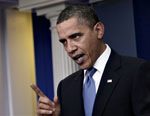
 AFP: US President Barack Obama Monday ordered new sanctions on Syria and Iran and the “digital guns for hire” who help them oppress their people with surveillance software and monitoring technology.
By Stephen Collinson
WASHINGTON (AFP) — US President Barack Obama Monday ordered new sanctions on Syria and Iran and the “digital guns for hire” who help them oppress their people with surveillance software and monitoring technology.
Obama announced additions to the pile of US sanctions already faced by the two governments as part of a wider effort to crack down on human rights abuses, atrocities and genocide, at a speech at the US Holocaust Museum.
The measures will hit the two governments but also companies that help create systems that track or monitor their people for killing, torture or other abuses and prevent individuals involved from entering the United States.
“I’ve signed an executive order that authorizes new sanctions against the Syrian government and Iran and those that abet them for using technologies to monitor and track and target citizens for violence,” Obama said.
“These technologies should be in place to empower citizens, not to repress them.
“It’s one more step that we can take toward the day that we know will come, the end of the Assad regime that has brutalized the Syrian people, and allow the Syrian people to chart their own destiny.”
The move blocks property and interests of people under US jurisdiction who have participated in aiding the Syrian and Iranian governments and suspends their right of entry into the United States.
It targets those who have sold, leased or otherwise provided goods, services or technology to Iran or Syria likely to be used to help disrupt, monitor or track individuals through computer or Internet networks.
Since the onset of the Arab Spring, a number of Western firms have been accused of supplying technology and software to repressive regimes, which has been used to track demonstrators and dissidents.
Technology has been used by security forces to disrupt demonstrators who use mobile phones, text messages and social media like Twitter and Facebook to assemble and organize protests.
Last year, US Secretary of State Hillary Clinton urged Internet firms to avoid offering the “tools of oppression” to authoritarian Middle Eastern regimes.
“When companies sell surveillance equipment to the security agency of a Syria, or Iran, or in past times (former Libyan leader Moamer) Kadhafi there can be no doubt that it will be used to violate rights,” she said.
In Asia, China’s Internet controls have already become a key irritant in relations with the United States, especially after a dispute over Chinese censorship led US search engine giant Google to cut back in China.
In Congress, a group of lawmakers has been pushing a bill aimed at choking off US exports of technology used for Internet surveillance or censorship.
It would require Internet firms listed on US stock exchanges to disclose to American regulators their practices in collecting and sharing personally identifiable information and steps taken to notify users when removing content.
Leading exporters of such technologies include Britain, France, Germany, Israel, Italy and the United States.
Obama also announced Monday that the government Atrocities Prevention Board (APB) that he set up in 2011 would do more to identify threats of looming atrocities and try to make the US government more nimble in combating them.
The US Intelligence Community will meanwhile strive to collect and analyze information allowing officials to predict where atrocities might occur.
The US military, aid and diplomatic communities will also pursue new strategies and techniques designed to prevent, detect and deal with atrocities and genocide, the White House said.
The creation of the APB was welcomed by human rights groups.
Human Rights First said the move would hike pressure on perpetrators of mass atrocities, and individuals, companies, and countries that provide technical help for regimes who attack civilians.
“The promises of ‘never again’ have rung hollow again and again,” said Human Rights First’s President and CEO Elisa Massimino.
“Today’s announcement is a critical step in turning those promises into preventive action.”


