


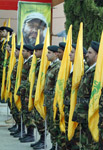
 AP: International sanctions are forcing Iran to cut back aid to its anti-Israel Hezbollah allies in Lebanon, but the Lebanese guerrilla group remains a potent force, a top Israeli military official said Monday.
The Associated Press
By AMY TEIBEL
 TEL AVIV, Israel (AP) — International sanctions are forcing Iran to cut back aid to its anti-Israel Hezbollah allies in Lebanon, but the Lebanese guerrilla group remains a potent force, a top Israeli military official said Monday.
He said Hezbollah has an arsenal far larger and more sophisticated than it possessed during a monthlong war in 2006, when it fired thousands of rockets at Israel.
The official said Israel remains worried that Syrian arsenals of chemical weapons might be raided by militants including Hezbollah, which is also backed by the Syrian regime. At present the government in Syria, which borders both Israel and Lebanon, appears to be maintaining control over its chemical weapons arsenals, he added.
“There are no signs now” that chemical weapons are being moved out of secure government warehouses, he said. But he said Israel fears “that could change overnight” because of the chaos of Syria’s civil war.
The official, a senior officer in the northern command, spoke with foreign reporters on condition of anonymity under military rules.
There was no immediate reaction from Hezbollah, which does not usually comment on military or security matters.
Hezbollah, a powerful Shiite Muslim group committed to Israel’s destruction, has long served as an Iranian proxy along Israel’s northern border. It fired 4,000 rockets and missiles into Israel during the 2006 war, while Israeli military strikes caused heavy damage and killed more than 1,100 Lebanese. The war ended in a stalemate.
In the intervening years, Israel has accused Hezbollah and its Iranian patron of targeting Israelis abroad, including a July bus bombing in Bulgaria that killed five Israeli tourists and earlier bombing attempts on Israelis in India, Thailand, Georgia, Azerbaijan and Kenya. Hezbollah has accused Israel of killing a top operative in Syria in a 2008 car bomb. Neither side has acknowledged culpability in the killings.
Iran is a central factor in arming and training Hezbollah inside Lebanon and in camps in Iran, but the flow of aid has diminished compared to four or five years back, the military official said.
“Sanctions have hurt the amount of aid Hezbollah receives from Iran,” he said, without providing evidence to back up his claims. He said aid remains a “significant amount,” estimating it at hundreds of millions of dollars a year.
Western sanctions, aimed at forcing Iran to curtail its nuclear development program, have hit Iran’s economy hard and cut off access to most international financial networks. The West suspects Iran might be aiming to build nuclear weapons.
Iran maintains its nuclear program is peaceful, intended mainly to produce energy. Israel considers Iran to be its most dangerous enemy, in part because of its nuclear program and its support for Hezbollah and Hamas, a Palestinian group that controls the Gaza Strip on Israel’s southern border.
Other Israeli officials have estimated Hezbollah possesses more than 40,000 rockets and missiles capable of striking anywhere in Israel. In addition to its military clout — which surpasses that of Lebanon’s official army — Hezbollah has developed into a key political force in Lebanon, holding the balance of power in the country’s Cabinet.
The official said should Israel find itself warring with Hezbollah again — for instance, if it were to carry out a mega-attack on Israelis abroad — then Israel would significantly scale back its use of cluster bombs. Its use of the weapons in 2006 drew heavy international criticism.
Cluster bombs open in flight and scatter dozens of bomblets over wide areas. The United Nations and human rights groups have said Israel dropped about 4 million cluster bomblets during the 2006 war. Up to 1 million failed to explode and now endanger civilians, according to U.N. demining experts.
“No doubt the use of cluster bombs would be much diminished,” he said. “Because Hezbollah is in every Shiite village, because it is so entrenched in the population and underneath buildings, it’s not enough to send a bomb from the air there, be it from a gun or a plane.”
Soldiers have to be sent in “at a relatively early stage,” and improved intelligence has allowed Israel to identify many targets, he said.


