


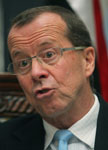
 AFP:he UN’s special envoy to Baghdad voiced worry over rising levels of violence and worsening sectarianism in Iraq in an interview with AFP, warning in particular of a deterioration in security. By Prashant Rao
BAGHDAD (AFP)— The UN’s special envoy to Baghdad voiced worry over rising levels of violence and worsening sectarianism in Iraq in an interview with AFP, warning in particular of a deterioration in security.
Martin Kobler, who made the remarks at the conclusion of his posting to the country, said much was still to be done, with little progress in the past two years on several key political issues, including laws regulating the energy sector and the dispersal of oil income and a long-running dispute over a swathe of territory in north Iraq.
He pointed to improving bilateral ties with Kuwait and well-run elections as positive developments over his two years in Iraq, but called for economic reforms and greater political and financial federalism.
“I am very concerned at the end of my two years, because sectarianism increases, violence increases,” Kobler told AFP from his residence in Baghdad’s heavily-fortified Green Zone ahead of his departure from Iraq to take up a new post as UN special envoy to the Democratic Republic of Congo.
The former German ambassador to Baghdad noted that May was the deadliest month in Iraq since 2008, adding, “here, we really see a deterioration”.
Analysts often tie the increase in violence to a high-level political dispute between Sunni Arab groups and the Shiite-led authorities, with months of angry protests by the Sunni minority against alleged targeting providing militant groups with recruitment fodder and room to manoeuvre.
Kobler said the “Sunni-Shiite conflict … is paralysing, so to say, everything in the country”.
“A dialogue is not taking place in a structured way,” he continued. “Not to talk to each other is a receipt for disaster.”
“We should not get used to a high level of violence. … I am very concerned that once you are at a higher level, everybody accepts, in a way, this high level of violence.”
He added that a political standoff between the government and Sunni demonstrators had to be resolved.
“If the stalemate between the demonstrators and the government continues, this is not the right way.”
Though the authorities insist they have taken measures to address protesters’ demands, analysts say underlying causes of frustration in the Sunni community have not been addressed.
The UN envoy pointed to improving ties with Kuwait, to which Iraq is still paying reparations tied to Saddam Hussein’s 1990 invasion, and a flurry of elections that have largely been deemed free and fair as signs of progress in the country, and insisted that “trend-wise, I am confident that the country will take off”.
But Kobler also listed a litany of legislation that needed to be passed, in addition to wide-ranging economic reforms and greater powers being handed to Iraq’s provinces.
“There are still many things unfinished here … like the oil and gas law, the revenue-sharing law, the political parties law, the law on minorities, and many, many, many more,” he said.
“There is … not yet a concept of having political federalism and financial federalism,” the diplomat added.
Kobler also pointed to an “overwhelming” public sector which “paralyses medium, small-sized enterprises” as needing to be reined in.
Iraq is overwhelmingly dependent on oil exports, but no legislation has been passed regulating the sector or the sharing of revenues generated from energy sales.
Officials, meanwhile, have for years trumpeted potential economic reforms and attempts to ease regulations for foreign and local businesses, but the country remains one of the most difficult in the world to do business in.
The country has also been hit by brutal violence in neighbouring Syria, which has proved divisive politically and socially, and biting sanctions in nearby Iran hitting Iraq’s economy and trade.
Kobler said that while those were factors, many of Iraq’s problems were of it’s own doing.
“It’s of course difficult in a regional environment as we have now,” he said.
“But on the other side, many of the problems of Iraq are homemade.”
“The Sunni-Shiite conflict, the Arab-Kurdish conflict, the situation in the disputed internal boundaries, the elections in Kirkuk — these, in principle, are homemade problems.


