


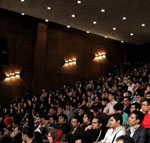
 Businessweek: Tens of thousands of Iranians have left the country of 77 million in recent years, largely for Europe and North America, in search of jobs and higher salaries. During the past two years, at least 40 percent of top-performing students left the country…
Businessweek
By Golnar Motevalli
Drawing on a cigarette in his flat in central Tehran, Araz Alipour can count on one hand the number of friends who stayed in Iran after college. “Easily 90 percent of them have gone overseas,” the 29-year-old software developer says, reflecting on the flight of many of the nation’s science and engineering students. “Of my 45 university classmates, maybe five remain.”
Tens of thousands of Iranians have left the country of 77 million in recent years, largely for Europe and North America, in search of jobs and higher salaries. During the past two years, at least 40 percent of top-performing students with undergraduate degrees in science and engineering left the country to pursue advanced degrees, according to Iran’s National Elites Foundation, a government-run organization that supports academically gifted and high-achieving students. “Mostly they want to go to Canada, Australia, Germany, or Sweden,” says Bahram Yousefi, 26, a translator who works with college students on their graduate school applications. “There’s no job security, no life security here,” he says.
Nine months after taking office, Iranian President Hassan Rouhani is under pressure to follow through on campaign promises to slow the brain drain that contributes to the country’s economic woes. From 2009-13, net emigration from Iran was 300,000, according to the World Bank. The number of Iranians studying in the U.S. increased 25 percent, to more than 8,700, in the 2012-13 academic year, according to the Institute of International Education. Many won’t return. According to a 2012 survey by the Arlington, Va.-based National Science Foundation, 89 percent of Iranian doctoral students remain in the U.S. after graduation—equal to the Chinese and the highest percentage of nationalities surveyed.
Story: Business Majors Get More Jobs but Less Workplace Fulfillment
Unemployment among Iran’s 15- to 29-year-olds is about 26 percent, twice the national average, though Rouhani has pledged to increase jobs and raise salaries. While there’s no official data, graduates who recently started work in Iran say they earn no more than $500 a month. “No matter how good you are, you’re never going to earn $3,000 a month, a starting salary for Iranians in Canada or the U.S.,” says Mohammad, a postdoctoral student of communications in Ireland (he asked that his surname and the name of his college not be published).
Iranians began leaving the country before the 1979 Islamic Revolution. Migration peaked between 1989 and 1993, when a net 2.2 million left, according to the World Bank. By the early 2000s, the number fell to less than 100,000. Emigration picked up under Rouhani’s predecessor, Mahmoud Ahmadinejad, whose angry rhetoric aimed at the U.S. and Israel, and refusal to cooperate with monitoring of Iran’s nuclear program, led to tighter sanctions and deeper isolation.
An interim agreement between Rouhani and world powers has resulted in about $7 billion in relief from sanctions. The International Monetary Fund forecasts the economy will expand in 2014 for the first time in three years, growing 1.5 percent.
Story: Iran vs. Israel in Davos: Who Made the Best Impression?
Even students who’ve stayed in Iran say better opportunities exist outside the country. Math and physics teacher Mehrdad, 31, chose to remain after receiving an undergraduate degree in 2006 (he asked that his surname not be published). Nearly all 300 students from his Tehran high school class have settled abroad. “They are either at really good universities or have really good jobs,” he says.
It’s not only low pay that feeds the emigration, says Reza Mansouri, a former deputy science minister and physics professor at Tehran’s Sharif University of Technology. “Students want to be able to grow and blossom intellectually. This society doesn’t allow that to happen,” he says.
Mansouri bemoans the lack of investment in science and an emphasis on religious ideology in higher education, which he blames for the exit of Iran’s brightest minds. He says the government is spending far less than the 2.5 percent of gross domestic product allotted for science and technology research. The professor spends about an hour a day writing recommendation letters for students applying to overseas universities. “Each year we admit about 50 physics students,” Mansouri says. “I’ve counted the ones who stay, and it’s around two.”


