


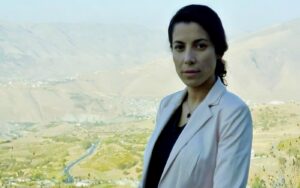
The Iran Human Rights Center announced on Tuesday, July 23, that Pakhsan Azizi, a political prisoner previously accused of “baghi,” has been sentenced to death by the Revolutionary Court.
According to the laws of the Iranian regime, baghi means rebellion against the legitimate Imam and the Islamic ruler.
Since late June, Pakhsan Azizi had been denied visits and contact with her family by the order of Evin prison officials.
She was arrested on August 4, 2023, in Kharrazi Township, Tehran, and was interrogated and tortured in the detention center of the Ministry of Intelligence. She was then transferred to Ward 209 of Evin prison and later to the women’s ward. In the winter of 2023, she was charged with “rebellion through membership in opposition groups” by Branch 5 of the Evin Security Prosecutor’s Office.
This political prisoner appeared on May 28 and June 16, 2024, at Branch 26 of the Islamic Revolutionary Court in Tehran, presided over by Judge Iman Afshari, to address the charge of “baghi.”
Human rights organizations say Pakhsan Azizi has been subjected to torture and pressure by security officials to force her to make coerced confessions.
Pakhsan Azizi, a native of Mahabad and a graduate in social work from Allameh Tabataba’i University, was first arrested in November 2009 during a student protest against political executions in Kurdistan and was released on bail on March 19, 2010.
She has consistently faced accusations of “membership in opposition groups.”
Another two political prisoners, Varisheh Moradi and Sharifeh Mohammadi, are also imprisoned on charges of “Baghi.”
Sharifeh Mohammadi, who was a member of the “Coordinating Committee to Help Form Workers’ Organizations” over a decade ago, was arrested in December 2023 and sentenced to death by the Islamic Revolutionary Court of Rasht on July 4.
The Coordinating Committee to Help Form Workers’ Organizations, which Sharifeh Mohammadi was a part of in the 2000s, has rejected the charges against her.
Following the nationwide protests in 2022, Iranian regime officials have intensified the repression of women activists and human rights defenders, resorting to harsher methods and issuing heavy sentences to silence dissenters and those with differing views.


