


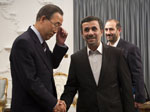
 AP: The U.N. chief jolted his Iranian hosts for a nonaligned nations meeting Wednesday by pointing out “serious concerns” in Tehran’s human rights record and urging cooperation with the world body to improve freedoms.
The Associated Press
By ALI AKBAR DAREINI
TEHRAN, Iran (AP) — The U.N. chief jolted his Iranian hosts for a nonaligned nations meeting Wednesday by pointing out “serious concerns” in Tehran’s human rights record and urging cooperation with the world body to improve freedoms.
U.N. Secretary-General Ban Ki-moon had signaled he would not shy away from criticism of Iran during his visit to the Nonaligned Movement gathering in Tehran, but the sharp comments appeared to catch Iranian officials off guard just hours after his arrival.
“We have discussed how United Nations can work together with Iran to improve the human rights situation in Iran. We have our serious concerns on the human rights abuses and violations in this country,” he told a news conference as he sat next to Iran’s Parliament Speaker Ali Larijani, who frowned at the remarks.
Iran’s opposition groups had urged Ban to use his appearance in Tehran as a platform to criticize Iran’s ruling system over its crackdowns on political dissent, including the house arrests of opposition leaders Mir Hossein Mousavi and Mahdi Karroubi.
While in Tehran, Ban also could raise sensitive issues such as demands by U.N. nuclear inspectors for wider access to various sites, including a military base near Tehran suspected of being a proving ground for explosives experiments that could be used to test nuclear triggers. Iran denies it seeks nuclear arms, but Western nations and allies fear Tehran’s uranium enrichment labs are moving close to warhead-grade material.
U.N. spokesman Martin Nesirky said in his talks, Ban expressed frustration that “little tangible progress” has been made in talks between Iran and world powers over Tehran’s nuclear program. No date has been set to resume negotiations after several rounds over the past months.
Iran says it wants talks to continue, but also claims that the current gathering in Tehran shows that Western efforts to isolate Iran have failed.
In Vienna, the U.N.’s nuclear agency has created a special Iran Task Force of nuclear weapons experts, intelligence analysts and other specialists focused on probing Tehran’s atomic program, according to an internal document shared with The Associated Press.
Iran is seeking to use the weeklong meeting of the 120-nation Nonaligned Movement to promote its position that its nuclear program is peaceful and its uranium enrichment is within the U.N. treaty rules. The meetings are capped by a two-day summit that begins Thursday.
Ban’s visit is being interpreted by Iranian media as a blow to Western attempts to isolate the Islamic republic in defiance of Israeli and American calls to boycott the meeting.
Tehran is also seeking to win support from the nonaligned bloc, accounting for nearly two-thirds of the U.N. member states, for its nuclear program. A visit to Natanz uranium enrichment site in central Iran by participating leaders has not been ruled out.
Ban met Iran’s Supreme Leader Ayatollah Ali Khamenei and President Mahmoud Ahmadinejad later Wednesday.
Khamenei called on him to take action over Israel’s nuclear weapons, according to Khamenei’s website, calling this “a big danger to the region.” Israel has never acknowledged having nuclear weapons but is widely believed to have a large arsenal.
In advance, Ban also said he would discuss the Syria crisis with Iranian leaders, who remain staunch allies of Bashar Assad’s regime. The U.N. chief has in the past called Iran a major player capable of mediating in regional conflicts, including Syria’s civil war.
Nesirky, the U.N. spokesman, said that in his meetings in Tehran Ban “urged the leadership — the president, the Supreme Leader, the speaker of parliament — to really reach out to the Syrian leadership and impress on them the really urgent need to stop the violence and to create the conditions that are necessary for a political process.”
Iran plans to propose the formation of a three-member nonaligned team, plus two neighbors of Syria, to help resolve the crisis there, Iran’s state media quoted prominent lawmaker Alaeddin Boroujerdi as saying.
The proposed troika will include Egypt, Iran and Venezuela plus Iraq and Lebanon. Boroujerdi, who met Assad during a visit to Syria last week, said the Syrian president said he would welcome the Iranian plan.
Khamenei told Ban that the solution is to stop weapons shipments to the Syrian rebels, or as he put it, “irresponsible groups inside Syria,” according to his website.
A senior Iranian official gave details of the plan Iran is proposing at the summit.
“Iran’s proposal … is a cease-fire and the implementation of a three-month mechanism for national reconciliation talks in this country,” the official IRNA news agency quoted Deputy Foreign Minister Hossein Amir Abdollahian as saying Wednesday.
Anti-regime fighters have dismissed any role for Iran in such a plan. The rebels and some others say it has little hope of succeeding. Also, the United States has rejected Iranian participation in international meetings on the Syrian crisis.
In Washington, State Department spokeswoman Victoria Nuland urged Ban to press Iran over Syria. She said Iran does have a role to play: “It can break with the Assad regime and stop providing material support and arms and advisers and all of these kinds of things,” she said.
Associated Press writer Edith M. Lederer contributed to this report from the United Nations.


