


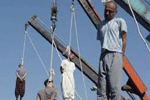
An Iranian official has defended the regime’s soaring execution rate for drugs offences under so-called ‘moderate’ President Hassan Rouhani.
An Iranian official has defended the regime’s soaring execution rate for drugs offences under so-called ‘moderate’ President Hassan Rouhani.
Mohammadreza Habibi, the head of judiciary in Yazd province, said ‘no sentence can replace death verdict’
as a means of reducing drug trafficking across the country.
He added: “There are some who are critical of the execution of drug traffickers. These should know that if there is no firmness and execution, drugs would be easily distributed across the country.”
Habibi also acknowledged that based on the regime’s own Law of Retribution, death sentences are not required for drug related crimes. But some death sentences must be handed down ‘based on the social situation and state verdicts’.
At least 1,200 people have been executed since Rouhani became president, including political prisoners, women and those committing crimes when under 18.
Iranian opposition groups and human rights organizations insist executions are being carried out to create fear and intimidation in society and to prevent any public expression of dissent against the regime.
Earlier this month, a number of human rights organizations demanded that the United Nations Office of Drugs and Crime stop providing aide to the regime in Tehran until it has abolished executions for drug related offences.
These organizations have warned the UNODC of ‘the widening gulf between Iran’s rhetoric and the realities of its justice system’, and described the agency’s decision to continue funding supply-side counter-narcotics efforts in the country as ‘ineffective if not counterproductive’.
The UN agency’s records show it has given more than $15 million to ‘supply control’ operations by Iran’s Anti-Narcotics Police, funding specialist training, intelligence, trucks, body scanners, night vision goggles, drug detection dogs, bases, and border patrol offices, the groups said.
UNODC projects in Iran have come with performance indicators including ‘an increase in drug seizures and an improved capability of intercepting smugglers’, and an ‘increase of drug-related sentences’.
The London-based Reprieve organization recently published a detailed report on how the aide provided to Iran by UN member states help Iran to carry out executions.
Reprieve director Maya Foa said: “As Iran executes alleged drug offenders in ever-greater numbers, it beggars belief that the UN sees fit to continue funding Iranian anti-drug operations.
“How many more hangings will it take for the UN to open its eyes to the lethal consequences of its current approach, and make its counter-narcotics support conditional on an end to the death penalty for drug offenses?”
So far England, Denmark and Ireland have stopped their support. These countries worry that their money would be used for executing drug traffickers.
A number of Iranian judiciary officials have also recently insisted executions will continue for drug related offences.


