


 CBS: A month after more than 30 Iranian dissidents were killed and several hundred wounded when Iraqi army forces entered Camp Ashraf, the fate of the 3,400 camp residents is still uncertain.
Posted by CBSNews.com staff
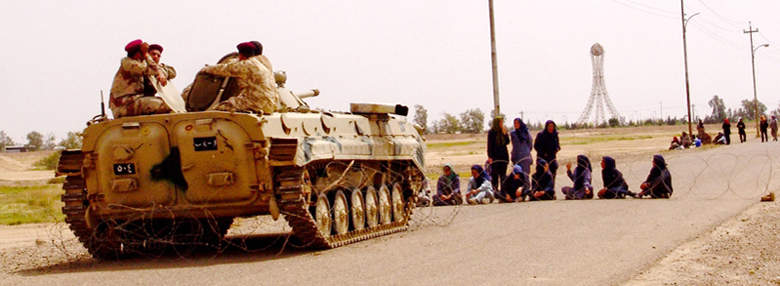
(CBS/AP) A month after more than 30 Iranian dissidents were killed and several hundred wounded when Iraqi army forces entered Camp Ashraf, the fate of the 3,400 camp residents is still uncertain.
Camp Ashraf, located in Iraq’s northeast Diyala province, is the home of the People’s Mujahedeen Organization of Iran (PMOI), which seeks the overthrow of Iran’s leaders and is considered a terrorist group by Iran, as well as the U.S. The group was given sanctuary by the Saddam Hussein, then protected by the American forces after the regime fell, and now falls under the jurisdiction of the Iraqi government.
The PMOI maintains that 35 people were killed and 345 wounded during fighting with Iraqi Army forces, and that 42 of the seriously injured still have not received adequate treatment.
The residents who were killed on April 8 have not yet been buried, according to Ali Safavi, a member of Iran’s Parliament in Exile, National Council of Resistance of Iran, and president of the Near East Policy Research. He said that Iraqi forces have occupied the area of the camp where the cemetery is located, and have constructed a four-mile long embankment that divides the camp.
“Iraqi forces need to leave Camp Ashraf so that those who were killed can be buried,” Safavi said. “In addition, wounded residents must get treatment; families and international delegations must be allowed to visit the camp, and all sides have to resolve the issue peacefully. Unless those conditions are met, the threat of another attack is very real.”
The U.S. and the United Nations have condemned the April 8, 2011 attack on Camp Ashraf.
U.S. Senate Foreign Relations Chairman John Kerry called the raid a “massacre,” saying the Iraqi government should “hold accountable the responsible parties and ensure that there will be no sequel to these horrific events.”
“It now seems certain that at least 34 people were killed in Camp Ashraf, including seven or more women,” U.N. High Commissioner for Human Rights Navi Pillay said. “Most were shot, and some appear to have been crushed to death, presumably by vehicles.”
“There is no possible excuse for this number of casualties,” said Pillay. “There must be a full, independent and transparent inquiry, and any person found responsible for use of excessive force should be prosecuted.”
The European Parliament met with Iraqi leaders at the end of April, and called for an independent inquiry, and call for the perpetrators being brought to international justice.
The main obstacle obstacle to resolving the situation is the terrorist designation accorded the PMOI by U.S., according to Safavi. “The onus is on the U.S. to protect these people,” he said.
Retired Gen. James Jones, a former national security advisor to President Obama and Supreme Allied Commander Europe, and retired Gen. Peter Pace, former Chairman of the Joint Chiefs of Staff, both advocate delisting PMOI as a terrorist organization.
“Some folks said to me this week if the United States government took the MEK [Mojahedin-e-Khalq Organization, another designation forPMOI] off the terrorist list it would be a signal to the Iranian regime that we had changed from a desire to see changes in regime behavior to a desire to see changes in regime. My response to that is: sounds good to me,” Pace said in February 2011.
Reuters has reported that the U.S. is drafting a plan to move camp residents to a new location in Iraq, and then resettle them in other countries.
“We recognize that this is a humanitarian tragedy that is occurring and has great potential to be a humanitarian issue into the future,” an official said on condition of anonymity.
Struan Stevenson, president of the European Parliament’s Delegation for Relations with Iraq, believes that residents should not be moved from the camp they have inhabited for 20 years. “Forcible transfer of these 3400 unarmed refugees would be illegal and in violation of international standards and provisions of International Humanitarian Law,” he said in a May 6 statement.


