


 AP: Opponents of Prime Minister Nouri al-Maliki have failed to muster enough support to bring him down in a vote of no confidence, Iraq’s president said in a statement posted on his website Sunday.
The Associated Press
By QASSIM ABDUL-ZAHRA
 BAGHDAD (AP) — Opponents of Prime Minister Nouri al-Maliki have failed to muster enough support to bring him down in a vote of no confidence, Iraq’s president said in a statement posted on his website Sunday.
Al-Maliki, a Shiite, faces a growing challenge from Sunni and Kurdish parties as well as other Shiites within his unity government who accuse him of monopolizing power.
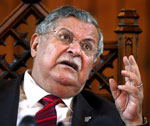
But al-Maliki also has allies such as President Jalal Talabani, a Kurd, whose office must affirm that a petition for a no-confidence vote has enough signatures. Talabani’s refusal to ratify the no-confidence campaign’s letter is a setback for al-Maliki’s opponents, although the constitution gives them other ways of trying for the vote.
Coalition rebels said in a statement they would keep trying to unseat al-Maliki and to “put an end to the monopoly (on power) and domination” by the prime minister.
Talabani has close ties to Iran, which has been using its leverage in Iraq to keep al-Maliki in place. Divisions among the prime minister’s opponents may also be undercutting the no confidence push.
The failure to obtain a no-confidence vote averts an immediate political blowup, but perpetuates the sectarian-based deadlock that has been paralyzing the country.
In the latest violence, two mortar shells hit Baghdad’s Shiite neighborhood of Kazamiyah late Sunday, killing two residents and wounding 15, police officials and medics said on customary condition of anonymity.
The attack came just days before tens of thousands of Shiite pilgrims are expected to visit a shrine in Kazamiyah. Baghdad security officials said they are blocking off a nearby Sunni area, Azamiyah, for a week to avoid friction between residents and Shiite pilgrims.
Last week, the prime minister’s opponents said they sent a letter to Talabani with pledges from 176 lawmakers in the 325-member parliament — or a dozen more than the 164 needed — that they would vote for the prime minister’s recall.
However, Talabani said Sunday that the letter has only 160 valid signatures. He said 13 lawmakers informed him that they are withdrawing or suspending their signatures. There was no immediate explanation for the discrepancy between the 176 signatures cited by al-Maliki’s opponents and the total of 173 referred to by Talabani.
The president has urged al-Maliki and his coalition partners to try to iron out their differences.
He said Sunday that he plans to leave for medical treatment in Europe next week, further distancing himself from those trying to unseat al-Maliki.
Al-Maliki’s disgruntled coalition partners, including representatives of the Sunni-dominated Iraqiya movement, Kurdish parties and supporters of radical Shiite cleric Muqtada al-Sadr were meeting Sunday in the autonomous Kurdistan region to discuss their next move.
The current standoff, which has dragged on since inconclusive March 2010 elections, is holding back attempts to rebuild the country after eight years of U.S. occupation.
Sunnis accuse al-Maliki of targeting their leaders in politically motivated prosecutions, Kurds believe his government is hostile to their regional autonomy, and many Shiites feel he cuts them out of decision-making.
Others think he has provided at least some stability after years of sectarian conflict. Iran is also believed to view him as perhaps the only viable Iraqi national leader at this point — a view that Washington is said to share, according to Iraqi politicians.
In other developments Sunday, an al-Qaida-linked group, the Islamic State of Iraq, claimed responsibility for a suicide car bomb that killed 26 people last week outside a Shiite religious affairs office in Baghdad last week.
Attacks in Iraq are down sharply compared to a few years ago, but bombings and shootings remain common.
Associated Press writer Mazin Yahya in Baghdad contributed reporting.


