


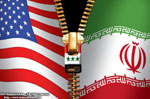
 AFP: Iraq insisted on Monday that its trade with neighbouring Iran was above board, and denied reports that it was helping the Islamic republic skirt sanctions by smuggling oil and secretly moving cash.
  BAGHDAD (AFP)— Iraq insisted on Monday that its trade with neighbouring Iran was above board, and denied reports that it was helping the Islamic republic skirt sanctions by smuggling oil and secretly moving cash.
Ali Mussawi, spokesman for Iraqi Prime Minister Nuri al-Maliki, said that Baghdad’s trade and dealings with Tehran were below “the permitted level” for neighbouring countries, and dismissed claims Iraq was selling oil on Iran’s behalf as a “big lie”.
“We are dealing with Iran in a public and transparent fashion, we have not done any secret deals,” Mussawi told AFP.
“We feel that we have dealt with Iran less than the permitted level.”
He said of enforcing sanctions against Iran: “There is always a permitted level for neighbouring countries.
“International officials and Americans always emphasise that the international sanctions on Iran do not apply to Iraq for many reasons.”
The New York Times reported on Sunday that Iraq was carrying out an array of tasks within a network of financial institutions and oil-smuggling operations that have helped funnel cash to Iran as sanctions choke its economy.
Mussawi, however, insisted that Iraq’s central bank was an independent institution and was not subject to Maliki’s orders, and said of the Times’s claims Iraq was selling oil on Iran’s behalf: “This is a big lie.”
But he added that some oil was being smuggled through Iraq’s autonomous northern Kurdistan region, which he said was not only breaking sanctions, but also infringing on Iraq’s sovereignty.
“We have warned about this from the beginning,” Mussawi said. “It (oil smuggling via Kurdistan) is not only breaking sanctions, but Iraqi oil is being smuggled out of the country, and not through Iraq’s main pipelines.”
Iran and Iraq, which fought a 1980-1988 war that was one of the bloodiest conflicts of the past century, killing an estimated one million people, have drawn closer since the US-led invasion of 2003.
The US sanctions, and others imposed by the European Union, aim to pressure Tehran to roll back its nuclear activities, which the West fears are geared to developing atomic weapons. Iran denies its programme is anything but peaceful.


