


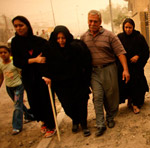
 AP: The fliers began turning up at Sunni households in the Iraqi capital’s Jihad neighborhood last week bearing a chilling message: Get out now or face “great agony” soon. The leaflets were signed by the Mukhtar Army, a new Shiite militant group with ties to Iran’s Revolutionary Guard.
The Associated Press
By By ADAM SCHRECK and QASSIM ABDUL-ZAHRA
BAGHDAD (AP) — The fliers began turning up at Sunni households in the Iraqi capital’s Jihad neighborhood last week bearing a chilling message: Get out now or face “great agony” soon.
The leaflets were signed by the Mukhtar Army, a new Shiite militant group with ties to Iran’s Revolutionary Guard. “The zero hour has come. So leave along with your families. … You are the enemy,” the messages warned.
Such overt threats all but disappeared as the darkest days of outright sectarian fighting waned in 2008 and Iraq stepped back from the brink of civil war. Their re-emergence now — nearly a decade after the U.S.-led invasion — is a worrying sign that rising sectarian tensions are again gnawing away at Iraqi society.
Iraqis increasingly fear that militants on both sides of the country’s sectarian divide are gearing up for a new round of violence that could undo the fragile gains Iraq has made in recent years.
Members of the country’s Sunni minority have been staging mass rallies for two months, with some calling for the toppling of a Shiite-led government they feel discriminates against them and is too closely allied with neighboring Iran. Sunni extremists have been stepping up large-scale attacks on predominantly Shiite targets, and concerns are growing that the brutal and increasingly sectarian fighting in Syria could spill across the border.
Many Sunnis who received the Jihad neighborhood messages are taking the warnings at face value and considering making a move.
“Residents are panicking. All of us are obsessed with these fliers,” said Waleed Nadhim, a Sunni mobile phone shop owner who lives in the neighborhood. The 33-year-old father plans to leave the area because he doesn’t have faith in the police to keep his family safe. “In a lawless country like Iraq, nobody can ignore threats like this.”
Iraqi security forces have beefed up their presence in and around Jihad. The middle-class community, nestled along a road to the airport in southwest Baghdad, was home to Sunni civil servants and security officials under Saddam Hussein’s regime, though many Shiites now live there too.
The Shiites, who are emboldened by a government and security forces dominated by their sect, have made their presence felt in Jihad in recent years. A Sunni mosque bears graffiti hailing a revered Shiite saint. A billboard on a major road shows firebrand Shiite cleric Moqtada al-Sadr flanked by a fighter gripping a machine gun.
Jihad was one of the earliest flashpoints in Baghdad’s descent into sectarian bloodshed. In July 2006, the neighborhood witnessed a brazen massacre that left as many as 41 residents dead and marked an escalation in Iraq’s sectarian bloodletting. In that incident, Shiite militiamen set up checkpoints to stop morning commuters, singled out Sunnis based on their names and systematically executed them in front of their Shiite neighbors.
Residents now fear the events in southwest Baghdad could be the spark for a new round of tit-for-tat killing. Two weeks ago, a Sunni and a Shiite were each killed in separate attacks in Sadiyah, next to Jihad, said a 30-year-old Sunni government employee living in the area who gave her name only as Umm Abdullah al-Taie, or mother of Abdullah.
“Nobody dares to go out after dark,” she said. “People have started to hear sectarian alarm bells ringing again.”
The Mukhtar Army whose named appeared on the threatening leaflets was formed by Wathiq al-Batat, a onetime senior official in the Hezbollah Brigades. He announced the creation of the new militant group earlier this month.
Hezbollah in Iraq is believed to be funded and trained by Iran’s elite Revolutionary Guard and was among the Shiite militias that targeted U.S. military bases months before their December 2011 withdrawal.
Al-Batat told Iraq’s al-Sharqiya channel that he formed the Mukhtar Army to confront Sunnis who might attempt to topple the government in the same way that Syrian rebels are trying to overthrow Bashar Assad’s Iranian-backed regime in neighboring Syria. He said the group is advised by Iran’s hard-line Quds Force, which oversees external operations of the Iranian Revolutionary Guard. He declined to say whether the group received any further support from Tehran.
Little is known about Mukhtar Army’s size or capabilities. Abdullah al-Rikabi, a spokesman for the group, boasted it has 1 million members and described al-Batat as loyal to Iran’s supreme leader, Ayatollah Ali Khamenei.
Iraqi Prime Minister Nouri al-Maliki’s government has issued an arrest warrant against al-Batat, though he still walks free. In a speech Saturday, the Shiite premier vowed to prosecute anyone who seeks to incite sectarian strife.
The Mukhtar Army denies being behind the threats, which some Shiites believe are a ruse to tar their sect and inflame sectarian divisions.
“We have nothing to do with the fliers,” said al-Rikabi, the group’s spokesman. He accused members of Saddam’s now-outlawed Baath party and al-Qaida of making the threats in an effort to ignite civil war.
Even though they are busy hunting down the group’s leader, Iraqi authorities have their doubts about the Shiite militia’s involvement in the leaflets too.
Two senior security officials said intelligence agents have obtained an al-Qaida hit list containing detailed names and residential information about people — both Sunnis and Shiites — living in mixed areas. They believe the group plans to target residents one by one, alternating by sect, in an effort to spread panic and suggest an atmosphere of retaliatory killings.
They spoke on condition of anonymity because they were not authorized to disclose information about security operations.
Threatening fliers from both Sunni and Shiite militias aimed at members of the opposite sect also have begun turning up in Baqouba, a former al-Qaida stronghold north of Baghdad that has a history of sectarian violence, according to Diyala provincial council member Sadiq al-Hussein.
For those living in areas where the threats turned up, their source matters less than what they portend.
Jafaar al-Fatlawi, a Shiite government employee who lives in the Jihad neighborhood, said he has started carrying a pistol with him just to answer the door and takes his family to spend the night with relatives elsewhere in the city.
“Everybody in the neighborhood expects sectarian fighting to erupt any minute,” he said. “Our security forces weren’t able to stop the sectarian war before and now they’ll fail again.”
___
Associated Press writer Sameer N. Yacoub contributed reporting.


