


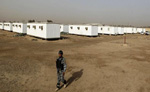
 IPS: Approximately 300 supporters of Camp Liberty inmates gathered outside the United Nations on Tuesday to protest the conduct of Martin Kobler, the Special Representative of the U. N. Assistance Mission in Iraq (UNAMI).
By Flossie Baker
UNITED NATIONS (IPS) – Approximately 300 supporters of Camp Liberty inmates gathered outside the United Nations on Tuesday to protest the conduct of Martin Kobler, the Special Representative of the U. N. Assistance Mission in Iraq (UNAMI).
On Jul. 16, Kobler, who has recently been appointed as Special Envoy to the U.N. Mission in the Congo (MONUSCO), updated the Security Council on UNAMI’s work for the final time before undertaking his new role.
Since his appointment in Iraq in August 2011, the treatment of the Iranian leftist political organisation People’s Mujahedin of Iran (MEK) by Iraqi forces has worsened.
The MEK were exiled after the Islamic revolution of 1979 and since 2003 have purported to be working to overthrow the Islamic regime of Iran using only peaceful means.
Last August, members of the MEK who had been living as refugees on Iraqi soil in Camp Ashraf were transferred to Camp Liberty, a former United States military base close to Baghdad airport where conditions are far inferior.
The Iraqi government, which views the group as a terrorist organisation has been trying to instigate this move for several years but was only successful under Kobler’s leadership of UNAMI.
Camp Ashraf, which is 36 square km in size, was built over the last 26 years by its residents, many of whom possess high-level degrees from universities in the United States.
Tahar Boumedra, former U.N. Human Rights chief in Baghdad, believes that Camp Ashraf is one of the most impressive cities in Iraq. “They generated solar energy to light the streets,” he told IPS. Camp residents also built a graveyard, shopping centre and university.
At Camp Liberty, however, residents are squeezed into 600 square metres of space, in an area devoid of the facilities mentioned above. Although the move was meant to be a temporary one, 18 months later over 3,000 MEK members still remain there, amid deteriorating conditions including uncollected raw sewage, little sanitation and no protection from attacks by Iraqi forces.
Since the move to Camp Liberty, 16 residents have died and 230 have sustained injuries as a result of three rocket attacks launched by Iraqi forces.
After the latest attack on Jun. 15, Kobler and Claire Bourgeois, the Iraqi representative for the U.N. Refugee Agency (UNHCR) said they were “deeply concerned…that tragic violence has occurred despite repeated requests to the government of Iraq to provide CampLiberty and its residents with protective measures, including T- Walls (steel-reinforced concrete walls used for blast protection).”
However, the protesters outside the U.N. headquarters in New York argue that Kobler should have done more to protect the camp’s inhabitants, accusing him of being complicit in their deteriorating situation.
The inmates, who were declared ‘protected persons’ in 2004 under the Fourth Geneva Convention, have repeatedly asked, and offered to pay for, helmets, bunkers and medical supplies, however these are being denied by the Iraqi government. Ali Safavi of the National Council of Resistance of Iran told IPS that the current security conventions at Camp Liberty are not sufficient: “people have to live in fox hides…because they are not safe from rockets,” he said.
In his address to the U.N. Security Council (UNSC) on Tuesday, Kobler said the security of Camp Liberty inmates was UNAMI’s “main concern”. He told the UNSC that “we (UNAMI and UNHCR) went every extra mile and left no stone unturned in our quest to find a humanitarian solution…I have repeatedly reminded the Iraqi authorities both in writing and orally to fulfill the requests of the camp residents for additional protective measures.”
However, Boumedra, who resigned over Kobler’s action in Iraq, told IPS: “In Iraq, the U.N. acted illegally and immorally.” The decision to appoint Kobler to the DRC is therefore a highly controversial move and his conduct in his new position will no doubt be monitored closely on the world stage.


