


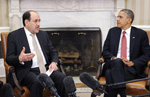
 The Hill: As the wave of sectarian bloodshed spreads,the Iranian-backed Nouri al-Maliki has requested that the United States accelerate its deliveries of weapons, which, he claims, will be used to combat al-Qaeda-linked insurgents.
The Hill
By U.S. Army Gen. Ron Griffith (Ret.) and U.S. Army Lt. Gen. Jay Garner (Ret.)
The Iranian-backed Iraqi government of Prime Minister Nouri al-Maliki again is struggling with civil war. As the wave of sectarian bloodshed spreads, al-Maliki has requested that the United States accelerate its deliveries of weapons, which, he claims, will be used to combat al-Qaeda-linked insurgents. Among the weapons the United States has agreed to provide al-Maliki’s embattled government are Apache attack helicopters — the most lethal helicopter in military aviation history.
Al-Maliki’s largely Shiite government has victimized Sunnis and other minorities since the departure of the U.S. military. Clashes with Sunnis erupted after the violent December 28, 2013 arrest of Sunni lawmaker Ahmed al-Alwani, leaving at least six dead, including al-Alwani’s brother. Two days later, Iraqi security forces raided and dismantled an anti-government Sunni protest camp in Ramadi, killing thirteen and injuring dozens more.
The latest rise in violence and increasing crackdowns on al-Maliki’s political opponents should raise concerns about the Iraqi government’s use of U.S.-provided weapons, and the conditions under which the United States should allow more weapons to Iraq.
Iraq’s recent budget, which passed with no Kurds represented, combined with al-Maliki’s threat to cancel the KRG budget predicts the length to which he may go to inflict his political will. This has heightened Kurdish and Sunni concerns about al-Maliki’s ability to buy advanced weapons to punish political disagreement with Baghdad.
The January 15, 2014 U.S. Presidential Policy Directive unequivocally mandates that U.S. arms transfers not violate human rights or any international humanitarian law. Thus, it is imperative that if the United States is to continue providing arms to Iraq, then, at a minimum, conditions and monitoring mechanisms should be imposed to prevent either deliberate or unwitting misuse of those weapons (for example, against Iraqis who oppose the government).
Since U.S. troops withdrew in 2011, Iraq’s sectarian violence, largely blamed on al-Maliki, has increased dramatically. In 2013, over 8000 people were killed – Iraq’s highest death toll in years. The Iraqi government states that recent crackdowns are to restore security and to target al Qaeda fighters, but many, especially Iraq’s minorities, question whether the government truly is restricting the fight to “terrorism.”
Sectarian tensions between the Iraqi government and Sunnis have led to unease in the Kurdistan Region of Iraq. The Kurds remember all too vividly the former Iraqi regime’s brutal al-Anfal genocide twenty-five years ago, which targeted and killed 180,000 Kurds. As violence escalates and Iraq’s security deteriorates, the Kurds realistically worry that U.S. weapons will also be used against them.
The Kurdistan region also faces an al Qaeda threat on its western border with Syria — the same threat facing the rest of Iraq. But, as the U.S. provides Baghdad with weapons to combat al Qaeda, the Iraqi government refuses arms for the Kurdish Peshmerga (part of Iraq’s security force) to protect against the very same threat. All Iraqi forces, including the Peshmerga, face the same terrorist threat, and thus deserve an equitable distribution of weapons. Distribution of U.S. arms that follows a political path, rather than a path dictated by national security requirements, inevitably will undermine the very stability that such arms are intended to provide. U.S. policy in this violence-plagued region should be that of an honest broker rather than an arms broker to an unstable government.
Moreover, while Iraq remains a questionable political ally to the United States in the region today, the current instability both within Iraq and on its borders suggests that this relationship may get worse rather than better. In view of Iraq’s deepening relationship with Iran, future alignment with the U.S. is in doubt. Moreover, the questionable outcome of the Syrian civil war on Iraq’s western border, as well as the uncertainties surrounding Iran’s nuclear ambitions all point to growing instability in Iraq’s neighborhood. Introducing weapons into this volatile environment, riddled with shifting allegiances, is an undertaking that requires serious thought and crystal clear, enforceable conditions. Caution and conditions for injecting weapons into this dangerous setting should be the order of the day.
Iraq’s primary challenge is political stability, which will turn more on greater political engagement and respect for constitutional rights than on more weapons — whose technologies could, for example, end up in the hands of Iranian experts. In view of the increasing volatility both within Iraq and on its borders, the United States should be reassessing the terms and safeguards under which it continues to provide arms to Iraq’s federal government.
First, weapons to be used to combat al Qaeda, as al-Maliki contends, should be provided conditioned on sharing such weapons with all groups that face the al Qaeda threat — not solely with those who align politically with al-Maliki.
Second, because al Qaeda in Iraq is growing in part by capitalizing on fissures between the federal government and Iraqi minority groups that feel alienated by the government, the U.S. must press al-Maliki to engage those minority groups and improve their political enfranchisement. Finally, we must insist on safeguards that prevent future weapon misuse against American troops or interests.
Griffith, a retired four-star general, was vice chief of staff of the U.S. Army, and commanded the First Armored Division in Desert Storm. Garner, a retired three-star general, in 2003 served as Director of the Office for Reconstruction and Humanitarian Assistance, Iraq.


