


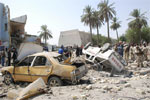
 AP: A key election for a new Iraqi parliament was underway Wednesday amid a massive security operation as the country continues to slide deeper into sectarian violence, more than two years after U.S. forces left Iraq.
The Associated Press
By Qassim Abdul-Zahra and Sameer N. Yacoub
BAGHDAD (AP) — A key election for a new Iraqi parliament was underway Wednesday amid a massive security operation as the country continues to slide deeper into sectarian violence, more than two years after U.S. forces left Iraq.
Hundreds of thousands of troops and police have fanned out to guard voting centers in what is also the first nationwide balloting since the 2011 American pullout. Polls across the Arab, energy-rich nation opened at 7 a.m. local time and will close at 6 p.m.
Iraq’s 22 million registered voters are electing a 328-seat parliament.
In central Baghdad, police and army manned checkpoints roughly 500 meters (yards) apart, while pickup trucks with machine-guns perched on top roamed the streets. Much of the city looked deserted without the normal traffic congestion that Baghdad is notorious for. Most stores were closed.
Voters are being subjected to multiple searches before they are allowed inside polling enters. Streets leading to the centers are blocked by police trucks and barbed wire.
“I decided to go and vote early while it’s safe. Crowds attract attacks,” said Azhar Mohammed as she and her husband approached a polling station in Baghdad’s mainly Shiite Karadah district. The 37-year-old woman in mourning black had just lost a brother – a soldier killed last week in the northern city of Mosul.
“There has been a big failure in the way the country has been run and I think it is time to elect new people,” she said.
Not far from where Mohammed was, Essam Shukr broke into tears as he remembered a son killed in a suicide bombing in Karadah last month. “I hope this election takes us to the shores of safety,” said the 72-year-old Shukr.
“We want a better life for our sons and grandchildren who cannot even go to playing areas or amusement parks because of the bad security situation. We want a better life for all Iraqis.”
A Shiite party led by Nouri al-Maliki, Iraq’s prime minister of eight years, is expected to win the most seats in Wednesday’s election but is unlikely to win a majority.
Al-Maliki will have to cobble together a coalition if he is to retain his job for a third four-year term, a tough task given the harsh criticism he has been under from his one-time Shiite, Sunni Arab and Kurdish allies.
Al-Maliki, a Shiite, rose from relative obscurity to office in 2006, when Iraq’s sectarian bloodletting began to spiral out of control, with Sunni militants and Shiite militias butchering each other’s communities.
Over the years that followed, Sunni tribes backed by the Americans rose up to fight al-Qaida-linked militants, while al-Maliki showed a readiness to rein in Shiite militiamen – and by 2008, the violence had eased.
But the Sunni-Shiite violence returned, stoked in part by al-Maliki. His moves last year to crush protests by Sunnis complaining of discrimination under his Shiite-led government sparked a new wave of violence by militants, who took over the city of Fallujah in the western, Sunni-dominated province of Anbar and parts of the provincial capital Ramadi.
Iraqi army and police forces battling them for months have been unable to take most areas back.
At the same time, many Iraqis increasingly complain of government corruption and the failure to rebuild the economy.
The violence has continued right up to the day before the vote.
On Tuesday, back-to-back bombs ripped through an outdoor market northeast of Baghdad, the deadliest in separate attacks that officials said killed 24 people. The largest election-related attack was last Friday in Baghdad, when a series of bombings killed at least 33 people at a campaign rally for a militant Shiite group, the Iranian-backed Asaib Ahl al-Haq.
A breakaway al-Qaida group, the Islamic State in Iraq and the Levant, claimed responsibility for that attack, as well as a suicide bombing northeast of Baghdad on Monday that killed at least 25 Kurds.


