


 Reuters: South Korea might ban Iranian petrochemical product imports following pressure from the United States to beef up sanctions against Tehran over its nuclear programme, sources said, although the measure would have a limited economic impact.
By Cho Mee-young
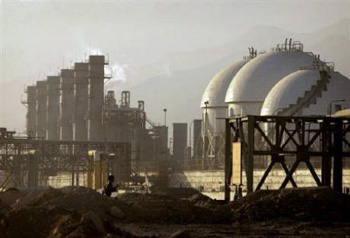 SEOUL, Nov 25 (Reuters) – South Korea might ban Iranian petrochemical product imports following pressure from the United States to beef up sanctions against Tehran over its nuclear programme, sources said, although the measure would have a limited economic impact.
Seoul is considering the sanctions following a two-day visit by the U.S. Undersecretary of State for Political Affairs Wendy Sherman, who discussed Iran.
The United States, Britain and Canada announced on Monday new sanctions against Iran in response to a report by the International Atomic Energy Agency suggesting Iran had worked on designing an atomic bomb.
The European Union agreed in principle on Tuesday to sanction some 200 Iranian people, companies and organisations and France mooted the idea of a Europe-wide ban on Iranian crude imports.
“We are cautiously considering an import ban on Iranian petrochemical products, and currently evaluating a possible impact of the ban,” one source said.
Petrochemicals that could be affected include butadiene, paraxylene and other intermediates produced by processing naphtha, another source said.
The sources declined to be identified as they were not authorised to speak to the media.
South Korea imported $350 million in Iranian petrochemicals last year, while exporting $450 million of its petrochemicals to Iran. That would represent a small part of South Korea’s global trade in petrochemicals, which last year totalled $49 billion.
“There is going to be a very miniscule economic impact for the two nations if Korea issues a petrochemical sanction,” said Jang Ji-Hyang, director of Middle East and North African studies, at the Seoul-based Asian Institute of Policy Studies.
“Even though Korea is one of the most prominent buyers of petrochemical products, the amount imported is not so significant for the Gulf nations.”
Sherman visited South Korea on Monday and Tuesday, South Korea’s foreign affairs ministry said. She discussed Iran nuclear issues during the trip. She was in Japan first and visited China after her stop over at Seoul.
U.S. VISIT
Sherman’s visit may have been aimed at building pressure on top consumers in the region to reduce their dealings with Iran.
Asian countries may be willing to go along with U.S. demands to a certain extent, but energy security will always come first.
“Countries would not want to antagonise the U.S., and if the U.S. puts pressure on them they might reduce imports slightly but nothing that would jeopardise energy security,” said, Hooman Peimani, head, energy security and geopolitics at the Energy Studies Institute in Singapore.
“South Korea, and to a lesser extent Japan, is in a unique situation because of North Korea and their dependence on the U.S. for security purposes.”
The United States has requested a ban on imports of Iranian petrochemicals, but not on exports, the second source at the economy ministry said.
On Thursday , South Korea’s foreign affairs ministry said in a media briefing that it was planning to determine additional sanctions after discussing the matter with related government offices.
“We plan to decide necessity and ranges of the ban, considering international circumstances including IAEA’s recent decision,” the ministry said.
In September 2010, South Korea blacklisted 102 companies, including the Seoul branch of Iran’s Bank Mellat, and 24 individuals accused of facilitating Iran’s efforts to develop nuclear weapons, while saying that it would ban investment and construction contracts in Iran related to petroleum resources.
U.S. and EU sanctions passed in 2010 stopped most Western banks dealing with Iran and pressure from Washington made it temporarily impossible for Indian oil buyers to pay for some $5 billion of Iranian oil earlier this year.
OPEC member Iran, the world’s No.5 oil producer, exports the largest volumes of oil to China, India, South Korea and Italy, but it will be Turkey, South Africa and Sri Lanka that struggle the most if they lose Iranian supplies.
Iran could have nearly $5 billion of cash trapped in South Korea by the end of the year as sanctions stop it repatriating money from oil sales, Korean government sources with direct knowledge of the situation told Reuters in August.
“As one of the country’s largest trade partners in the Middle East, it does not benefit South Korea to sour relations but the negative impact of standing opposite of the United States is even greater,” said Chang Byung-ock, director, Institute of Middle East Studies Hankuk University of Foreign Studies.
“As for Iran, the impact of sanctions imposed by South Korea alone may not be devastating, but a combined effort by Canada, U.S., Britain, and the EU will be.” (Additional reporting by Jumin Park and Iktae Park, Joonhee Yu in Seoul and Francis Kan in Singapore; Editing by Neil Fullick and Manash Goswami)


