


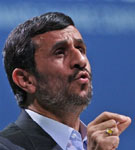
 AFP: Iranian President Mahmoud Ahmadinejad accused major world powers on Wednesday of looking for ways to “find excuses and to waste time” in talks over Tehran’s controversial nuclear programme.
By Mohammad Davari
 TEHRAN (AFP)— Iranian President Mahmoud Ahmadinejad accused major world powers on Wednesday of looking for ways to “find excuses and to waste time” in talks over Tehran’s controversial nuclear programme.
“Iran is ready to pursue negotiations in Moscow, and even in Beijing, and has made good proposals,” Ahmadinejad said in the Chinese capital, referring to talks set for later this month in Moscow amid claims by Tehran that the so-called P5+1 powers are dragging their feet on preparatory arrangements.
“But taking into account that, after a meeting in Baghdad and, in conformity with what was agreed, our efforts to arrange a meeting between the deputies of (EU foreign policy chief Catherine) Ashton and the deputy of (Iranian negotiator Saeed Jalili) have not been successful, we consider that the West is looking for excuses to waste time.”
Ahmadinejad’s remarks were posted on the government website.
Earlier on Wednesday, Jalili said Iran doubts the willingness of world powers to succeed in upcoming crunch talks in Moscow over its disputed nuclear programme.
“Delay by the other side in holding the meeting of experts and deputies is casting doubt and uncertainty on the willingness (of the P5+1) for success in the talks in Moscow,” state news agency IRNA quoted Jalili as saying.
Jalili, who made the comments in a letter to Ashton, the P5+1 lead negotiator, said: “The process of talks only for (further) talks is fruitless.”
Iran’s doubts were publicised a day after reports that it had sent two letters to Ashton deputy Helga Schmid asking for a preparatory meeting of experts as agreed in talks last month in Baghdad.
Iran’s Supreme National Security Council, which oversees the nuclear talks, found the EU response to the letters “unsatisfactory” and only touching on “general topics,” according to the reports.
Jalili, who is the council’s secretary, said he hoped the P5+1 (Britain, China, France, Russia and the United States, plus Germany) would be ready for the meeting between his deputy, Ali Bagheri, and Schmid to prepare an agenda for the talks in Moscow on June 18-19.
Ashton spokeswoman Maja Kocijancic told AFP in Brussels on Wednesday that to succeed in Moscow “engagement on substance is key, not the process.”
“The issue is of (a) political nature and we need (a) clear signal of Iranian readiness to engage on the substance” of proposals made by the P5+1 in Baghdad, she said.
“Ashton will take up the issue directly” with Jalili, she added without elaborating.
A diplomatic source close to the talks told AFP that further meetings at “technical” levels would serve no purpose, and that the Moscow meeting should be prepared by contacts at the highest level on substantive issues.
The last negotiations, held in Baghdad on May 23-24, exposed a gulf between the two sides’ positions that looked almost unbridgeable, and nearly caused the talks to collapse.
The priority issue for the P5+1 going into the Moscow round is convincing Iran to give up enriching uranium to 20 percent level, hand over its 20-percent stocks in a fuel-swap deal and shut down its Fordo plant, a mountainside bunker near Tehran.
Iran says it needs uranium enriched to 20 percent — just a few technical steps short of bomb-grade 90 percent — for a Tehran reactor that produces medical isotopes.
Western governments suspect Iran is intent on developing a nuclear weapons capability, a suspicion echoed by the International Atomic Energy Agency, which has identified a “possible military dimension” to some of Iran’s nuclear activities.
Iran insists its atomic work is for civilian purposes only.
The UN Security Council has issued six resolutions demanding Iran suspend all uranium enrichment. It has also imposed four sets of sanctions on Iran, which Western powers have hardened with their own tough economic sanctions.
Iranian officials had previously said they remained “optimistic” about the prospects for the Moscow talks, while admitting it would be “difficult” to achieve results immediately.
Ahmadinejad said last week that as much as Iran would like to see the nuclear dispute resolved, a “miracle” in Moscow was not on the cards.


