


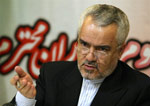
 AFP: The teachings of the Jewish book of law, the Talmud, are a driving force behind the international drugs trade, Iran’s First Vice President Mohammad Reza Rahimi said in comments reported on Wednesday.
  TEHRAN (AFP)— The teachings of the Jewish book of law, the Talmud, are a driving force behind the international drugs trade, Iran’s First Vice President Mohammad Reza Rahimi said in comments reported on Wednesday.
Rahimi’s remarks, at an international anti-drug conference in Tehran attended by many foreign diplomats on Tuesday, were a rare diatribe by an Iranian official targeting the Jewish faith, rather than the state of Israel.
The remarks were immediately slammed by Israel’s foreign minister, who also criticised the United Nations and European Union for sending representatives to the conference.
“The spread of narcotics in the world emanates from the teachings of the Talmud… whose objective is the destruction of the world,” Rahimi said in comments published by the official website of President Mahmoud Ahmadinejad as well as state media.
“The Talmud teaches that it is lawful to acquire wealth through legal and illegal means… which gives (the Jews) the right to destroy humanity,” he said.
“If one seeks what lies behind all forms of corruption, there is the repugnant face of Zionists. This is the same case for the narcotics trade … whose primary operator is the Zionist regime,” he said.
“The Zionists spread destruction not only by drugs, but also by (attacking) cultures.”
Iranian officials have repeatedly courted international outrage with tirades against the state of Israel but criticism of Judaism as a faith has been rare.
The Talmud is a book of oral tradition derived from the Jewish holy book, the Torah, that contains all the principles that govern daily life.
Ahmadinejad has said many times that the Jewish state is doomed to destruction, while supreme leader Ayatollah Ali Khamenei has branded it “a cancerous tumour that must be removed.”
In February last year, Iran accused Israel’s Mossad spy agency of promoting drug use in Iran by selling narcotics at cut price in the hope of weakening the regime.
In Israel, Foreign Minister Avigdor Lieberman issued a statement slamming the Iranian regime as composed of “anti-Semitic fanatics” and also criticised the presence of Western representatives at the conference.
“The Iranian regime is composed not of fools but anti-Semitic fanatics who have a clear strategy, with a detailed world plan, a central element of which — as they openly state — is the destruction of the state of Israel,” he said.
“The international community has not yet internalised the great danger that this regime represents for world peace,” he added.
Lieberman warned that the presence of international representatives at the conference “gives legitimacy to the regime of the ayatollahs, which poses a real threat to world peace.”
“Hitler said foolish things and succeeded in executing his plans. Today, the situation is different and the sovereign state of Israel will not allow a single Jew to be harmed,” he said.
And the Simon Wiesenthal Centre, a US-based group known for Nazi-hunting, described the remarks as “yet another example of the fact that anti-Semitism is a pillar of the mullahocracy in Tehran.”
Iran has long been a hub of drug trafficking from Afghanistan, with much of the substances bound for Western countries. Over two million Iranians consume narcotics, according to official estimates cited by the media.
Since the 1979 Islamic revolution, Iran has waged war against drug traffickers who make up half the population in Iranian prisons. Hundreds of them are executed each year.
More than 4,000 Iranian police officers and soldiers engaged in the battle have been killed over the last three decades, according to official figures.
Tehran’s anti-drugs efforts are regularly praised by the United Nations Office on Drugs and Crime.
However, the United States accuses some Iranian officials, particularly within the elite Revolutionary Guards, of facilitating the transit of drugs produced in Afghanistan in exchange for the services of drug lords in its eastern neighbour.


