


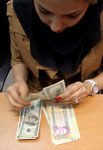
 New York Times: Western economic sanctions imposed on Iran over its disputed nuclear program have severely depressed the value of its national currency, the rial, causing higher inflation and forcing Iranians to carry ever-fatter wads of bank notes to buy everyday items. The New York Times
By RICK GLADSTONE
 Western economic sanctions imposed on Iran over its disputed nuclear program have severely depressed the value of its national currency, the rial, causing higher inflation and forcing Iranians to carry ever-fatter wads of bank notes to buy everyday items. But the sanctions have also presented a new complication to Iran’s banking authorities: they may not be able to print enough money.
At least three European companies that have been providing currency production services to Iran say they have stopped doing business there. One of the companies, Koenig & Bauer AG of Würzburg, Germany, also says it has not responded to an Iranian request for bids to make presses to print new rials.
Koenig & Bauer’s disclosure was contained in a mailed response to a query by United Against Nuclear Iran, a New York-based sanctions advocacy group, which seized upon the 40 percent drop in the rial’s value this month to begin a campaign aimed at the currency itself.
The group began by pressing the Europe-based bank note industry, which has historically counted Iran as a client, to further ostracize the country by denying its central bank the basics of a functioning currency system: the printing presses, engraving paper, anticounterfeiting technology and other services needed to provide enough rials.
“By manipulating and increasing the printing volume of the rial, the regime can bolster its floundering currency and mask the disastrous impact of its political decisions, economic mismanagement and isolation,” Mark D. Wallace, the chief executive of United Against Nuclear Iran, said in announcing the campaign.
In letters to Koenig & Bauer and two other companies in the bank note business, De La Rue P.L.C. of Hampshire, England, and Flint Group of Luxembourg, he said that European Union sanctions already prohibit Europe-based bank note companies from providing such services to Iran’s central bank.
Rob Hutchison, a spokesman for De La Rue, said on Tuesday in a telephone interview, “We don’t provide technical support or services to Iran.”
Nathan Carleton, a spokesman for United Against Nuclear Iran, said in an e-mail that it had been contacted on Tuesday by Flint Group, which said it was no longer active in Iran.
As inflation erodes the rial’s purchasing power, Iran’s central bank must increase the supply of money, which risks hyperinflation, a cycle of rising prices and rising volumes of money in circulation. Denying the bank’s ability to increase the supply of money would theoretically hasten an economic crisis.
Some economists, however, say the campaign to restrict rial circulation may have the unintended consequence of helping Iran. They point to hyperinflation in the former Yugoslavia from 1992 to 1994 and Zimbabwe in 2007 and 2008. In both cases, the authorities could not print money fast enough to outpace their currency’s falling value and the systems collapsed; Yugoslavs began using a new currency tied to the German mark, and Zimbabweans used a currency tied to the American dollar. And the cycle of higher prices ended.
Steve H. Hanke, an economist at Johns Hopkins University, said that in Iran’s case, limiting the amount of rials in circulation “would solve the biggest problem they have: inflation.”
But Mr. Wallace said that in Iran’s economic system, the authorities “must maintain the ability to manipulate their money supply and must maintain the integrity of their currency.” Without sophisticated security and printing technology, he said, “Iran may not be able to do either — hastening the demise of the rial.”


