


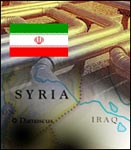
 New York Times: When Syria’s agricultural minister, Subhi Ahmad al-Abdullah, arrived in the Iranian capital for a visit last week, everybody involved stuck to a well-worn script. The New York Times
By THOMAS ERDBRINK
 TEHRAN — When Syria’s agricultural minister, Subhi Ahmad al-Abdullah, arrived in the Iranian capital for a visit last week, everybody involved stuck to a well-worn script.
There were welcoming ceremonies, handshakes in front of cameras and tête-à-têtes on rococo chairs. Stern-faced Iranian and Syrian officials discussed “expanding economic and agricultural ties” and signed a contract for the joint production of a vaccine for foot-and-mouth disease.
The unrest in Syria did not go unmentioned in the meetings, which were widely reported by Iranian state media. Iran’s vice president, Mohammad-Reza Rahimi, said Iran was confident of victory for the Syrian government forces, who, he said, were engaged in “sporadic fights with terrorists sent by regional countries.”
The upbeat ceremonies surrounding Mr. Abdullah’s visit illustrate how Iranian leaders perceive the bloody conflict that has engulfed their main ally in the Arabic world. While former Iranian diplomats, academics and analysts increasingly warn that President Bashar al-Assad’s government is on the brink of collapse, the country’s highest leaders insist the conflict is manageable and ultimately will be resolved to Iran’s advantage.
“We say that Bashar al-Assad, or at least his government, is the safest bet for stability and security in Syria,” said Amir Mohebbian, a political analyst whose views are sometimes published on the Web site of Iran’s supreme leader, Ayatollah Ali Khamenei. “If the foreign mercenaries take over, there will be a blood bath in Syria.”
Endless news broadcasts by Iran’s state television offer an ideological narrative in which Saudi Arabia and Qatar are doing the bidding of the United States and Israel, helping to arm foreign “terrorists” and sending them into Syria to punish it for having opposed Israel. War crimes committed by Syrian forces go unreported.
“Clearly, there is no real alternative for al-Assad and his government in Syria,” Mr. Mohebbian said. “They have agreed to reforms; there will be a multiparty system in Syria. So foreign countries should stop arming terrorists and let the Syrian people decide their own future.”
Some former diplomats, analysts and academics disagree with the blind support of Syria’s government. But they have little, if any, influence on Iran’s policy makers, who are mostly rigid ideologues.
“The Syrian Army is on the brink of complete collapse, and the downfall of al-Assad is inevitable,” Ebrahim Yazdi, a former foreign minister who is a member of the opposition, wrote Saturday in the newspaper Etemaad, which is critical of Iran’s government. “Syria’s leaders respond to reforms with bloody crackdowns. Their future is very bleak.”
Mashallah Shamsolvaezin, a Middle East analyst who has been imprisoned for his involvement in Iran’s opposition movement, echoed that view. “In reality, Syria will be in turmoil for years to come,” he said. “There will be nothing left of our anti-Israel front.”
Iran has organized two conferences for what it calls the “genuine” Syrian opposition, pushing for modest political changes, followed by nationwide presidential elections in 2014, as the only solution to stop the fighting.
Off the record, Iranian officials sometimes hint that Mr. Assad, as a symbol, could be sacrificed in Iran’s future vision for the country. But they insist that his political and security apparatus should remain in power, continuing to lead Syria as a regional spear against Iran’s archnemesis, Israel.
“We are seeking a peaceful solution in which the Syrian government implements reforms,” said Hamidreza Taraghi, a politician who is close to Iran’s leaders. “But whatever the cost, we want to keep Syria in the group of resistance against Israel.”
Mr. Taraghi, who recently led an Iranian delegation to North Korea and met with the country’s leader, Kim Jong-un, said that Iran was willing to do “whatever it takes” to keep Syria as an ally. He said the Syrian government had not yet asked Iran for military help, but if that happened Iran would be compelled by its treaty with Syria to step in.
The United States has accused Iran of providing weapons and money to Syria. Iran has always denied any military presence and military assistance, saying Mr. Assad does not need help in quelling the unrest.
There are signs, however, of some Iranian military involvement in the country. On Saturday, Iran’s Tabnak Web site claimed that military advisers, together with Russians in Syria, had suggested that the Syrian Army should pre-emptively attack opposition forces, who, the Web site claimed, were planning to attack Damascus from four sides.
In August, 48 Iranians were taken captive by Syrian resistance fighters who accused the men of being members of the Islamic Revolutionary Guards Corps. One of the kidnapped Iranians, identified by Iranian news media as Majid Adeli, a cultural adviser at the Iranian Embassy in Damascus, was released on Saturday. Iran insists the other captives are Shiite pilgrims.
On Saturday, Iran’s deputy minister of science, Mohammad Mehdinejad, told the Iranian Student News Agency that the country had sent drones to Syria but did not elaborate on how many.
“This is a fight between common people defending their homeland and foreign terrorists,” Mr. Taraghi said. He was sure that Iran’s main ally would soon be ready to face Israel again. “Syria’s army and security forces are still intact,” he said, “and they can be rebuilt in order for Syria to regain its former strength.”
During a conference on Syria organized by former diplomats in Tehran last week, Sadegh Zibakalam, a professor of international relations at Tehran University, shocked his audience by publicly criticizing Iran’s support for the Syrian government.
“What sort of foreign policy do we have that we support a regime that will be gone in one or two months?” he said. Mr. Zibakalam criticized those in power, saying that foreign policy must be based on national interests and not on ideology.
But even opposition figures say the government has no choice but to stick with the current Syrian leadership to the bitter end. “That way,” Mr. Shamsolvaezin said, “we can at least influence the unrest that will inevitably follow his downfall.”


