


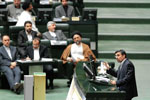
 Wall Street Journal: President Mahmoud Ahmadinejad presented measures to counter international sanctions that he said were hurting the nation’s economy, as United Nations envoys tried to restart nuclear talks that could ease those penalties. The Wall Street Journal
By FARNAZ FASSIHI
 BEIRUT—President Mahmoud Ahmadinejad presented measures to counter international sanctions that he said were hurting the nation’s economy, as United Nations envoys tried to restart nuclear talks that could ease those penalties.
During a rare parliamentary appearance Wednesday, Mr. Ahmadinejad told lawmakers Iran must wean itself from oil revenue, better tap the country’s rich natural resources, such as its mines and forests, further cut government subsidies, and raise cash handouts to citizens.
Mr. Ahmadinejad said Iran faced three options in dealing with the West: submit to pressure, continue the status quo, or embark on major overhaul of its economy. He said the only viable choice was the last one.
“Sanctions have definitely created some problems….Our enemies want to pressure the people in order to take revenge,” Mr. Ahmadinejad said, according to a transcript of his speech posted on official Iranian media. “They also want to squeeze the government’s budget to derail our country’s progress.”
Some lawmakers criticized Mr. Ahmadinejad’s address, saying a president with only six months left in office couldn’t implement such ambitious plans.
Some said Mr. Ahmadinejad’s speech was intended to boost the chances that an ally—possibly his adviser Esfanidar Rahim Mashaei—be elected in June presidential elections. Mr. Ahmadinejad, who has been in power for eight years, isn’t eligible to run for a third term.
The president had invited himself to speak at the Parliament and insisted on speaking in a public session over some lawmakers’ objections.
“Our ears are tired from hearing these empty promises of reducing dependence on oil revenues and bringing oil money to people’s tables….All of it is repetitive chatter,” said Gholamali Jaffarzadeh, a lawmaker from Rasht, said Mehr News Agency.
Iran’s economy has deteriorated in the past year due to sanctions aimed at targeting its oil and banking sectors and what critics say is mismanagement. Oil sales have dropped by nearly half and inflation rates and unemployment are rising.
Meanwhile, officials from the U.N.’s nuclear watchdog, the International Atomic Energy Agency, began talks in Tehran with Iranian officials to find a framework for it to inspect the country’s nuclear program, which Western nations say is aimed at building weapons. Iran says its nuclear program is only for peaceful energy purposes.
IAEA inspectors are pushing for access to the Parchin military base, located southeast of Tehran. So far, Iran has denied the request, saying its military bases are off-limits.
Iran’s foreign ministry spokesman, Ramin Mehmanparast, said Iran had reached a deal on an undisclosed date to restart nuclear talks with the so-called five plus one countries—permanent members of the U.N. Security Council plus Germany. Earlier talks fell apart last summer. The location for talks wasn’t set, Mr. Mehmanparast said, according to official Iranian media.
Analysts said that Mr. Ahmadinejad’s blunt acknowledgment in his speech that sanctions were crippling the economy is a signal that Iran is seeking a deal. “Iranian officials have concluded that they are at an economic dead end and would really like to negotiate. They just haven’t figured out how and where to compromise yet,” said Fereydoun Khavand, an economy professor specializing on Iran at Université Paris Descartes.
However, it remains unclear whether the West’s strategy of economic pressure will coerce Iran into a nuclear compromise. The country’s leadership has given mixed signals, and any deal would need approval by Supreme Leader Ayatollah Ali Khamenei.
After his address, Mr. Ahmadinejad rushed out of Parliament, citing shortage of time, while declining to hear lawmakers’ reaction to his plan. The Parliament and Mr. Ahmadinejad have a strained relationship, with each blaming the other for overstepping powers. Lawmakers tried to start the process of impeaching Mr. Ahmadinejad last year, but backed off when Mr. Khamenei intervened.


