


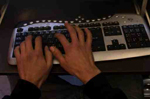
 AP: From a computer keyboard in London, an Iranian emigre plays the role of counselor, social media guru and all-around adviser for Internet users back home seeking ways around the cyber-blocks set up by authorities in Tehran. Associated Press
By NASSER KARIMI and BRIAN MURPHY
TEHRAN, Iran (AP) — From a computer keyboard in London, an Iranian emigre plays the role of counselor, social media guru and all-around adviser for Internet users back home seeking ways around the cyber-blocks set up by authorities in Tehran. These have been busy days.
His Twitter account – which goes under the handle of Nariman Gharib – registers a steady stream of calls for help from Iran and responses about new proxy servers, dial-up modems and other possible workarounds. The goal is to defeat Iran’s Internet clampdowns, which have intensified in the approach to presidential elections on June 14.
“Here is a new link for Siphon,” he wrote, describing a site that directs users to a server outside Iran. Minutes later, replies stream back that it worked on Android systems but not PCs. He sent a tweaked Web address.
“Hope this works,” he wrote.
State controls on the Internet in Iran are nothing new. Authorities have steadily tried to choke off social media and political opposition sites – among others – since they became tools for protesters alleging vote rigging after President Mahmoud Ahmadinejad’s disputed re-election four years ago.
Now, with the election to pick Ahmadinejad’s successor looming, the constraints are drawing even tighter. Iranian authorities appear to be stepping up their efforts to block the pathways to servers outside Iran that open access to outlawed sites such as Facebook, the BBC’s Persian service and websites from what’s left of Iran’s opposition Green Movement.
The Internet squeeze signifies more than a display of widening state controls before an election that is almost certain to bring an establishment-friendly winner. It’s also another showcase of Iran’s expanding online prowess led by the powerful Revolutionary Guards.
A special Web-watching corps established two years ago has the mission of patrolling the domestic Internet and fighting suspected cyberwars with the West and its allies. Some say it even creates false activist profiles to try to ferret out dissidents.
Iran is believed by many security experts to be behind computer-virus attacks last year on Saudi Arabian state oil giant Saudi Aramco and Qatari natural gas producer RasGas. Last week, The New York Times reported that Iran is considered a chief suspect in a series of malware breaches into U.S. energy companies, citing American officials and corporate security experts. Iran has repeatedly denied similar claims.
But Iran also has been hit by viruses it claims were launched by the U.S. and Israel. A date-siphoning program known as Flame forced Iran’s Oil Ministry to completely shut down its computer system last year. Three years ago, Iran’s uranium-enrichment labs were penetrated by a virus called Stuxnet, which was tailored to disrupt Iran’s nuclear centrifuges.
On Sunday, Iran inaugurated a 5,000-kilometer (3,000-mile) fiber-optic line running to Germany via Russia. Iran’s North Korean-educated communications minister, Mohammad Hasan Nami , said it will boost the “security” of telecommunications as part of Iran’s wider efforts to seek a self-contained Internet with its own Google-style search engines and vetted websites such as Twitter and Facebook accounts attributed to Supreme Leader Ayatollah Ali Khamenei.
“Iranian authorities are getting better at controlled cyberspace,” said Theodore Karasik, a security and political affairs analyst at the Dubai-based Institute for Near East and Gulf Military Analysis. “But Iran’s Internet generation is very clever at beating them at their own game.”
The legions of well-educated and highly Web literate Iranians under 30 are the backbone of a kind of cyber-underground. Names and Web addresses of proxy server sites that allow users to sidestep controls are passed around like hot gossip. Lately, however, authorities appear to be gaining the upper hand.
Each morning, Hossein Razaei, a mechanical engineer who runs a small engineering company in Tehran, checks up on the best-working path to beat the censors. Sometimes that means scanning banned news sites such as Voice of America or connecting to foreign engineering firms to look at new ideas.
“Nowadays,” he laments, “we cannot open many sites.”
Iranian authorities have not commented directly on any possible new Web controls. Some lawmakers have suggested that Web restrictions are needed to prevent “enemies” – a reference to U.S. and allies – from influencing the election.
But Iran’s leaders certainly have factored in the chaos in 2009, which marked Iran’s worst domestic unrest since the 1979 Islamic Revolution.
It also was a precursor to the Arab Spring in the use of social media. Sites such as Facebook and Twitter – still relatively obscure in the region at the time – were essential to organizing protests and giving accounts of crackdowns after blanket media restrictions were imposed. A YouTube video of a dying protester, Neda Agha Soltan, became an iconic image of the demonstrations.
Ironically, the latest apparent Internet pressures in Iran are not reflected in fears of rising opposition linked to the election. The rejection of former President Akbar Hashemi Rafsanjani from the ballot seemed to undercut a possible resurgence of reformist fervor after years of arrests and relentless intimidation.
Many liberals and others may now simply stay on the sidelines as most of the eight candidates represent firm loyalists to the Islamic system, including top nuclear negotiator Saeed Jalili, former Foreign Minister Ali Akbar Velayati and Tehran Mayor Mohammad Bagher Qalibaf. Two relatively moderate candidates, including a former vice president under reformist President Mohammad Khatami, have not yet generated much popular buzz.
Last week, U.S. Secretary of State John Kerry noted “troubling signs” that the Iranian government is cutting off Internet access to stifle criticism of how the candidates were chosen.
“Ultimately, the Iranian people will be prevented not only from choosing someone who might reflect their point of view, but also taking part in a way that is essential to a kind of legitimate democracy,” he said.
Khamenei said Monday that Kerry’s criticisms weren’t “worthy enough” to merit a response, according to the semiofficial Fars news agency. Then he vowed Washington would be “punched in the mouth” by a high turnout for the election.
At an Internet cafe in Tehran, a former activist during the 2009 unrest, Mohammad Feizi, spoke in dark tones about an election in which he feels no stake and Internet crackdowns that cut off his main window to the wider world. His old tricks of bypassing the Web controls, he said, are increasingly foiled.
“I am really frustrated,” the 27-year-old said. “The government put lethal restrictions on the Internet, yet expects people – particularly the youth – to get involved in society. It is meaningless.”
—
Murphy reported from Dubai, United Arab Emirates.


