


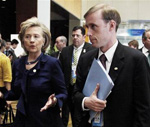
 AP: Last year, while Jake Sullivan was traveling with his boss, Secretary of State Hillary Clinton, he quietly disappeared during a stop in Paris. He showed up again a few days later, rejoining Clinton’s traveling contingent in Mongolia.
The Associated Press
By JULIE PACE – AP White House Correspondent
WASHINGTON (AP) — Last year, while Jake Sullivan was traveling with his boss, Secretary of State Hillary Clinton, he quietly disappeared during a stop in Paris. He showed up again a few days later, rejoining Clinton’s traveling contingent in Mongolia.
In between, Sullivan secretly jetted to the Middle Eastern nation of Oman to meet with officials from Iran, people familiar with the trip said. The July 2012 meeting is one of the Obama administration’s earliest known face-to-face contacts with Iran and reveals that Sullivan – who moved from the State Department to the White House earlier this year – was personally involved in the administration’s outreach to the Islamic republic far earlier than had been reported.
Senior administration officials had previously confirmed to The Associated Press that Sullivan and other officials held at least five secret meetings with Iran this year, paving the way for an interim nuclear agreement signed in November by Iran, the United States and five other world powers.
The cloak-and-dagger diplomacy may seem like a tough assignment even for a grizzled foreign policy veteran, but Sullivan is just 37 and looks even younger. Even-keeled and pragmatic, Sullivan’s temperament mirrors that of President Barack Obama, people close to him say. That helped him crack the tight-knit foreign policy team at the White House where he serves as Vice President Joe Biden’s national security adviser.
While Biden is a possible presidential candidate in 2016, Sullivan remains loyal to Clinton and is seen as her likely pick for White House national security adviser, should she run for president and win.
“He’s essentially a once-in-a-generation talent,” said Philippe Reines, a longtime Clinton aide who worked closely with Sullivan during their tenure at the State Department.
Sullivan has a gleaming resume: undergraduate and law degrees from Yale, Rhodes scholar at Oxford, and clerk for Supreme Court Justice Stephen Breyer. He entered politics by serving as chief counsel to Democratic Sen. Amy Klobuchar of Minnesota, Sullivan’s home state.
During the bruising 2008 Democratic primary, Sullivan sided with Clinton, serving as a top adviser on her debate preparation team. But he switched to Team Obama during the general election, taking on a similar role on the debate team.
When Obama tapped Clinton to lead the State Department, Sullivan followed the new secretary to Foggy Bottom. He had a pair of high-level titles – deputy chief of staff and director of policy planning – and quickly became known as one of Clinton’s most trusted advisers. He traveled with her to nearly all of the 112 countries she visited as secretary and played a leading role in shaping U.S. policy toward Libya and Syria, as well as the historic opening of relations with the isolated Asian nation of Myanmar.
Clinton, whose daughter Chelsea is just four years younger than Sullivan, would sometimes turn motherly with her young adviser, openly worrying that the single Sullivan’s work schedule wasn’t leaving him enough time to date.
After Clinton announced she would leave the State Department after the first term, Obama advisers began courting Sullivan for a job at the White House. They hatched plans for Sullivan to have more face time with the president, including when Obama and Clinton headed to Asia in November 2012 for their final trip together as president and secretary of state.
Former White House national security adviser Tom Donilon said that after that trip, Obama gave him “direct instructions that Jake was a person he wanted to retain.”
But Sullivan was weighing other options, including a possible run for Congress back in Minnesota. It took cajoling from several high-level White House staffers and personal phone calls from both Obama and Biden to coax Sullivan to the White House.
As the vice president’s top foreign policy aide, he has overseen Biden’s increased outreach to Latin America and Asia. But he also has become a key player on the president’s national security team, participating in Obama’s daily briefings and deepening his involvement in the secret Iran talks he started at the State Department.
In March, just one month after starting at the White House, Sullivan secretly boarded a military plane and headed back to Oman. This time he was joined by deputy secretary of state William Burns, one of the nation’s most seasoned diplomats and a mentor to Sullivan. Waiting for them in Oman was a small handful of senior Iranian officials, wary but also curious about the possibility of a thaw in relations between the longtime adversaries.
Sullivan’s contacts with the Iranians in 2012 and early 2013 were largely focused on logistics and finding out whether Americans and Iranians could even get in the same room together. But after Iranians elected a new, more moderate president this summer, the meetings quickly morphed into substantive discussions about ways to tame Iran’s disputed nuclear program.
“By the early fall, I think it became clear to all of us that there was an opportunity,” Burns said in an interview. “But neither Jake nor I underestimated the difficulty.”
Perhaps the most important quality the understated Sullivan brought to the clandestine diplomacy: an ability to disappear and reappear while drawing little notice. Only a small handful of people were aware of the secret Iranian talks, leaving even those close to Sullivan in the dark.
Reines, who traveled with Clinton and Sullivan on the July 2012 trip, said he remembered his colleague slipping away and resurfacing in Mongolia, but only learned why in recent weeks.
Sullivan wouldn’t comment on his outreach to Iran and declined to be interviewed for this story. But a speech he gave at the University of Minnesota last year provides some insight into how he views his quick rise in Washington and his view of public policy as a “study in imperfection.”
“Our government – any government, any organization – is the sum of the human beings who operate it, who bring with them all their faults, foibles, and frailties, and all of their creativity and cleverness,” he said.


