


On June 7, Hossein Akbari, Deputy of Natural Environment and Biodiversity at the Department of Environmental Protection Agency of Isfahan Province in Iran touched on one aspect of the country’s environmental disasters due to the mullahs’ rule. “During the past year alone, seven million cubic meters of ‘sewage and wastewater’ were temporarily released into the ‘Gavkhuni’ wetland, along with eight million cubic meters of water. This, however, proved to be ineffective,” he said.
Akbari explained that based on satellite images, the Gavkhuni wetland is “completely” dry, and maybe a mere two or three percent of its northern part is “slightly moist.”
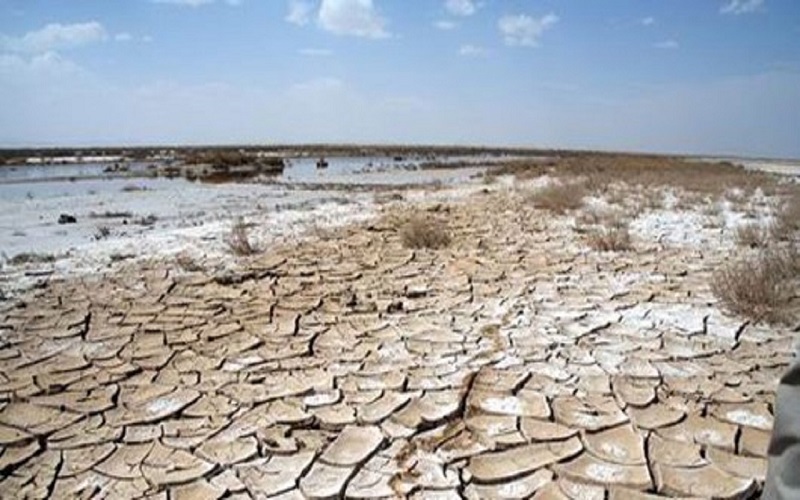
Last August, Mansour Shisheforoush, the Director of Crisis Management of Isfahan Governorate, had also announced that 98 percent of the Gavkhuni wetland had dried up.
Gavkhuni, one of Iran’s most famous international wetlands, spans across Isfahan and Yazd provinces in central Iran and is considered one of the country’s largest and most important wetlands, serving as a habitat for migratory birds and aquatic animals.
This wetland used to be nourished by the Zayandeh Rud, the largest river in central Iran. In recent years, however, as a result of dam construction and the subsequent drying up of Zayandeh Rud, this wetland has also almost dried up.
In recent years, numerous reports have been published on the destruction of Iran’s wetlands and lakes, and experts have attributed this catastrophe to mismanagement, uncontrlled dam construction, and unsustainable policies alongside drought.
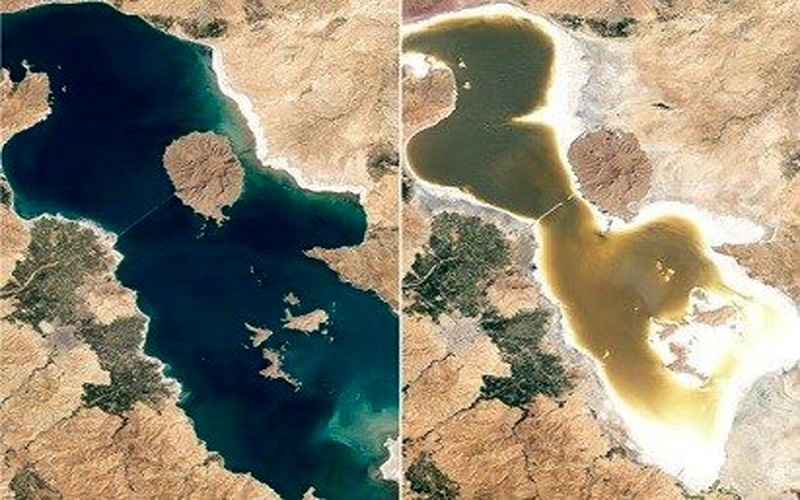
The Iranian regime’s destructive policies in recent years have led to numerous environmental disasters. These policies have caused Lake Urmia, the world’s second-largest saltwater lake located in northwest Iran, to dry up and witness its final days.
Historical mosques in Isfahan “have sunk” due to land subsidence
According to a report by the regime’s “Ham-Mihan” newspaper on Wednesday about the continuation of land subsidence in Isfahan, “all areas” of the city have been affected, including areas near the historical monuments of Isfahan.
Based on the report, due to drought and a decrease in groundwater levels, the phenomenon of subsidence is progressing at a faster rate than expected and has reached downtown Isfahan.
An archaeology expert who, according to “Ham-Mihan,” wished to remain anonymous, mentioned that structures such as the “Hakim and Atiq Mosque, Imam Gate, Vazir Bath, the Ali-Qoli Agha Mosque and Bath, and the Seyed Mosque” have all been affected by subsidence.
He considers “long vertical cracks” in these structures as signs of subsidence, adding that evidence of this phenomenon can also be seen on the Hafez and Sepah entrances to the city’s famous Naghsh-e Jahan Square, as well as on the domes and walls of the historic Jameh Abbasi Mosque.
Meanwhile, in an interview with the semi-official Mehr News Agency, Alireza Izadi, Director-General of the Isfahan Province Cultural Heritage, claimed that the cracks in structures such as Seyed Mosque and Jameh Abbasi Mosque are not related to subsidence and are “natural cracks” due to their brick and adobe structure.
However, Izadi acknowledged subsidence in northern areas of Isfahan, adding that due to its close proximity to the city’s historic monuments there is “no guarantee” that subsidence will not affect the all-important sites.
On the other hand, the Director of Cultural and Communications Affairs of Isfahan’s Cultural Heritage Organization has told Ham-Mihan daily that with the continuation of drought and the failure to establish a continuous flow of the Zayandeh Rud River, further subsidence will spread further in downtown Isfahan, describing it as an “incurable disease.”
The report, citing the head of the Seismology and Engineering and Vulnerability section of the Research Center for Roads, Housing, and Urban Development, indicates that more than “2.7 million people” live in the “subsidence zones” of Isfahan, and over 400 registered historical buildings are located in these areas.
Iran’s heavy industries, including steel, petrochemical and military complexes, are another factor that is depleting Iran of its waters.
One solution lies in investing in Iran’s farming industry and transforming this highly potential sphere into mechanized farming to provide produce suitable to Iran’s land and climate.
However, the mullahs’ regime is busy wasting billions of dollars in pursuit of nuclear weapons, ballistic missiles, supporting regional terror groups, and meddling in Iraq, Lebanon and …
Iran is also plagued by corrupt officials heavily involved in plundering the country’s water resources to sell abroad and pocket the hefty profits themselves.


