


 Washington Post: The chief U.N. nuclear official said Wednesday he is launching a new effort to resolve questions about alleged atomic weapons research by Iranian scientists, hinting at a firmer stance by the U.N. watchdog agency in seeking answers from Iran about its nuclear intentions.
The Washington Post
By Joby Warrick
Washington Post Staff Writer
Thursday, May 6, 2010; A13
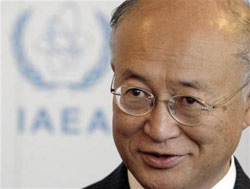 UNITED NATIONS — The chief U.N. nuclear official said Wednesday he is launching a new effort to resolve questions about alleged atomic weapons research by Iranian scientists, hinting at a firmer stance by the U.N. watchdog agency in seeking answers from Iran about its nuclear intentions.
Yukiya Amano, who became director general of the International Atomic Energy Agency in December, said he is also pressing Iran for more robust monitoring of a nuclear facility that began producing a higher grade of enriched uranium this year. U.S. officials fear that the facility could shorten Iran’s path to nuclear weapons if the country’s leaders choose to make them.
In his first interview with a U.S. news outlet since taking office, Amano asserted that he is not sure whether Iran intends to acquire the bomb. But the Japanese diplomat repeatedly stressed the need for Iran to be transparent about its nuclear activities. That, he said, would include a full accounting of dozens of scientific papers and databases — most of them obtained by Western spy agencies in the past decade — that appear to show secret research on nuclear warheads.
“What we want to do is to sit down with our Iranian partners and jointly clarify these activities,” said Amano, who is in New York to attend a nuclear Non-Proliferation Treaty review conference. “If the concerns are removed, that will be very nice. If not, we need to ask for measures to remedy the situation.”
Longtime observers of the IAEA have credited Amano with taking a harder line toward Iran and other countries accused of failing to comply with commitments under the 189-nation Non-Proliferation Treaty (NPT). In February, the first IAEA inspection report on Iran under Amano’s leadership used uncharacteristically blunt language in calling for Iran to clear up questions about past — and possibly ongoing — weapons research.
Amano, whose soft-spoken style contrasts sharply with that of his predecessor, Egyptian diplomat Mohamed ElBaradei, dismissed suggestions that he is being tougher with Iran.
“It is not a question of being tough, or not,” he said. As IAEA chief, Amano said, he is “bound by IAEA statutes” and must “stick with principles.” He added that he has met with senior Iranian nuclear officials, and he pledged to continue to engage in a respectful diplomacy, which he says means “to talk quietly and listen.”
But on the question of the possible weapons research, he chided Iran for failing for years to respond to serious allegations that he said were based on “very extensive information . . . from multiple sources.” He said the agency was reopening the issue and would press Iranian leaders to provide explanations.
Iran says it has no interest in nuclear weapons, and it contends that many of the papers in dispute are forgeries. Iranian nuclear officials have consistently rebuffed attempts by IAEA officials to interview key scientists involved in the alleged research.
Iran’s refusal to disclose nuclear activities resulted in two major clashes with the U.N. watchdog in the past year. Iran was criticized in September after being forced to reveal the existence of a uranium enrichment plant built in a mountain tunnel near the city of Qom. And in February, Iran unilaterally decided to begin making a higher grade of enriched uranium at a plant near the city of Natanz, without giving IAEA officials time to put a monitoring system in place. Until this year, Iran’s nuclear program produced only uranium with an enrichment level of less than 5 percent, the level needed for commercial nuclear reactor fuel. But now Iran is also churning out uranium enriched to 20 percent, saying the higher-grade product is needed to fuel a reactor that makes medical isotopes. Ninety percent enrichment is needed for nuclear weapons.
Amano said in the interview that Iran has not yet agreed to IAEA requests for a special monitoring regime for its fuel enriched to 20 percent. The agency typically seeks to install cameras and other technical systems to ensure that a country is not cheating on its enrichment program or diverting uranium for possible use in weapons.
Talks with Iranian officials in recent days have yielded “some good progress, but we have not had a resolution,” Amano said.
“If this continues for a long time, we may have a problem,” he said. He said that the IAEA is monitoring the site but that “our arrangement is not proper as of today.”
Separately, during an NPT conference session on Wednesday, Amano asked for international input on how to persuade Israel to join the treaty, a move that could add to pressure on the Jewish state to disclose its unacknowledged nuclear arsenal. In a letter made available to the Associated Press, Amano asked foreign ministers of the IAEA’s 151 member states to share views on how to implement a resolution demanding that Israel “accede to the” treaty and open its nuclear facilities to IAEA oversight.
The letter comes amid renewed Arab criticism of Israel during the New York conference. On Tuesday, Muslim nations made repeated calls for a nuclear-free Middle East, while criticizing Israel for not divulging its nuclear capabilities and refusing to sign the nonproliferation pact.


