


 Washington Post: The United States and its allies are swiftly tightening an economic cordon around Iran by imposing new strictures that could inflict far more economic pain on the Islamic republic than previous sanctions.
The Washington Post
By Glenn Kessler
Washington Post Staff Writer
Friday, June 18, 2010; A19
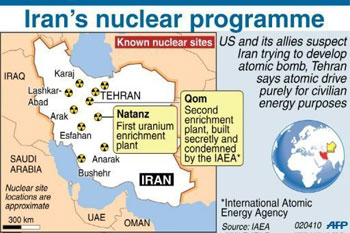 The United States and its allies are swiftly tightening an economic cordon around Iran by imposing new strictures that could inflict far more economic pain on the Islamic republic than previous sanctions.
On Thursday, European Union governments agreed to ban companies from investing in or otherwise assisting Iran’s oil and gas industry — measures that went well beyond a U.N. Security Council resolution last week that reiterated international demands that Iran forswear nuclear weapons. Along with the United States, Australia, Japan, South Korea and other countries are set to adopt or strengthen their own sanctions against trading with Iran.
The cascading effect appears to validate the Obama administration’s strategy of accepting a watered-down U.N. resolution, with a less-than-unanimous vote, to move to the next stage in the confrontation with Iran: tough unilateral sanctions imposed by individual nations.
The goal, Western diplomats and U.S. officials say, is still to get Iran back to the negotiating table. But there are important secondary goals: deterring an Israeli military strike against Iran’s nuclear sites, which could inflame the region; reassuring Arab allies that the rise of Iran is being checked; and signaling to other countries considering building a nuclear weapon that there can be real costs to doing so.
Costs and benefits
So far, Iran’s leaders have shown no inclination to negotiate seriously over its nuclear program, which they say is entirely peaceful. But some U.S. officials detect what they say are exploitable fissures within Iran’s leadership.
“The sanctions are not an end unto themselves; they are a means to an end,” said Robert Einhorn, the senior State Department official in charge of implementing the sanctions. “They will make it harder for Iran to support their nuclear and missile ambitions, and hopefully they will alter Iran’s calculation of costs and benefits and encourage them to negotiate much more seriously with us than they have in the past.”
U.S. and European officials acknowledge that the administration’s gambit faces uncertainties.
China, for instance, could swoop into Iran to replace Western investors. “China is the elephant in the room,” one diplomat said, but the hope is that China will face political pressure not to appear to profit from an international pullout. Officials also say China cannot replicate some of the technologies and products produced in Europe.
The E.U. sanctions are potentially significant because Europe is Iran’s biggest trading partner. There is more than $30 billion in annual trade between Iran and the 27 E.U. nations, in contrast to the minimal trade with the United States.
The Europeans acted with unusual dispatch, a week after the U.N. vote and with a goal of crafting the final rules by July 26. Generally, it has taken Europe seven to eight months to write laws implementing a U.N. sanctions resolution. But officials said that the Obama administration’s unrequited efforts at engagement with Iran, the exposure last year of another secret Iranian nuclear facility and the bloody crackdown on post-election demonstrations in Iran had combined to shift attitudes in European capitals.
Human rights issues
Some European nations most skeptical of sanctions, such as Sweden, are also concerned about human rights. “There has been a dramatic change in the last year,” said Patrick Clawson, deputy director of research at the Washington Institute for Near East Policy. “Human rights in Iran has really caught on in Europe.”
European leaders for the first time dropped any pretense that the sanctions should be limited to Iran’s nuclear and missile activities and ordered the development of sanctions that would include banking, insurance and shipping restrictions, visa bans and asset freezes on the Islamic Revolutionary Guard Corps. The oil and gas measures include bans on transfers of refining, liquefaction and liquid-natural-gas technology.
The E.U. sanctions do not include a curb on gasoline sales to Iran, which lacks refining capacity and imports about one-third of its gasoline. Such a ban is expected to be included in U.S. legislation, but oil traders have said that a thriving black market in gasoline could help Iran evade such measures.
Many oil companies have already left the Iranian market, so the main impact of the new sanctions will be on the small- and medium-size European companies that provide equipment to keep Iranian facilities running.
Mark Dubowitz, executive director of the Washington-based Foundation for Defense of Democracies, said the European sanctions, depending on how the final language is crafted, “could be consequential” because a loophole in existing sanctions allows the transfer of technology and engineering services.
Western diplomats and U.S. officials insist that there has been no serious discussion about a containment strategy if the sanctions fail to pressure Iran.
“It is good to be skeptical about sanctions,” said one Western diplomat, speaking on the condition of anonymity to communicate more freely. “I don’t think we have any assurance that by doing this, we will be sure they will enter a serious negotiation. But if we don’t do this, we have one assurance: We will never get to a serious negotiation.”


