


 AFP: Iran will begin building its third uranium enrichment plant in early 2011, a top official said, defying world powers who have imposed new sanctions on Tehran for pursuing the sensitive nuclear work.
By Jay Deshmukh
 TEHRAN (AFP) — Iran will begin building its third uranium enrichment plant in early 2011, a top official said, defying world powers who have imposed new sanctions on Tehran for pursuing the sensitive nuclear work.
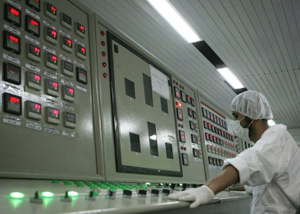
Iran’s atomic chief Ali Akbar Salehi was cited on state television’s website late Sunday as saying the search for locations for 10 new enrichment facilities has ended and “the construction of one of these facilities will begin by the end of the (current Iranian) year (to March 2011) or the start of next year.”
Iran is already enriching uranium at its main plant in the central city of Natanz and is building a second enrichment facility inside a mountain at Fordo, southwest of Tehran.
President Mahmoud Ahmadinejad had announced the planned construction of 10 new enrichment plants late last year after Tehran was censured by the UN atomic watchdog over building the Fordo facility.
Salehi, who is also one of 12 vice presidents of Iran, has previously said that any new uranium plants the Islamic republic builds would be located at sites which cannot be targeted by air strikes.
He did not specify where the third plant would be located.
Iran’s arch-foes the United States and Israel have never ruled out military strikes against Tehran to halt its nuclear programme which they suspect is aimed at making weapons.
Tehran denies the charge, saying its atomic programme has purely peaceful goals.
Iran’s uranium enrichment programme is at the heart of its nuclear controversy and the key reason for the Islamic republic to be imposed with the fourth round of UN sanctions on June 9.
Enriched uranium can be used as fuel to power nuclear reactors as well as to make the fissile core of an atom bomb.
The UN sanctions have been followed by unilateral punitive measures by the United States, the European Union, Australia and Canada.
The Western powers have been particularly infuriated with Iran for defiantly enriching uranium to the 20 percent level, which theoretically brings it closer to the 90 percent level required to make an atom bomb.
Iran says it is enriching uranium to 20 percent level to produce fuel for a research reactor in Tehran and as a potential deal with some of the world powers to supply the fuel is still embroiled in a deadlock.
On July 11, Salehi said that Iran has produced more than 20 kilogrammes of this high grade uranium, but added a few days later that it has no intention of “stockpiling” the sensitive material.
According to the May report of the International Atomic Energy Agency (IAEA), Iran has produced around 2,500 kilogrammes of low-enriched uranium at its Natanz facility.
Ahmadinejad ordered in February the refining of uranium to 20 percent after a swap deal, aimed at providing nuclear fuel for the Tehran reactor and drafted by the IAEA in October last year, hit a deadlock.
Brazil and Turkey brokered a counter proposal in Tehran on May 17 under which Iran would send its low-enriched uranium to Turkey in return for research reactor fuel to be supplied later.
But the world powers initially cold-shouldered that proposal and voted through a fourth set of sanctions, which had the effect of further tightening financial and military restrictions on Tehran.
They later raised questions about the counter proposal as they issued calls for discussing Iran’s overall nuclear programme.
Iran says it has responded to their questions over the counter proposal, known now as the Tehran Declaration, and is waiting for an official date for a meeting with the Vienna group to discuss the details of the plan.
“The other sides have announced their readiness (to discuss) in the media, but we have not received any official or written response,” Salehi said.
The IAEA, the United States, France and Russia, known as the Vienna group, are involved in thrashing out the issue of fuel supply to the Tehran reactor.


