


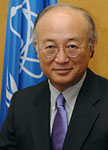
 AP: The U.N. nuclear chief said Monday he still can’t confirm that all aspects of Iran’s nuclear program are peaceful, and he expressed serious concern at North Korea’s refusal to allow the return of nuclear inspectors.
The Associated Press
By Edith M. Lederer
The U.N. nuclear chief said Monday he still can’t confirm that all aspects of Iran’s nuclear program are peaceful, and he expressed serious concern at North Korea’s refusal to allow the return of nuclear inspectors.
Yukiya Amano, the head of the International Atomic Energy Agency, called on Iran to fully implement all resolutions of the IAEA board of governors and the U.N. Security Council, including demands to suspend uranium enrichment and start negotiations to ease global concerns that it is seeking to make atomic weapons.
Amano also called for “concerted efforts” to resume six-party talks on dismantling North Korea’s nuclear program “at an appropriate time.” He addressed the General Assembly Monday with his first annual report since he took over the post from Mohamed ElBaradei late last year.
North Korea conducted two nuclear weapons tests in 2006 and 2009, drawing international condemnation and U.N. sanctions and heightening concern that the country is building a nuclear arsenal. The autocratic Asian state has not permitted the Vienna-based watchdog to implement safeguards in the country since December 2002 and no inspectors have been allowed in since April, making it impossible for inspectors to report about its atomic activities.
The six-party talks — including the U.S, China, Russia, Japan, North Korea and South Korea — have been stalled since Pyongyang walked out last year amid international criticism of its long-range missile launch. Prospects for resuming negotiations had been clouded since the deadly March sinking of a South Korean warship blamed on North Korea.
A North Korean diplomat rejected the IAEA’s allegations saying they are based on a misunderstanding of the nuclear issue on the Korean peninsula.
The diplomat said North Korea’s nuclear deterrence is a response to the nuclear threat from the United States dating back to the 1950s, and the only way to denuclearize the Korean peninsula is to build confidence between Washington and Pyongyang and conclude a peace treaty officially ending the 1950-53 Korean War.
Amano’s statement that “Iran has not provided the necessary co-operation to permit the agency to confirm that all nuclear material in Iran is in peaceful activities” came as Tehran is negotiating on a date and place to resume talks with six major powers — the U.S., China, Russia, Britain, France and Germany. Tehran has said it would be ready to renew talks, which foundered a year ago, some time after Nov. 10, and on Sunday it proposed Turkey as a venue.
Iran’s Deputy U.N. Ambassador Eshagh Al-Habib said his government is “waiting to see the goodwill of the other parties and their real intention for meaningful and successful talks.”
Iran denies having nuclear weapons ambitions and says it only wants to enrich uranium to the lower levels used in producing fuel for power plants and nuclear medical radioisotopes used to treat cancer.
Al-Habib reiterated Iran’s commitment to the peaceful use of nuclear energy and said Iran has fulfilled its requirements under the Nuclear Nonproliferation Treaty’s safeguards agreement. He said additional requests “have been made under the pretext of the illegal resolutions of the U.N. Security Council.”
“Therefore, claiming that ‘Iran has not provided the necessary co-operation’ is incorrect and misleading,” Al-Habib said.
Amano told the 192-member General Assembly that there is growing interest in nuclear power “as a clean and stable source of energy that can help mitigate the impact of climate change.”
Some 60 countries are considering introducing nuclear energy and the IAEA expects up to 25 new countries to bring their first nuclear power plants on line by 2030, he said, and many countries with nuclear power are planning or building new reactors or trying to extend the life of existing reactors.
Amano said he has made cancer treatment in developing countries “a high priority for my first year in office,” noting that some 665 people in developing countries die of cancer every hour — nearly three times as many as in developed countries. He said the IAEA has delivered over $220 million worth of cancer-related assistance to developing countries since 1980 and the new focus has increased pledges and donations.


