


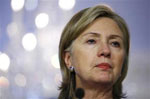
 Washington Post: Secretary of State Hillary Rodham Clinton lobbied Arab governments on Monday to help tighten the screws on their Iranian neighbor, saying that sanctions and other measures are hurting Tehran and undermining its ability to acquire components for its nuclear program.
The Washington Post
By Joby Warrick
Washington Post Foreign Service
Tuesday, January 11, 2011; A12
 ABU DHABI, UNITED ARAB EMIRATES – Secretary of State Hillary Rodham Clinton lobbied Arab governments on Monday to help tighten the screws on their Iranian neighbor, saying that sanctions and other measures are hurting Tehran and undermining its ability to acquire components for its nuclear program.
Clinton, in the Middle East for four days of talks, also pushed oil-rich Persian Gulf states to do more to back fragile governments in the West Bank and Iraq to create stability in a region that has so frequently veered into war.
The top U.S. diplomat expressed solidarity with Arabs in battling against domestic extremists, citing Saturday’s attempted assassination of Rep. Gabrielle Giffords (D-Ariz.) as an example of extremist-inspired violence in the United States.
“That is not who you are, and that is not who we are,” Clinton said in a television talk show in which she took questions from audience members. “We have to make clear that this does not represent either Arabs or Americans.”
Repeating a theme she has sounded frequently in trips to the region, Clinton warned that a nuclear-armed Iran would trigger an “extremely dangerous” arms race, and she said Arabs should show common cause with Western powers by helping enforce economic sanctions. She said current sanctions already were having a significant effect, echoing claims made by other administration officials in testimony in recent weeks.
“Sanctions have been working,” Clinton said. “They have made it much more difficult for Iran to pursue its nuclear ambitions.”
Iran also is having unspecified “technological problems” that have made it slow down its timetables, Clinton said, a possible reference to technical glitches believed to have been caused by a computer virus. “But the real question is, how do we convince Iran that pursuing nuclear weapons will not make it safer and stronger, but just the opposite?” she asked.
Clinton also brought up Iran in private sessions with the United Arab Emirates’ president, Sheik Khalifa bin Zayed al Nahyan, and with Dubai’s ruler, Prime Minister Mohammed bin Rashid al Maktoum. She is expected to travel to Oman and Qatar later in the week before returning to Washington.
Clinton made her public comments on the set of a popular women’s television show, “Soft Talk” – the United Arab Emirates’ equivalent of “The View” – where she chatted with the hosts on subjects ranging from her political career to her husband’s saxophone playing. The hosts and questioners from the audience asked polite but pointed questions about the prospects for war in the Middle East and why the United States tolerated nuclear weapons for Israel but not for Iran. On the latter question, Clinton said the Obama administration supports the idea of a nuclear-free Middle East, eventually.
The Giffords shooting came up when a young woman in the audience asked why Americans seem to blame all Muslims for the actions of the handful of radicals responsible for the Sept. 11, 2001, terrorist attacks. Clinton assured the audience that most Americans are not anti-Muslim, but she explained that extremist voices are amplified because they command media attention.
Asked repeatedly about the foundering Israeli-Palestinian peace process, Clinton reiterated the Obama administration’s support for an independent Palestine, but she also called on the gulf states to do more to foster economic stability in the West Bank to create conditions that could lead eventually to a prosperous, independent Palestinian state. Ultimately, to achieve peace, Israelis and Palestinians will have to want an accord badly enough to agree to painful compromises, she said. But in the meantime, there is “an essential role for outsiders,” Clinton said.


