


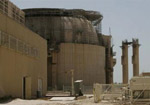
 AFP: World powers Thursday overcame divisions at the UN atomic agency with a resolution of “deep” concern on Iran’s nuclear programme, but without reporting Tehran to the UN Security Council or setting any deadline.
By Simon Sturdee
VIENNA (AFP) — World powers Thursday overcame divisions at the UN atomic agency with a resolution of “deep” concern on Iran’s nuclear programme, but without reporting Tehran to the UN Security Council or setting any deadline.
The head of the International Atomic Energy Agency, Yukiya Amano, meanwhile proposed to the Islamic republic a “high-level” visit to clarify issues raised in the watchdog’s damning new report on Iran’s suspected nuclear weapons drive.
He told reporters: “The information we have received in the past three years has given us a clearer picture of Iran’s nuclear programme. We now have more pieces of the jigsaw puzzle.
“It is clear that Iran has a case to answer.”
The resolution tabled at the IAEA by the five permanent members of the UN Security Council and Germany, the P5+1, “expresses deep and increasing concern” about Iran’s activities.
But to assuage Chinese and Russian misgivings, it sets no deadline for Iran to respond, requesting instead Amano to report to the IAEA board in March on Tehran’s “implementation of this resolution.”
The resolution, expected to be approved by the 35-nation IAEA board of governors on Friday, said it was “essential for Iran and the Agency to intensify their dialogue.”
It calls on Tehran “to comply fully and without delay with its obligations under relevant resolutions of the UN Security Council.”
It expresses “continuing support for a diplomatic solution, and calls on Iran to engage seriously and without preconditions in talks aimed at restoring international confidence.”
Last week, the agency came the closest yet to accusing Iran outright of seeking to develop nuclear weapons, in a report immediately rejected by the Islamic republic as “baseless.”
The evidence included a bus-sized steel container visible by satellite for explosives testing and weapons design work, including examining how to arm a Shahab-3 missile, capable of reaching Israel, with a nuclear warhead.
Iranian Foreign Minister Ali Akbar Salehi said on Wednesday that Tehran, which insists its nuclear programme is peaceful, would send “an analytical letter with logical and rational responses” to the IAEA.
But the report laid bare deep differences within the so-called P5+1 bloc dealing with the Iran question, the five permanent members of the UN Security Council — the United States, China, Russia, Britain, France — and Germany.
Washington, Paris and London jumped on the IAEA report as justification to increase pressure on Iran, already under four rounds of Security Council sanctions and additional US and European Union restrictions.
But Beijing, which relies heavily on Iranian oil imports, and Moscow, which also has close commercial ties and built Iran’s only nuclear power plant, have been more cautious.
Israel’s ambassador on Thursday expressed disappointment at the resolution, having hoped for a stronger response and even what would be a fifth round of sanctions.
“It could be tougher,” Israel’s envoy Ehud Azoulay told AFP on the sidelines of the meeting at the IAEA’s Vienna headquarters.
“But this is the magic of diplomacy. If you want to get everyone on board you have to sacrifice something. I hope it will lay the ground for future (UN Security Council) resolutions … I really hope so.”
But Western diplomats stressed that all major powers had agreed, thus avoiding what would have been a potentially damaging split in the UN Security Council, where relations have already been tested this year over Libya and Syria.
Mark Hibbs from the Carnegie Endowment for International Peace think tank said the resolution “goes far to accommodate the interest in China and Russia — and Iran — in resolving outstanding issues diplomatically.”
He noted it calls on Iran to address outstanding “substantive issues” but does not single out weapons-related items in Amano’s report, “and, most significantly, it doesn’t set any deadline for Iran to comply.”


