


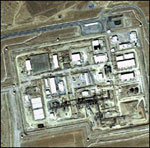
 Reuters: Iran has yet to give an explanation over a small quantity of uranium metal missing from a research site, the U.N. nuclear watchdog said in a report that voiced concern over possible military links to Tehran’s nuclear programme.
By Fredrik Dahl
VIENNA (Reuters) – Iran has yet to give an explanation over a small quantity of uranium metal missing from a research site, the U.N. nuclear watchdog said in a report that voiced concern over possible military links to Tehran’s nuclear programme.
The discrepancy found at the research site in the Iranian capital came to light after measurements by international inspectors last year failed to match the amount declared by the laboratory.
Experts say the quantity of natural uranium not accounted for is too small to be used for a bomb, but that it could be relevant to weapons-linked tests.
The United States has expressed concern the material may have been diverted to suspected weapons-related research.
“The discrepancy remains to be clarified,” said the latest quarterly report on Iran by the U.N. International Atomic Energy Agency (IAEA), issued to member states on Friday evening.
U.N. inspectors have sought information from Iran to help explain the issue after their inventory last August of natural uranium metal and process waste at the research facility in Tehran measured 19.8 kg (43.6 pounds) less than the laboratory’s count.
The 11-page IAEA report also showed that Iran had sharply increased its uranium enrichment drive. The findings, which added to fears of escalating tension between Iran and the West, sent oil prices higher.
Preparatory work to install thousands more centrifuges is under way, potentially shortening the time needed to make high-grade uranium for nuclear weapons.
Iran says it is enriching uranium only as fuel for nuclear power plants, not weapons, but its refusal to curb the activity has drawn increasingly tough sanctions aimed at its oil exports.
U.S. Secretary of State Hillary Clinton said the report “is concerning, and raises a lot of worrisome questions.”
“We continue to urge Iran to abide by its international obligations, and that is something that countries everywhere do, and we want to see them do it, and we hope that they will be listening,” Clinton told Reuters TV during a visit to Tunisia.
Israel, which has made veiled threats to carry out pre-emptive strikes on Iran’s nuclear sites, said the document offered further proof that Iran was pushing ahead with plans to build an atomic weapon.
“The IAEA report provides more proof that Israel’s estimations are accurate. Iran is continuing with its nuclear programme unchecked and is enriching uranium to a high level of 20 percent while blatantly ignoring the demands of the international community,” said a statement issued by the office of Prime Minister Benjamin Netanyahu.
In discussions with Iran this month about the discrepancy at the Jabr Ibn Hayan Multipurpose Research Laboratory (JHL), the IAEA said it had requested access to records and staff involved in uranium metal conversion experiments from 1995 to 2002.
“Iran indicated that it no longer possessed the relevant documentation and that the personnel involved were no longer available,” the U.N. agency’s report said.
URANIUM ANALYSIS
The IAEA said Iran had suggested the discrepancy may have been caused by a higher amount of uranium in the waste than had been measured by the U.N. inspectors.
“In light of this, Iran has offered to process all of the waste material and to extract the uranium contained therein,” it said. The IAEA said it had also begun taking additional analysis samples of the material involved.
Iran’s envoy to the Vienna-based U.N. agency, Ali Asghar Soltanieh, last year dismissed the reported discrepancy as “absolutely not an issue.”
But a senior U.S. official said in November it required “immediate” resolution, citing information indicating that “kilogram quantities” of natural uranium metal had been available to Iran’s military programme.
Enriched uranium can be used to power plants, which is Iran’s stated aim, or provide material for weapons if refined much further, as Western states suspect is Iran’s ultimate aim.
Last November, the IAEA presented a stash of intelligence indicating that Iran has undertaken research and experiments geared to developing a nuclear weapons capability, prompting Western states to ratchet up sanctions on Tehran.
Friday’s IAEA report also gave details of its mission to Tehran this week where Iran failed to respond to allegations of research relevant to developing nuclear arms – a blow to the possible resumption of diplomatic talks that could help calm worries about a new war in the Middle East.
Nuclear bombs require uranium enriched to 90 percent, but Western experts say much of the effort required to get there is already achieved once it reaches 20 percent concentration, shortening the time needed for any nuclear weapons “break-out.”
The IAEA said Iran had now produced nearly 110 kg (240 pounds) of uranium enriched to 20 percent since early 2010. Western experts say about 250 kg are needed for a nuclear weapon, although it would need to be enriched much further.
(Reporting by Fredrik Dahl, additional reporting by Dan Williams in Jerusalem and Ashraf Fahim in Tunis.; Editing by Ori Lewis and Maria Golovnina)


