


 AFP: Iran declared on Monday it will not be swayed from its nuclear “path” by sanctions, a week before talks with world powers that are increasingly seen as a last chance for diplomacy in its showdown with the West.
By Marc Burleigh
TEHRAN (AFP)— Iran declared on Monday it will not be swayed from its nuclear “path” by sanctions, a week before talks with world powers that are increasingly seen as a last chance for diplomacy in its showdown with the West.
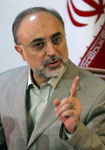
“The sanctions may have caused us small problems but we will continue our path,” Foreign Minister Ali Akbar Salehi vowed in an interview with the official Islamic Republic News Agency (IRNA).
“We do not underestimate any enemy, no matter how tiny and lowly they are. The regime’s officials — the supreme leader, the president, the army, the (Revolutionary) Guards and Basij (militia) — are completely vigilant. And the nation is prepared to defend the achievements of Islamic Iran,” he said.
The defiant words came after US Secretary of State Hillary Clinton said on Saturday that the talks between Iran and the world powers would take place April 13 and 14 in Istanbul.
She and US President Barack Obama have both publicly said that the window for diplomacy in the standoff over Iran’s nuclear programme is closing.
“Our policy is one of prevention, not containment,” Clinton said in Saudi Arabia after talks with her Gulf Arab counterparts.
It is up to Iran to engage in the talks “with an effort to obtain concrete results,” Clinton said.
Israel — the sole if undeclared nuclear weapons state in the Middle East — and the United States have threatened military strikes against Iran’s nuclear facilities if diplomacy and sanctions fail to curb the Islamic republic’s nuclear ambitions.
The UN Security Council has imposed four sets of sanctions on Iran because of suspicions over its nuclear programme, which the United States and its allies believe includes a drive to develop atomic weapons capability.
The West has imposed its own unilateral economic sanctions on Iran.
But Iran’s oil minister, Rostam Qasemi, told the Mehr news agency on Monday that the West’s efforts to curb Iranian oil exports “have been a failure”.
“We have seen off what they describe as ‘rigorous sanctions’ against the oil industry,” he said.
Iran denies any military dimension to its nuclear activities.
Its supreme leader, Ayatollah Ali Khamenei, has called nuclear weapons a “sin”. But he has also refused to bow to sanctions, and warned Iran would retaliate in kind if attacked.
Foreign ministry spokesman Ramin Mehmanparast said in an interview with the Fars news agency that Iran considered the talk of war to be a “psychological” gambit “to affect the Iranian nation, to lower the support of the people for the system.”
But, he said, “our readiness (to ward off any threat) is at its peak. We take any threat, even those with a low probability of happening, seriously.
“If any practical action, either surgical or long-lasting, is taken, we will respond decisively.”
The talks between Iran and the P5+1 group — the five permanent UN Security Council members plus Germany — are seen as an opportunity to defuse the tense situation.
EU officials in Brussels said that, despite Clinton’s affirmation, Istanbul had not yet been fully confirmed as the venue.
“The talks are scheduled to start late on the 13th and will be held primarily on the 14th,” one EU diplomat told AFP on condition of anonymity.
They will “very likely” take place in Istanbul, but all parties had not yet reached complete agreement, the diplomat said.
A spokeswoman for EU foreign policy chief Catherine Ashton, who represents the P5+1 in the negotiations, said only: “We will announce it (the venue) formally once we have full agreement.”
The last round of talks between Iran and the P5+1 group was held in Istanbul in January 2011 and ended in failure. Geneva hosted the round before that in late 2010.
The United States is poised to bolster unilateral sanctions that are already making it harder for Iran to sell its vital oil exports. Countries that do not reduce Iranian oil imports risk being targeted by US sanctions.
But Salehi stressed to IRNA: “The West thinks that Iran is like many other countries who will yield under America’s pressure. But they are mistaken.”
He said Iran had resisted Western pressure ever since it became an Islamic republic following its 1979 revolution. And he said the United States would be forced to retreat from its positions if Iranian “national unity” was strengthened.


