


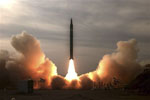
 UPI: Iran’s development of its most advanced ballistic missile has been stalled by international sanctions imposed on Tehran to curb its nuclear program. United Press International
 BEIRUT, Lebanon, July 20 (UPI) — Iran’s development of its most advanced ballistic missile, the Sejjil-2, has been stalled by international sanctions imposed on the Islamic Republic to curb its nuclear program, a leading think tank says.
Indeed, London’s International Institute for Strategic Studies warned in a July analysis of Iran’s missile program that the ever-tightening sanctions first introduced in mid-2010 “could yet deal a knockout blow to the country’s development of long-range ballistic missiles.”
The IISS cited “mounting evidence” that if sanctions continue “Iranian attempts to develop and field long-range ballistic missiles could be significantly impeded, if not halted altogether.”
This has deflated the recent boasts of Iranian military commanders that the Revolutionary Guards, who’re responsible for Iran’s missile program, have improved the accuracy and killing power of long- and short-range ballistic weapons.
This was even endorsed by U.S. Defense Secretary Leon Panetta in the Pentagon’s annual assessment of Iran’s military capabilities to Congress June 29.
Iran has been placing greater emphasis on its missile capabilities, strategic and tactical, particularly in response to the European Union’s boycott of Iranian oil exports that took effect July 1.
Indeed, one analyst observed that over the last year, “Iran’s security has become increasingly dependent on its missile arsenal as its other deterrent capabilities have deteriorated.”
This was evident in the test-firing of dozens of missiles of all calibers during Iran’s large-scale Great Prophet exercises earlier this month in a display that coincided with a major tightening of sanctions.
So the IISS report that development of the Sejjil-2 has apparently been stalled for more than a year because of problems acquiring key components has a particular resonance.
“The most likely explanation … centers on Iran’s inability to establish a reliable supply chain for the high-quality solid-propellant ingredients needed to produce the Sejjil-2,” the institute observed.
Sejjil-2 is a two-stage weapon with a range of 1,250 miles, sufficient to reach Israel.
The United States and Europe are particularly concerned that Iran’s striving to develop an intercontinental ballistic missile capable of hitting their cities, and Sejjil’s a key stepping stone toward that objective.
At present, Iranian missiles can only reach U.S. military bases in the Middle East as well as southern Europe.
The Sejjil-2 is Iran’s first ballistic missile to use solid fuel. That means it takes only a few minutes to launch, whereas the liquid-fueled Shehab-3, Tehran’s main strategic missile currently in production, takes at least a half-hour to fuel and launch. That makes it vulnerable to pre-emptive strikes.
Sejjil-2 is also more accurate and has a longer range. It follows that Israel and the United States would do anything to sabotage or slow development of the Sejjil — and the sanctions appear to doing that.
Sejjil’s solid fuel system requires “high-quality ingredients” and “strict adherence to quality-control measures becomes increasingly critical to success,” the IISS noted.
“Iran may have the industrial capacity to produce some, or even most, of the key propellant ingredients to support the manufacture of small solid-fueled rocket motors,” it said.
“However, the quality of locally produced ingredients very likely falls short of the requirements for the production of the much larger Sejjil-2 rocket motors.”
Iran’s absolute reliance on imports of such key ingredients underscores that assessment.
The IISS said that Western experts who monitor Iran’s compliance with U.N. Security Council Resolution 1929 of June 2010, which banned Tehran from developing nuclear-capable ballistic missiles, have reported that vital propellant ingredients are being seized before they reach Iran.
These include “the interception in Singapore on Sept. 30, 2010, of 302 drums of pure aluminum powder destined for Iran from China,” the IISS said. “The seized powder was suitable solely for solid-propellant production.
“Diplomatic cables made public by WikiLeaks provide additional evidence of Iran’s worldwide search for propellant ingredients, including attempted acquisitions from India and China …
“While it is impossible for outsiders to identify the precise reasons behind the stalled Sejjil-2 program, it is reasonable to conclude that trade sanctions have disrupted Iran’s access to key propellant ingredients and compromise development efforts.”
“If true, and if future applications of sanctions prevent Iran from establishing a reliable source of propellant ingredients regulated by the Missile Technology Control Regime, the Islamic Republic will not be able to create missiles capable of threatening Western Europe, much less the United States, before the end of this decade.”


