


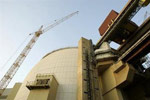
 AP: Several countries monitoring Iran’s nuclear program have picked up information that the country’s only power-producing nuclear reactor was damaged by one or more of several recent earthquakes, with long cracks appearing in at least one section of the structure, two diplomats said Tuesday. The Associated Press
By GEORGE JAHN
Several countries monitoring Iran’s nuclear program have picked up information that the country’s only power-producing nuclear reactor was damaged by one or more of several recent earthquakes, with long cracks appearing in at least one section of the structure, two diplomats said Tuesday.
Iran is under U.N. sanctions for refusing to stop nuclear programs that could be used to make weapons, even as it insists it has no such plans.
Its Bushehr nuclear plant is not considered a proliferation threat. But some nations are concerned about how safe it is. Iran has refused to join an international nuclear safety convention and persistent technical problems have shut the plant for lengthy periods since it started up in September 2011 after years of construction delays.
Reports of the International Atomic Energy Agency in February and May said the agency had been informed by the Iranians that the facility was shut down, without specifying why.
Kuwait and other Arab countries are only a few hundred kilometers (miles) away from Iran’s Bushehr reactor, which is on the Persian Gulf coast, and are particularly worried about the safety of the Russian-built reactor. Saudi Arabia mentioned Bushehr as a safety concern on Tuesday at a session of the Vienna-based IAEA’s 35-nation board.
But Iran insists the plant is technically sound and built to withstand all but the largest earthquakes unscathed. Officials in Tehran reassured the international community after the quakes struck in April and early May that the facility was undamaged.
The diplomats referred to recent restricted information gathered from the site in questioning that assertion. They told The Associated Press that one concrete section of the structure developed cracks several meters long as a result of the quakes on April 9 and April 16.
Both diplomats are from member countries of the Vienna-based International Atomic Energy Agency, which monitors Iran’s nuclear program. They demanded anonymity because they are not allowed to divulge confidential information.
One of the two said that the cracks seen were not in the vicinity of the reactor core, which contains highly radioactive fuel. But he said that the information available was limited to one section of the reactor, meaning damage elsewhere could not be ruled out.
He declined to go into details, saying that could jeopardize the sources.
Asked about the reports, Ali Asghar Soltanieh, Iran’s chief delegate to the IAEA, said, `’I know nothing about Bushehr.”
Iran is the only country operating a nuclear power plant that has not signed on to the 75-nation nuclear safety convention, which was created after the 1986 Chernobyl nuclear disaster.
While IAEA inspectors occasionally do inventory of nuclear material at Bushehr they do not have a mandate to conduct safety inspections.
IAEA chief Yukiya Amano suggested sending in experts after the quakes was a good idea, but an IAEA official, who also demanded anonymity because his information is confidential, said no such visits took place.
A moderate quake struck near Bushehr May 6, preceded by two more powerful temblors in April including one of 7.7 magnitude. Iranian officials say the Bushehr plant, south of Tehran, was built to withstand quakes up to magnitude 8.
Because it’s not a member of the international safety convention, `’there are questions about the day-to-day safety at the installation,” said Mark Hibbs of the Carnegie Endowment for International Peace.
Concerns about Bushehr’s safety have been compounded by its location in the wake of Japan’s 2011 earthquake and tsunami that crippled the Fukushima reactor and resulted in huge radioactive spills.
Iran is located in a zone of tectonic compression where the Arabian plate is moving into the Eurasian plate, leaving more than 90 percent of the country crisscrossed by seismic fault lines.
Nine quakes that hit Iran in the last decades were over magnitude six including a 2003 temblor that killed at least 26,000 people in the city of Bam. Scientists say more fault lines are waiting to be discovered and more major quakes are only a matter of time.
Iran is not prone to tsunamis. But a severe earthquake alone can crack protective containment vessels that keep radioactivity inside reactors. Earthquakes can also knock out the power, crippling cooling systems that prevent reactors from overheating and possibly exploding.


