


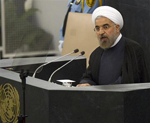
 Bloomberg: The Iranian president, Hassan Rouhani, the putative moderate on whose shoulders great American hopes have been placed, is proud of the work he did to advance his country’s nuclear program — and also of his efforts to stymie Western attempts to stop that work.
Bloomberg
By Jeffrey Goldberg
Here is something to remember as nuclear negotiations between the West and Iran appear set to recommence: The Iranian president, Hassan Rouhani, the putative moderate on whose shoulders great American hopes have been placed, is proud of the work he did to advance his country’s nuclear program — and also of his efforts to stymie Western attempts to stop that work.
Rouhani didn’t talk about this during his recent visit to the United Nations. He came bearing a different message: Iran seeks a peaceful resolution to its decade-old nuclear standoff with the international community.
Yet in May, shortly before he was elected, Rouhani appeared on state-run IRIB TV to defend his nuclear work, appearing defensive as a hard-line interviewer essentially accused him of bowing before the West. We may one day thank the interviewer, Hassan Abedini, for pushing Rouhani on the subject. According to an account of the conversation published in the Times of Israel, Rouhani at one point became flustered by the insinuation that, as Iran’s chief nuclear negotiator 10 years ago, he kowtowed to the West by bringing his country’s nuclear activities to a stop.
“We halted the nuclear program?” he asked, rhetorically. “We were the ones to complete it! We completed the technology.”
Abedini pushed Rouhani harder, claiming that uranium enrichment at a facility in Isfahan had been suspended while Rouhani was in charge. Rouhani denied the accusation, and then claimed credit for the development of a heavy-water reactor in Arak in 2004.
“Do you know when we developed yellowcake? Winter 2004. Do you know when the number of centrifuges reached 3,000? Winter 2004.”
Reading accounts of Rouhani’s combative interview made me wonder if this might represent his personal Hudaybiyyah moment. What is a Hudaybiyyah moment? The moment when a mask slips.
In the mid-1990s, Yasser Arafat, who was then the leader of the Palestinian Authority, began giving speeches (and sermons) about the Middle East peace process, which was then progressing in earnest. There were doubts about Arafat’s willingness to compromise with Israel, a nation he had long terrorized, but he appeared to be fully engaged in negotiations, and Israel’s suspicious leaders appeared to have overcome many of their misgivings.
In these sermons and discussions, however, Arafat began making reference to the Treaty of Hudaybiyyah, which, Muslim tradition tells us, the Prophet Muhammad had signed with a rival tribe called the Quraysh out of tactical necessity. Two years later, by most accounts, a stronger Muhammad, citing a violation by the Quraysh as pretext, saw to it that the treaty was dissolved. He then defeated his enemy. Arafat appeared to be signaling to Muslim audiences that even if the Palestinians came to an agreement, they shouldn’t fear, because an agreement with Israel wouldn’t last forever.
Optimists — including me — dismissed Arafat’s invocation of the treaty as an example of a frightened politician playing to his base. The pessimists — those who said this reference, among others, proved that Arafat was already devising an exit strategy from a still-theoretical (and ultimately unrealized) peace treaty — were right.
The lesson of this sad episode was to listen more carefully to what leaders actually say.
Rouhani, in the interview, was in the midst of a presidential campaign and getting pressured from his right. So it’s possible that he reacted defensively in the heat of the moment. But consider this statement, which he wrote in 2011: “While we were talking to the Europeans in Tehran, we were installing equipment in Isfahan.”
These are not the words of someone who wants to end Iran’s nuclear program. Taken together, Rouhani’s statements sound like those of a man who is proud of the program and believes he may have devised a way to carry it to completion: By speaking softly, smiling and spinning the centrifuges all the while.
It’s obviously worth testing Rouhani’s intentions through intensive diplomacy and negotiations, but it’s vital to conduct this test while paying careful attention to what he’s saying at home. Avoiding a Hudaybiyyah moment isn’t impossible, unless we’re not paying attention.
(Jeffrey Goldberg is a Bloomberg View columnist.


