


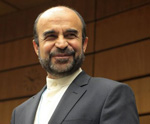
 AFP: Iran’s six-month freeze of its nuclear programme agreed with world powers in Geneva will start by early January, Tehran’s envoy to the UN atomic watchdog indicated Friday. The accord struck last weekend between Iran and the P5+1 foresees Tehran rolling back some of its nuclear programme.
By Simon Sturdee
Vienna (AFP)— Iran’s six-month freeze of its nuclear programme agreed with world powers in Geneva will start by early January, Tehran’s envoy to the UN atomic watchdog indicated Friday.
“We expect that either at the end of December or the beginning of January we should start implementing the measures agreed by both sides,” Reza Najafi, envoy to the International Atomic Energy Agency, told reporters.
The breakthrough accord struck last weekend between Iran and the United States, China, Russia, Britain, France and Germany — the P5+1 — foresees Tehran rolling back some of its nuclear programme temporarily in exchange for sanctions relief.
The freeze is meant to make it more difficult for Iran to develop a nuclear weapon and to build confidence while Tehran and the P5+1 hammer out a long-term accord.
Israel has demanded that dismantlement should be part of any deal.
But Iranian President Hassan Rouhani told the Financial Times in an interview published on Friday that Tehran would not do so.
Asked by the newspaper whether dismantling Iran’s atomic facilities was a “red line” for the Islamic republic, Rouhani replied: “100 percent”.
Iran has pledged to limit uranium enrichment to low fissile purities. It will also lower the purity of its stockpile of medium-enriched material, which is relatively easy to convert to weapons-grade, or convert it to another form.
Iran also committed for six months “not to make further advances” at its Fordo and Natanz uranium enrichment sites and at the Arak heavy water reactor, which could provide Tehran with weapons-grade plutonium once operating.
The Islamic republic, subject to painful UN and Western sanctions, will continue enriching uranium to low levels and it will retain its stockpile of low-enriched material.
It has been unclear since Geneva when the accord was due to take effect, with technical discussions between Iran, the powers and the IAEA, whose job verifying Tehran’s compliance will be key, set to work out the details.
“We have had preliminary discussions with the agency with regard to the nuclear-related measures … to be verified by the agency,” Najafi said Friday. “We are going to continue those discussions.”
The IAEA already keeps close tabs on Iran’s nuclear work, with personnel almost constantly in the country inspecting machinery and measuring stockpiles.
But under Sunday’s deal this will go further, with daily IAEA visits to enrichment sites and access to centrifuge assembly sites, uranium mines, and more frequent trips to Arak — in addition to verifying the enrichment freeze.
This will mean an increased workload for the IAEA and its Japanese chief Yukiya Amano, who said Thursday that “some time” — and more money — would be needed to work out how to verify the deal.
“This requires a significant amount of money and manpower…. The IAEA’s budget is very, very tight. I don’t think we can cover everything from our own budget,” Amano told reporters.
In exchange for the freeze, Iran will receive some $7 billion (5.2 billion euros) in sanctions relief and the powers promised to impose no new embargo measures for six months if Tehran sticks to the accord.
But the vast raft of international sanctions that have badly hobbled the Iranian economy, more than halving its vital oil exports and sending inflation soaring, remain untouched.
Israel, widely assumed to have nuclear weapons itself and which has refused to rule out military action, is deeply unhappy with the accord, with Prime Minister Benjamin Netanyahu calling it a “historic mistake”.
“Israel, sitting on 200 nuclear warheads all of them targeted at Muslim cities … is crying wolf about nuclear proliferation”, Najafi told closed-door meeting of the IAEA’s board of governors, according to the text of his remarks.
Meanwhile, in his FT interview Rouhani held out hope for further improvements in Iran’s ties with the United States.
“Iran-US problems are very complicated and cannot be resolved over a short period of time. Despite the complications, there has been an opening over the past 100 days, which can widen later,” he said.


