


Iran Focus
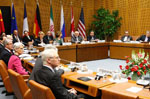
Vienna, 7 Jul – Negotiations on a nuclear agreement between Iran and six major powers will be extended through Friday to provide more time for talks on a final agreement, United States negotiators said on Tuesday.
“We’ve made substantial progress in every area, but this work is highly technical and high stakes for all of the countries involved”, Marie Harf, the spokeswoman for the US delegation, said in a statement. “We’re frankly more concerned about the quality of the deal than we are about the clock, though we also know that difficult decisions won’t get any easier with time — that is why we are continuing to negotiate”.
Russian Foreign Minister Sergei Lavrov said there was “every reason” to believe a deal would be done within “a few days”, and that there was an “understanding” that most of the current sanctions against Iran would be lifted.
“There is only one big problem in terms of sanctions – it is the problem of a weapons embargo”, he told journalists, according to the news agency Interfax.
The extension of the talks was confirmed by the European Union’s chief diplomat on Tuesday.
“We are continuing to negotiate for the next couple of days. This does not mean we are extending our deadline,” EU foreign policy chief Federica Mogherini said outside the hotel where the talks between Iran and the major powers are taking place.
The deal under discussion between Iran and the P5+1 – Britain, China, France, Germany, Russia and the United States – is aimed at curbing Tehran’s most sensitive nuclear work for a decade or more, in exchange for relief from sanctions that have slashed Iran’s oil exports and crippled its economy.
The negotiators missed a June 30 deadline for a final agreement and then gave themselves until Tuesday.
“We are interpreting in a flexible way our deadline, which means that we are taking the time, the days we still need, to finalize the agreement”, Mogherini said, adding that there remained several difficult issues to resolve.
Among these, officials said, are Iranian demands for a UN arms embargo and ballistic missiles sanctions to be lifted, the timing of US and EU sanctions relief, and disagreements over future Iranian nuclear research and development.
“We have entered the most difficult, but also the most real, part of the negotiations”, Mogherini added.
“We knew it would be difficult, challenging and sometimes hard and some things get tense and others we make progress”.
She said foreign ministers now in Vienna might come and go.
“Don’t get too excited if you see ministers leaving. They might come back. They will come back. And it doesn’t mean that we are stopping the work we are doing inside. On the contrary, on the contrary”.
French Foreign Minister Laurent Fabius confirmed that he would leave, and return to Vienna on Wednesday night.
The US and its allies fear Iran is using its civilian nuclear program as a cover to develop a nuclear weapons capability. Iran says its program is peaceful.
US President Barack Obama warned Iran last week that there would be no nuclear deal if Tehran does not agree to “serious, rigorous” inspections of its facilities.
“The goal of the nuclear negotiations is not to rely on trust, but to set up a verifiable mechanism where we are cutting off the pathways for Iran to obtain a nuclear weapon”, Obama said.
Iran’s main opposition group, the National Council of Resistance of Iran (NCRI), last month published a 28-page report stating that Iran has been trying to keep its nuclear infrastructure intact and retain the capability to produce a nuclear weapon. It said Iranian Supreme Leader Ali Khamenei had put red lines for international inspectors having access to Iranian military sites and nuclear scientists and any halt to nuclear Research and Development (R&D).
The NCRI, the group which first blew the whistle on Iran’s secret uranium enrichment and heavy-water sites in 2002, last week also warned that without “complete unrestricted access” to international inspectors to monitor Iranian military facilities, Iran could not be trusted to abide by the terms of the international agreement.
It published a partial list of Iranian nuclear sites that it had exposed and which Tehran had previously kept secret.
Based in part on wire reports


