


Five months after the end of the twelve-day war, the Institute for Science and International Security announced—based on satellite imagery—that Iran’s regime is carrying out a cleanup operation at the new headquarters of the Defense Ministry’s Organization of Defensive Innovation and Research (SPND), which is responsible for weaponizing Iran’s nuclear program.
The National Council of Resistance of Iran-U.S. Representative Office (NCRI-US) held a press conference on January 31, unveiling new intelligence that Tehran is actively advancing its nuclear warhead development program.
Tehran Advances Nuclear Weapons Program with Covert Russian Assistance
The intelligence outlines how the Iranian regime is focusing on the development of nuclear warheads for solid-fuel missiles at the Shahrud missile site. This effort is spearheaded by the Organization for Advanced Defense Research (SPND), which oversees Iran’s nuclear weapons program.
The Washington-based institute wrote in its latest report on uranium-enrichment facilities in Iran—which were attacked during the twelve-day war—that SPND moved to a new building in 2013 but continued its key operations at the Lavizan-2 complex.
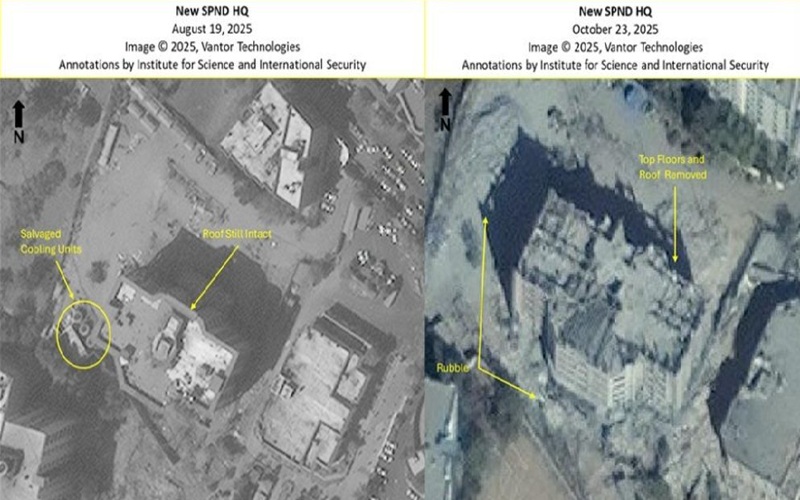
The new headquarters was located one and a half kilometers from the previous Lavizan-2 site, on Fakhrizadeh Street in Tehran.
According to the institute, the International Atomic Energy Agency never inspected this building, and it appears to have been targeted multiple times in airstrikes.
On June 20, the Israeli military announced that in its overnight strikes on Iran, it had targeted, among other sites, the central SPND building in Tehran.
This institution was established by Mohsen Fakhrizadeh to research and develop advanced technologies and weaponry for the Iranian regime’s military capabilities. Fakhrizadeh, a key figure in the regime’s nuclear program, was killed in 2020.
During the twelve-day war, seven B-2 bombers took off from Whiteman Air Force Base in the United States as part of “Operation Midnight Hammer” and struck the regime’s nuclear sites.
Since then, Donald Trump has described the operation as successful and stated that these facilities were destroyed.
Nevertheless, after the attack, Ali Khamenei, the leader of Iran’s regime, defended the policy of domestic enrichment inside Iran.
The SPND building became unusable
The institute emphasized that the new SPND headquarters never collapsed but was likely severely damaged internally and ultimately rendered unusable.
Based on satellite images from the company Ventour, the institute wrote that between August 19 and October 23 Iran has been demolishing the building; its roof and upper floors have been removed, and large piles of debris surround the structure.
According to the report, it is unclear how long full demolition will take, but it is evident that officials of the Iranian regime are salvaging remaining equipment from the building, including three cooling units that no longer appear in the latest images.
The clearing of the main SPND building follows an August 27 report by the institute stating that Iran’s regime was also wiping away traces of nuclear activity at the Lavizan site.
Destruction of one copy of Iran’s nuclear archive
The institute reported that the bombing destroyed one copy of Iran’s nuclear archive—a collection of key documents related to nuclear activities that included details on past weapons-development work and likely contained additional, more recent and critical data on the development, testing, and production of nuclear weapons.
The institute raised the key question of whether other copies of this archive exist.
The institute also wrote in its new report that the main nuclear sites at Fordow, Natanz, and Isfahan have been largely destroyed, and no significant activity has been observed at them since the war.
The institute emphasized that unlike the enrichment sites that were attacked, several locations connected to “nuclear weaponization”—such as the main SPND building—show extensive signs of cleanup efforts.
Furthermore, the fate and status of enriched-uranium stockpiles—particularly the 60% enriched stock—remain unknown, and Iran’s regime has refused to grant the IAEA access for verification.
Rebuilding the destroyed capability is difficult
The institute wrote that without access to the sites and without up-to-date information from Iran, the IAEA has been forced to rely on satellite imagery—although such images reveal only part of the reality.


