Home Blog Page 128

Negative Record in Iran’s Oil Exports; Consequences of Sanctions

On February 5, Mohsen Paknejad, the Iranian regime’s oil minister, claimed that the regime had recorded its highest oil exports in over a decade in January. This claim contradicts data from tanker tracking companies and international organizations.

These remarks by Paknejad came one day after former U.S. President Donald Trump signed an order to “revive the maximum pressure policy” against the Iranian regime. On Wednesday, Paknejad claimed, “In January, we broke the record for oil exports in over a decade; we are announcing this news to make our people happy.”

On February 4, the tanker tracking company TankerTrackers announced that Iran’s daily oil exports in January stood at 1.567 million barrels. This figure is roughly in line with the country’s average oil exports in 2024.

Contrary to Paknejad’s claims, data from the commodity intelligence company Kpler shows that Iran’s oil exports in December were half of what they were in May 2018. At that time, the U.S. government, led by Trump, withdrew from the JCPOA, and Iran’s daily oil exports reached a record of nearly three million barrels.

Estimates by the advocacy group United Against Nuclear Iran indicate that Iran’s daily oil exports in January were below 1.4 million barrels. Of this amount, only one million barrels were sent to China, while the rest went to unknown destinations. It is unclear whether these shipments had buyers or not.

At the same time as Pezeshkian’s oil minister claimed to have “broken a 10-year record in oil exports,” Reuters reported that Iran’s oil production had declined for the second consecutive month. In January, oil production fell by 60,000 barrels compared to December 2024.

Goldman Sachs, one of the largest financial firms in the United States, has predicted that with the reinstatement of the maximum pressure policy by the Trump administration, the production and export of oil by the Iranian government will experience a downward trend.

The remarks by the Iranian regime’s oil minister about record-breaking oil exports came after the signing of the “maximum pressure” order by Donald Trump on February 4.

Reuters reported that Trump has reimposed the maximum pressure policy against the Iranian government. This policy includes efforts to reduce the Iranian government’s oil exports to zero. Reuters quoted Trump as saying,
“With me, it’s very simple: Iran cannot have a nuclear weapon.” The U.S. also has the right to halt the sale of Iranian oil to other countries.

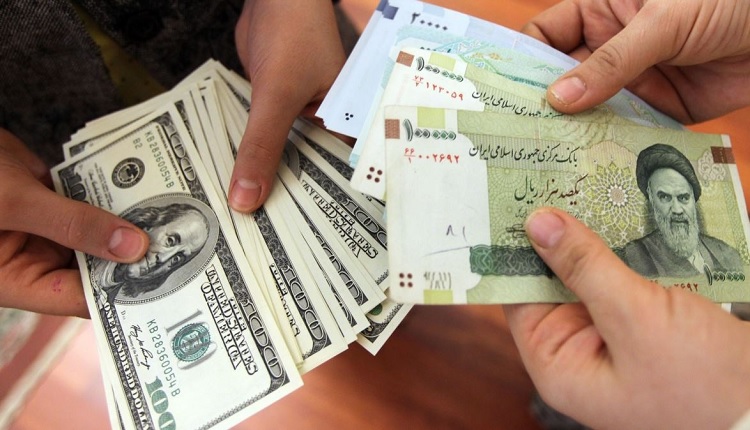
Since the signing of the order to reinstate the maximum pressure policy by Trump, the exchange rate of the dollar in the Iranian free market has increased by approximately 2%, and each U.S. dollar is now being traded at 860,000 rials.

The Iranian regime’s oil minister, referring to the sanctions, said: “We are always ready to offer solutions, and we will reach our goals.” He emphasized that if the sanctions continue, the strategies of the Iranian government will change. “We will not sit idly by.”

He added: “Maximum pressure is a failed theory.” He stressed that this policy will not succeed against the Iranian people. He said: “If they try maximum pressure again, they will fail once more.”

It seems that the statements and lies of the oil minister, following the implementation of maximum pressure, are more of a desperate attempt to reverse the situation facing the clerical regime.
 

Khamenei Rejects Talks with the U.S.; “No Problem Will Be Solved Through Negotiation”

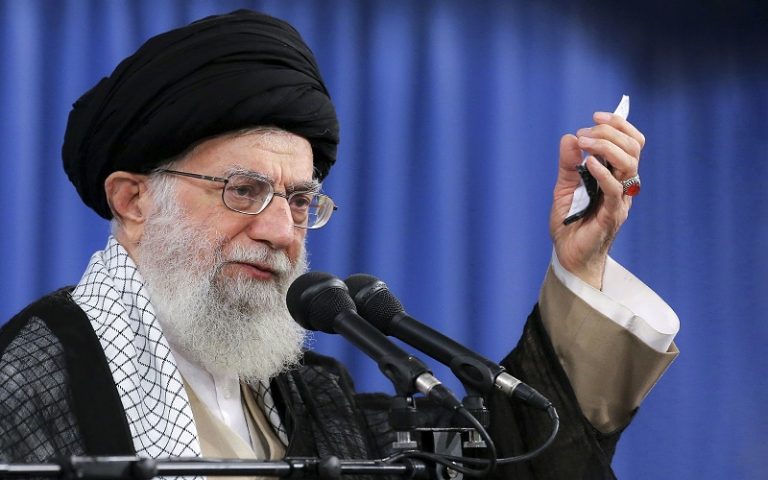
Ali Khamenei, the leader of the Iranian regime, rejected negotiations with the U.S. over Tehran’snuclear program and sanctions relief, stating that talks with Donald Trump’s administration are “neither rational, nor wise, nor honorable.”

In a speech on Friday, February 7, addressing the commanders of the Air Force and Air Defense of the Iranian military, Khamenei referred to Trump’s previous administration’s withdrawal from the nuclear deal (JCPOA) and the continuation of sanctions. He stated that negotiations with such a government “have no effect on resolving the country’s problems.”

Meanwhile, Donald Trump, who has repeatedly expressed willingness to negotiate with the Iranian regime, stated on February 5 that the United States seeks a verifiable nuclear agreement with Tehran that would allow Iran to achieve peaceful prosperity.

Trump also reiterated that Iran must not possess nuclear weapons and stated that immediate action is necessary to reach a new agreement. He added that once the deal is finalized and signed, “the Middle East will celebrate in a big way.”

However, Khamenei, in his latest remarks, stated, “Do not try to make us believe that if we sit at the negotiation table with that government, this problem or that problem will be solved. No, no problem will be solved through negotiations with the U.S.”


Flawed Economic Policies and Foreign Exchange Corruption in Iran; An Obstacle to Growth and Livelihoods

Hussein Selahvarzi, the former head of Iran’s regime Chamber of Commerce, revealed corruption in foreign exchange and the government’s flawed economic policies in an interview with the state-run media outlet Shafaqna on February 3. He believes that price controls and misguided Central Bank policies have not only created rent-seeking opportunities and corruption but have also had widespread negative effects on exports and the country’s trade balance.

Selahvarzi, referring to the recent foreign exchange crisis, stated: “In recent years, due to the establishment of unrealistic exchange rates, many have sought to gain the largest share of foreign currency resources. This unhealthy competition, especially under political pressure on the Central Bank, has led to increased corruption in foreign exchange and inefficiency in the economy.”

Corruption Allegations Surround Tehran’s Friday Prayer Leader Amid Factional Struggles

Selahvarzi further added: “One of the serious consequences of these flawed policies is the outflow of foreign currency from the country without it returning to the economic cycle. Last year, when the country faced a trade deficit of 16 to 17 billion dollars, approximately 9 billion dollars from export revenues did not return to the country, which is a clear example of foreign exchange corruption. This not only depleted the country’s foreign currency resources but also fueled currency market turmoil.”

Flawed economic policies have prevented the realization of 8% growth

Selahvarzi, criticizing the economic policymaking process, added: “Over the past four decades, seven development plans have been drafted, all targeting 8% economic growth. However, in practice, due to the lack of structural reforms, widespread foreign exchange corruption, and weaknesses in macroeconomic policies, we have never come close to this goal.”

He further stated: “The only way to reduce corruption and prevent the wastage of foreign exchange resources is to ensure transparency in currency policies, eliminate price controls, and grant the Central Bank independence from political pressures. Otherwise, foreign exchange and economic crises will persist. This situation could inflict irreparable damage on the country’s economy, and any delay in reforms will lead to even heavier consequences.”

Iran: $3.37 Billion Stolen in Latest Government-Linked Embezzlement Case

However, the current reality indicates that within the corrupt political structure imposed by the Iranian regime, talk of reforms is nothing more than an illusion.

Foreign exchange corruption and the government’s flawed policies have had devastating effects on people’s livelihoods. The depletion of the country’s foreign currency reserves has led to an increase in exchange rates, which directly exacerbates inflation and price hikes. Rising production costs, declining purchasing power, and the depreciation of the national currency are among the destructive consequences affecting society. This situation has not only plunged low-income groups into a livelihood crisis but has also destabilized the business environment.


US Dollar and Gold Coins Hit Record Price Against Iran’s Rial

As the value of the rial continues to plummet, the exchange rate of the US dollar in Iran’s free market has reached a new record of 860,000 rials. Meanwhile, economic protests are ongoing, and reports indicate rising prices of essential goods.

According to reports on Thursday, February 6, the exchange rate of one US dollar in Iran’s free market has now surpassed 860,000 rials, while the euro is trading in the 890,000-rial range.

Reports also indicate that the price of a single gold coin has exceeded 690 million rials and is on the verge of entering the 70-million-toman range.

Iran’s Rial Continues to Plunge, Hits All-Time Low At 840,000 Against the Dollar

Meanwhile, news sources have reported that economic protests continue with the ongoing strike of third-party contract workers in the Lavan oil operations zone in Hormozgan province, as well as a protest gathering of medical staff in Lordegan, Chaharmahal and Bakhtiari province.

According to news sources on February 6, the prices of essential goods, particularly rice and dairy products, experienced “severe fluctuations” on Saturday.

According to the state-affiliated website Eghtesad News, the price of one kilogram of fresh slaughtered chicken in the market today exceeds 840,000 rials (approximately one dollar), while the price of one kilogram of bone-in lamb loin has been reported at 6.15 million rials (about 7.15 dollars).

As Iran’s economic crisis intensifies, a member of the Iranian regime’s parliament has previously warned about the potential for famine in the country.

The economic hardships faced by the Iranian people are deliberate and not merely due to mismanagement; all policies are detrimental to national interests. Why is inflation not controlled? The Iranian regime, as the most indebted economic entity, benefits greatly from inflation, as it reduces the real value of its debt.

The priorities of the Iranian regime are regional interference and warmongering, as well as the suppression of its own people, rather than improving the livelihood of Iranians.


Amnesty International Urges Global Action to Stop Execution of Pakhshan Azizi

0

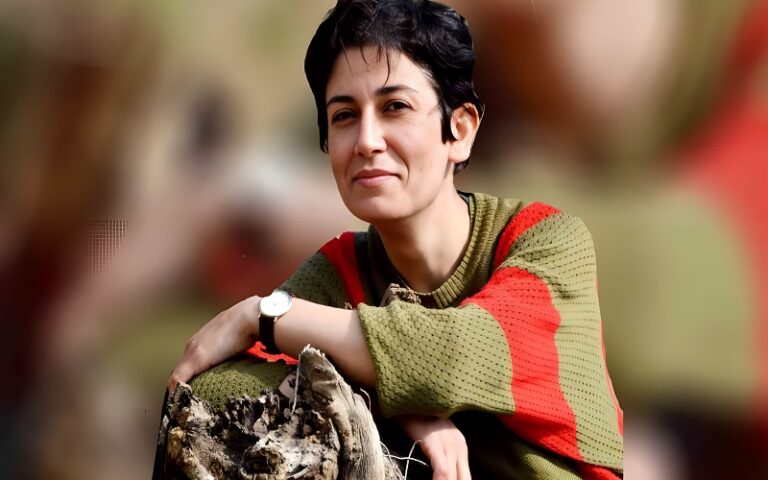
Amnesty International issued a statement calling on the international community to urgently demand that Iranian authorities halt the execution of Pakhshan Azizi.

The international human rights organization emphasized in its statement on Thursday, February 6, that Pakhshan Azizi was “arbitrarily” arrested by Iranian authorities due to her “humanitarian activities” and sentenced to death “following a grossly unfair trial.”

Diana Eltahawy, Amnesty International’s Deputy Director for the Middle East and North Africa, said: “Pakhshan Azizi was detained solely in relation to her peaceful human rights and humanitarian activities, including providing humanitarian support to women and children in northeast Syria who were displaced following attacks by the Islamic State armed group. Instead of facing imminent execution she should be immediately and unconditionally released.”

According to Ms. Eltahawy, “The Supreme Court’s decision to reject her request for judicial review highlights yet again how the Iranian authorities remain adamantly resolved to use death penalty as a tool of political repression to instil fear among the population.”

UN Experts Challenge Death Sentence of Iranian Political Prisoner Pakhshan Azizi

She emphasized that “The death penalty is abhorrent in all circumstances”, referring to Ms. Azizi’s statements about “torture and other ill-treatment, including gender-based violence”, and described the issuance of the death sentence for this civil activist “after a grossly unfair trial before a Revolutionary Court” as “arbitrary,” which “illustrates yet again the Iranian authorities’ shameless disregard for the right to life.”

Eltahawy emphasized that “Governments worldwide must speak out loudly now against this injustice to halt Pakhshan Azizi’s execution before it is too late.”

Amir Raeesian, the lawyer for Pakhshan Azizi, stated on Thursday that Iran’s Supreme Court has rejected his client’s request for a retrial and that the stay of execution order has been revoked, warning that “her execution could happen at any moment.”

On July 23, 2024, Pakhshan Azizi was sentenced to death and four years in prison by Branch 26 of Tehran’s Revolutionary Court, presided over by Judge Iman Afshari, on charges of “armed rebellion through membership in opposition groups.” She had been arrested by Iranian intelligence forces in Tehran in the summer of 2023.

A group of United Nations experts expressed deep concern on January 14, 2025, over the Iranian regime’s Supreme Court upholding Azizi’s death sentence.

On its website,  the UN Human Rights Council described the charges against Pakhshan Azizi as not meeting the threshold for “the most serious crimes” required under international law to justify a death sentence and stressed that her execution would constitute a serious violation of international human rights law.

The upholding of the death sentence for Azizi has been met with widespread domestic and international criticism.

In response, Kurdish cities in Iran witnessed a widespread strike by shopkeepers and businesses on January 21, protesting the death sentences of Pakhshan Azizi and another civil activist, Varisheh Moradi. 


U.S. Sanctions International Network Facilitating Iran’s Oil Shipments to China

On Thursday, February 6, the United States sanctioned an international network that facilitates the transportation of millions of barrels of Iranian crude oil to China, worth hundreds of millions of dollars.

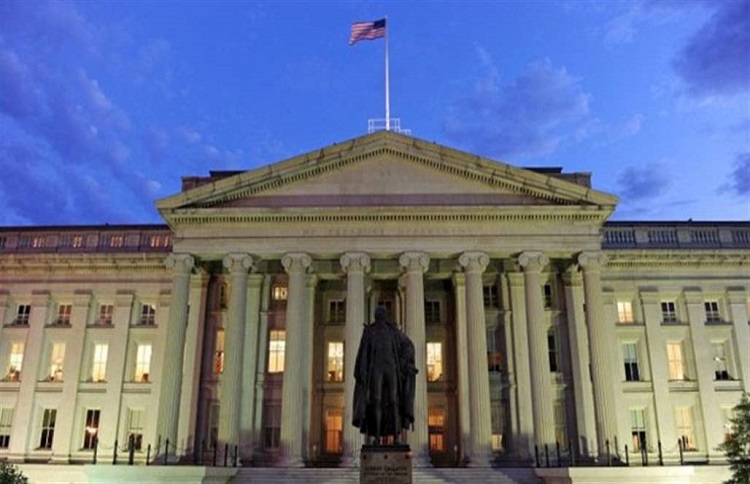
The U.S. Department of the Treasury’s Office of Foreign Assets Control (OFAC) issued a statement saying that Iranian oil is being shipped to China on behalf of Iran’s Armed Forces General Staff and its sanctioned entity, “Sepehr Energy Jahan Nama Pars.”

According to the statement, the Iranian government generates billions of dollars annually from oil sales to finance its destabilizing regional activities and support terrorist groups such as Hamas, Hezbollah, and the Houthis. Iran’s Armed Forces General Staff enables the sale and shipment of oil from Iran through networks and intermediaries based outside the country.

Iran’s Efforts to Reclaim 25 Million Barrels of Stranded Oil in Chinese Ports

Scott Bessent, the U.S. Treasury Secretary, stated that the Iranian regime remains focused on using its oil revenues to fund its nuclear program, produce ballistic missiles and lethal drones, and support its terrorist proxy groups in the region.

He emphasized that the United States is committed to targeting any attempts by the Iranian regime to finance these malign activities.

The U.S. State Department also issued a statement warning that the United States will not tolerate the Iranian government’s destructive and destabilizing behavior. As a result, it is sanctioning the “shadow fleet” of ships and management companies involved in the sale and transportation of Iranian oil.

The U.S. diplomatic apparatus further warned that the United States will use all available tools to hold the Iranian regime accountable for its destabilizing activities and its attempts to acquire nuclear weapons.


Tehran on the Brink of a Water Crisis

0

Isa Bozorgzadeh, spokesperson for the Iranian regime’s water industry, warned about the “water shortage crisis in Tehran,” stating that if water consumption is not reduced, “Tehran will reach a dead end in terms of water supply.”

In an interview with the state-run ILNA news agency, Bozorgzadeh stated, “If citizens do not change their lifestyle and water consumption is not reduced by half, Tehran will face a severe crisis.”

The pressure on people to change their lifestyle and water consumption patterns comes amid numerous reports highlighting the Iranian regime’s failure in managing water and energy resources across various ministries.

Iran Faces a Harsh Summer Ahead

Without analyzing the political and economic causes of water scarcity, Bozorgzadeh stated that solving Tehran’s water crisis is not merely a matter of financial investment. He promised that “comprehensive and specialized programs must be developed for water resource management.”

According to the water industry spokesperson, part of Tehran’s water supply comes from surrounding areas, which has negatively impacted agriculture and industries in those regions.

Regarding the relocation of the capital as a potential solution to ease pressure on Tehran’s water resources, Bozorgzadeh said, “This issue requires in-depth expert evaluations, as both supporters and opponents have noteworthy arguments.”

Referring to climate change, he stated, “Iran is a country with an arid and semi-arid climate, receiving an average of about 250 millimeters of rainfall per year. These natural limitations do not allow for the sustainable development of megacities like Tehran.”

He also cited air pollution, population density, and infrastructure problems as additional challenges facing Tehran, emphasizing the need for fundamental decisions and efficient urban development management.

He stressed that the water shortage issue extends beyond Tehran’s city limits and will impact other parts of the country as well.

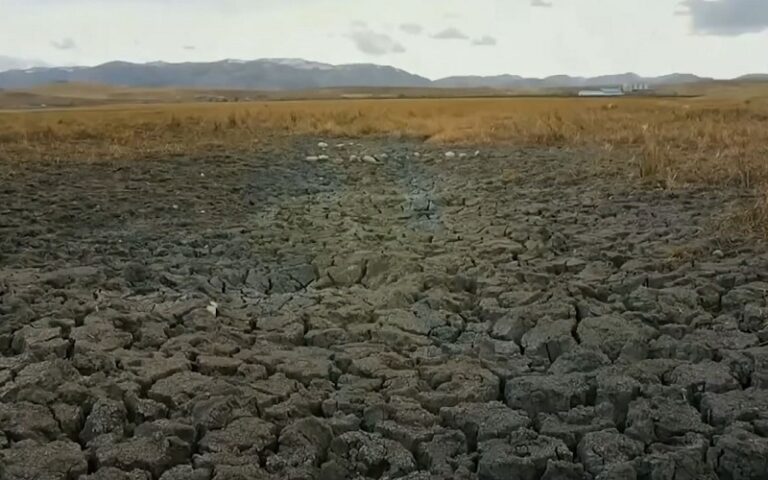
Meanwhile, due to a significant decline in rainfall this year and rising temperatures, Iran’s water resources are on the verge of a severe crisis, with media outlets reporting the possibility of water rationing in the summer.

According to the latest statistics, by the end of January, six of the country’s key dams contained less than 10 million cubic meters of water.

Experts have warned that this decline in reserves poses a serious threat to the agricultural sector in addition to its direct impact on household consumption. Moreover, disruptions in crop and orchard production could lead to further increases in food prices and exacerbate inflation in the medium term.


Extensive Damage to Farmers Due to Power Outages in Iran

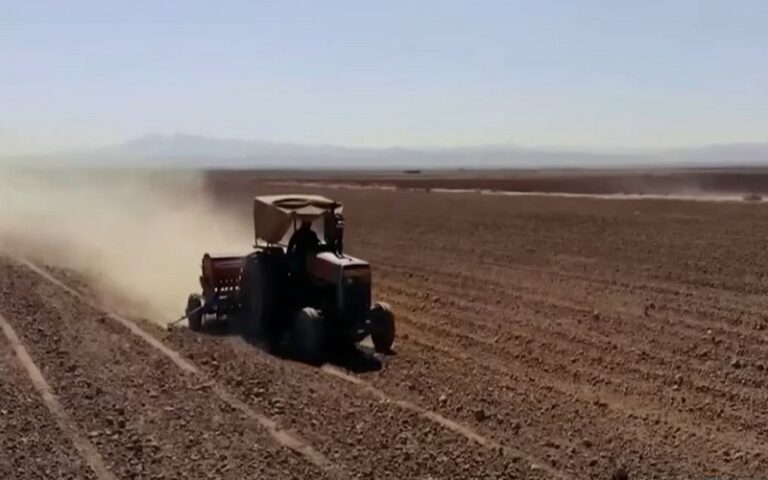
Ali Bagheri, head of the Agricultural Jihad Organization of Northern Kerman Province, announced that electricity imbalances and frequent blackouts have caused severe damage to 60% of orchard lands and 14% of farmland in the province.

According to the state-run ILNA news agency, Bagheri estimated the total damage to the agricultural sector in northern Kerman caused by electricity imbalances at approximately 12,300 billion rials (about 140.64 million dollars). He stated, “Around 127,000 farmers have suffered losses due to this situation, and if this trend continues, the future of the province’s agriculture could face a serious crisis.”

This government official also noted that the greenhouse sector in northern Kerman has suffered a 24% loss. He added, “The blackouts have not only damaged agricultural and orchard products but have also disrupted the power supply to 8% of livestock and poultry farms.”

Ahmad Ahmadpour, head of the Agricultural Jihad Organization of Southern Kerman, also told ILNA that power imbalances have inflicted over 20,000 billion rials (about 23.8 million dollars) in damages to the agricultural sector in the southern part of the province.

He emphasized, “A significant portion of agriculture in southern Kerman relies on electric water wells, but prolonged power outages have disrupted irrigation processes and destroyed many crops.”

“70 Percent” of Iranian Farmers Are Illiterate

According to this report, 152 motor pumps of agricultural wells have burned out in southern Kerman.

Additionally, 60,000 tons of citrus fruits have been damaged due to delayed irrigation, and date production has decreased by 21,000 tons.

The report further states that Kerman farmers, who rely on electricity for irrigation, have been severely affected by 10- to 12-hour power outages during the critical planting season.

A citrus farmer from southern Kerman said, “We wake up every day worrying whether we will have electricity or not. If there is no electricity, water won’t reach the trees, and our crops will be ruined. Last year, we harvested 40 tons per hectare, but this year, we won’t even reach 20 tons.”

A livestock farmer from northern Kerman also spoke about the problems caused by power outages in dairy farming: “Industrial milking machines depend on electricity, and when the power goes out, we cannot milk the cows on time. This leads to reduced milk production and, in some cases, illness in the animals. The losses we have suffered are irreparable.”

Experts have warned that if this trend continues, the decline of the agricultural industry will be inevitable, and thousands of farmers will lose their jobs.


Iran Escalates Nuclear Rhetoric as U.S. Reinstates ‘Maximum Pressure’ Campaign

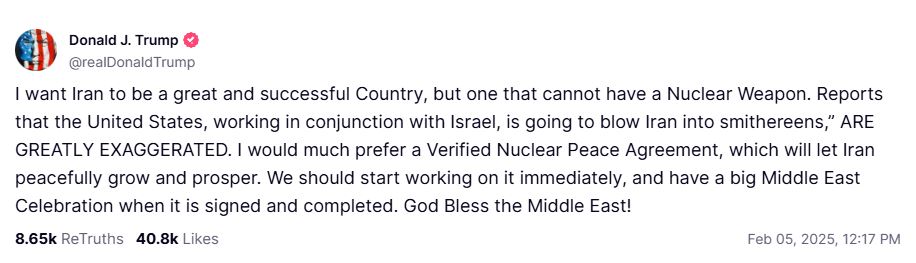
Donald Trump, the President of the United States, stated in a message on the social media platform Truth Social that he desires “a great and successful Iran,” but nuclear weapons should not be part of that future. He also called for a new nuclear agreement with the Iranian regime.

He said: “I want Iran to be a great and successful Country, but one that cannot have a Nuclear Weapon. Reports that the United States, working in conjunction with Israel, is going to blow Iran into smithereens,” ARE GREATLY EXAGGERATED. I would much prefer a Verified Nuclear Peace Agreement, which will let Iran peacefully grow and prosper. We should start working on it immediately and have a big Middle East Celebration when it is signed and completed. God Bless the Middle East!”

On Tuesday, after meeting with Israeli Prime Minister Benjamin Netanyahu, U.S. President Donald Trump stated in a joint press conference that he does not want the situation with Iran to reach a catastrophic outcome.

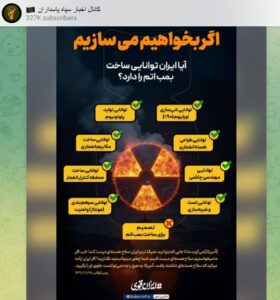
In a provocative statement, the Telegram channel Akhbar Sepah Pasdaran, affiliated with the Iranian regime’s Islamic Revolutionary Guard Corps (IRGC), declared, “We don’t have a nuclear bomb, but if we want one, we will build it.” The post also outlined the Iranian regime’s nuclear capabilities, including 90% uranium enrichment, plutonium production, and explosive mechanism engineering. This declaration is the latest in a series of remarks from Iranian officials, further signaling Tehran’s nuclear ambitions.

The Telegram post specifically listed the regime’s nuclear capabilities, marking them with a check:

✔ Plutonium production capability
✔ Explosive mechanism construction capability
✔ Explosion control chamber construction capability
✔ Assembly and security capability
✔ 90% uranium enrichment capability
✔ Nuclear core design capability
✔ Detonator engineering capability
✔ Testing and simulation capability
✔ Decision to build a nuclear bomb

IRGC Telegram channel, Akhbar Sepah Pasdaran's post
IRGC Telegram channel, Akhbar Sepah Pasdaran’s post

The statement came just hours after U.S. President Donald Trump reinstated the “maximum pressure” campaign against Iran through an executive order, emphasizing that the regime must not be allowed to obtain nuclear weapons. Following this development, Iranian Foreign Minister Abbas Araqchi commented after a cabinet meeting, stating, “If the main issue is ensuring Iran does not pursue nuclear weapons, this is achievable and not particularly difficult.”

NCRI-US Reveals New Intelligence on Iran’s Nuclear Warhead Development

Meanwhile, at conferences held in December 2024 and January 2025, the National Council of Resistance of Iran (NCRI) warned that Tehran has accelerated its nuclear weapons program in response to strategic setbacks in Syria and the broader Middle East. Facing mounting losses in the region, the regime is now expediting warhead development while leveraging potential negotiations to buy time.

The NCRI also revealed that Iran’s secret military programs under the SPND and METFAZ divisions are intensifying efforts to develop nuclear warheads. Sites at Shahrud and Semnan cities have reportedly played a critical role in high-explosive testing and missile development, further fueling concerns over Tehran’s nuclear trajectory.


65% of Iran’s Mines Have Shut Down for Various Reasons

Bahram Shakouri, head of the Mining Commission of Iran’s regime Chamber of Commerce, announced that 65% of the country’s mines have been shut down due to “numerous problems.” He also stated that 12 economic organizations have sent a letter to Ali Khamenei, the regime’s Supreme Leader, requesting the removal of obstacles for the private sector.

On Sunday, February 2, during a press conference, Shakouri stated that they expect the government to work alongside the private sector to remove obstacles and play a “facilitating” role.

According to him, the challenges in the mining sector are “chains around the feet of economic actors,” and he went on to criticize the impact of “energy imbalances” on mining activities.

Qadeer Qiyafe, vice president of Iran’s Chamber of Commerce, also addressed the economic difficulties in the mining sector during the press conference. He noted that economic actors throughout the entire mining supply chain are currently struggling with financial constraints, and exports are facing multiple challenges.

He identified the root of these problems as the government’s high budget deficit and cited power outages as another issue preventing the achievement of the projected 13% growth.

Officials and media of the Iranian regime use the term “imbalance” to refer to the issue of energy shortages or deficits in Iran—a problem that has, among other things, prevented mines from operating properly and has even led to difficulties in paying wages.

Previously, Mehrdad Akbariyan, head of Iran’s Iron Ore Association, stated in an interview with the state-run IRNA news agency that mines require diesel for machinery, transportation equipment, and extraction operations. However, due to the energy imbalance, this need has intensified.

He described the lack of fuel as a limiting factor that leads to reduced production and higher final costs for mining products.

According to Akbariyan, under these conditions, miners cannot even purchase diesel outside of their allotted quota because the prices are “10 times” higher than the government rate. Additionally, if miners buy diesel outside their quota, they may face “smuggling charges.”

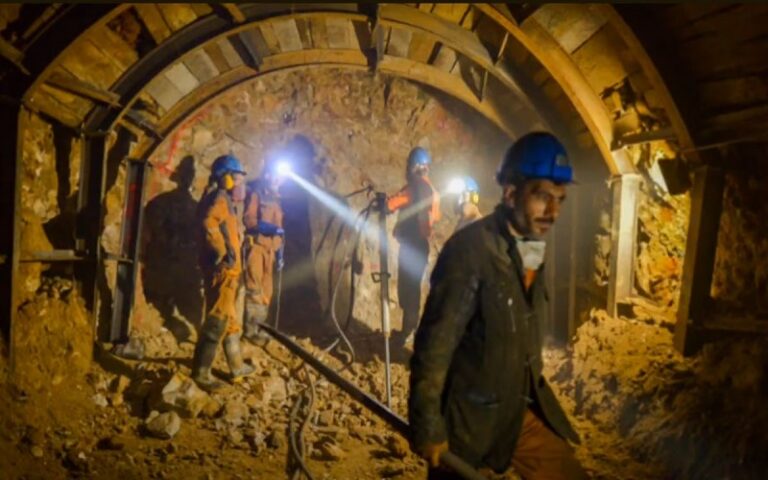
Meanwhile, miners in Iran have been grappling with various accidents in substandard mines for years, sometimes losing their lives in the process.