Home Blog Page 146

Experts Warn About the Iran’s Inflationary “War Budget” in 2025

Massoud Pezeshkian, the president of Iran’s regime, has presented his first budget bill to the Majlis (parliament) since taking office. This budget, with a 200% increase in military expenditures, has been likened to a “war budget,” with its general framework approved amid exceptional economic and security circumstances for Iran.

47% of Iran’s oil export revenues are set to go directly to the armed forces, similar to the current year. This amount, totaling 5.61 quadrillion rials (approximately $8 billion), leaves the government with only 43%, equivalent to 5.09 quadrillion rials (approximately $7.271 billion).

Accordingly, activists and economic analysts note a “war footprint” in the 2024 budget. This comes as budget resources, even excluding military expenses, have faced significant deficits in recent years.

Increased Withdrawals from the National Development Fund

For 2025, about 5.4 quadrillion rials (approximately $7.714 billion) of the budget deficit is expected to be covered by borrowing from the National Development Fund.

This is the first time a government has relied so heavily on borrowing from the National Development Fund in a budget bill.

Abdolnasser Hemmati, the Minister of Economy, recently stated that they have already withdrawn funds from the National Development Fund to cover the budget deficit, with permission obtained from the regime’s Supreme Leader.

Another portion of the budget deficit is to be covered by borrowing from the capital market and issuing treasury bonds. However, the debt burden from previous governments has become so heavy that the government’s borrowing from the debt market will place additional pressure on the capital market.

Inflationary Budget

Inflation is the most likely outcome of increased borrowing in next year’s budget, as government pressure on the debt market accelerates the cycle of liquidity creation. Inflation drivers in the 2025 budget are based on two pillars: “removal of state subsidies” and “liberalization of energy prices.”

Majlis members predict that the “reduction of foreign currency allocations for essential goods from $15 billion to $12 billion” in next year’s budget will drive up prices and inflation. As a result, some essential goods will be removed from the preferential currency basket.

Rising Energy Carrier Prices

Government officials have made conflicting statements about raising gasoline prices. In defense of the budget bill in Majlis, Pezeshkian stated that the production cost of gasoline is 80,000 rials (about 10 cents), indirectly suggesting his interest in raising gasoline prices.

Ambitious Goals for Oil Sales

In the budget bill, the government estimates oil exports at two million barrels per day. However, Iran’s oil sales have been limited by international sanctions, and the potential return of Donald Trump to office in the United States could increase international pressures on Iran’s presence in global markets.

Iran’s Regime Withholds 2 Million Hectares of Land Amid Peak Housing Prices

Despite the role of land scarcity in the significant cost of housing, Iran’s Ministry of Roads and Urban Development holds more than 1.8 million hectares of land.

The state-run ISNA news agency reported on Sunday, November 10: “With the release of less than six percent of the land acquired by the Ministry of Roads, the housing deficit of seven million units across the country could be resolved.”

Domestic newspapers have also highlighted this issue in their latest editions, with Quds Daily publishing a piece titled “The People’s Lands Held Under the Government’s Key” and Farhikhtegan Online reporting that “Land equivalent to 30 times the size of Tehran has been hoarded.”

Mohammad Bagher Ghalibaf, Speaker of the regime’s Majlis (parliament), also stated last week at the annual conference of the Housing Foundation of the Islamic Revolution that the National Land and Housing Organization holds twice the area of all residential land in the country in vacant land.

Land scarcity has consistently been cited as a barrier to housing development, and ISNA reported that in 2023, land accounted for more than 42% of the final cost of housing in urban centers and over 55% in Tehran.

These figures indicate a direct correlation between housing prices and land prices, suggesting that one solution to the housing crisis lies in addressing land costs.

Meanwhile, Massoud Pezeshkian, the regime’s Iran, stated during his election campaign this June that “solving the livelihood problems of the people” and “reaching the disadvantaged” are his top priorities in managing the country.

On November 4, Pezeshkian also remarked, “We are not afraid of military conflict,” but “what could bring us down are economic problems.”

At the same time, the Iranian Statistics Center reported in September that, as in the past, housing continues to account for the largest share of monthly inflation for households.

The center further reported that approximately 57% of the country’s monthly inflation in September was due to housing inflation, with housing’s share of monthly inflation rising since the beginning of the current year.

Additionally, a report from the Majlis Research Center in early November showed that, with Iran’s poverty rate solidly at over 30.1%, one-third of the country’s citizens are unable to meet their basic needs.

According to this report, Iran’s poverty rate reached 30.1% of the population in 2023, and estimates from the Majlis Research Center indicate that this rate will remain at its current level in 2024.

The center, reviewing the latest economic developments in Iran, emphasized that policymakers should avoid inaction and delays and pursue gradual reform policies to address some of the existing imbalances.

In 2018, the World Bank reported that about 420,000 people in Iran were living below the absolute poverty line. According to a 2018 report from the Majlis Research Center, between 23% and 40% of Iran’s population were living below the poverty line.

Iranian Man Sentenced to Hand Amputation on Bank Robbery Charges

Armin and Hatef, the primary and secondary suspects in the robbery of safety deposit boxes at the University Branch of Bank Melli, were sentenced to hand amputation by the Tehran Province Criminal Court. The Supreme Court of Iran has also charged them with “corruption on earth,” which could lead to severe punishments such as the death penalty.  

On November 9, the regime’s Etemad newspaper reported that Armin and Hatef, the primary and secondary suspects in the Bank Melli University Branch safety deposit box robbery, faced the charge of “corruption on earth” on November 6 from Branch 17 of the Supreme Court of Iran.  

According to the report, the two were tried in mid-September by the Tehran Province Criminal Court and sentenced to hand amputation on the charge of “hudud theft” (a category of theft punishable under Islamic law).  

The amputation sentences were issued despite the Iranian regime’s commitment to the International Covenant on Civil and Political Rights, which explicitly prohibits degrading and inhumane punishments. Hand amputation is considered one of these punishments.  

Such punishments violate the principle of human dignity, a fundamental tenet of human rights. Iran remains one of the few countries that applies corporal punishment, including amputation, for certain crimes and has not joined the United Nations Convention Against Torture.  

Iranian media reported in June that the robbers at Bank Melli’s University Branch in Tehran gained entry via a backdoor located in the building’s internal parking area. They then cut through a large safe and bypassed its code to access the safety deposit box area.  

The lead defendant’s lawyer argued against the “corruption on earth” charge, stating, “Not every action that disrupts public order qualifies as corruption on earth.”  

In recent months, those who lost property in the Bank Melli safety deposit box robbery have repeatedly held protests, demanding the return of their belongings.  

Despite a rise in theft in Iran, robberies targeting state banks have been rare, with safety deposit box heists being even less common.

Iran Regime’s Budget Policies for Next Year Raise Concerns

Frashad Momeni, a government-affiliated economist, expressed concern over a potential 40% increase in gasoline prices in Iran’s 2025 budget proposal, calling the overall budget policies “dangerous and worrisome.”  

In an interview with the Jamaran website, this university economics professor criticized “secrecy” in the government’s framework, identifying the lack of transparency as a major flaw in next year’s budget proposal.  

According to Momeni, despite warnings to the administration of Iranian regime’s president Masoud Pezeshkian about the “significant economic, social, political, and even national security costs” that would accompany a gas price increase, the Deputy Chair of the regime’s Majlis (parliament) Budget and Planning Commission recently announced that the government intends to raise gas prices by at least 40% next year.  

The sudden rise in gasoline prices in November 2019 triggered widespread protests in Iran, which were met with a harsh crackdown by the regime. According to Reuters, at least 1,500 protestors were killed during the November crackdown.  

Mehrdad Lahouti, Deputy Chair of Majlis Budget and Planning Commission, told the government-affiliated ILNA news agency that due to a reduction in the government’s budget for gasoline imports in next year’s budget proposal, gasoline “is very likely to become more expensive next year.”  

In his remarks, Momeni criticized the $6 billion reduction in the foreign currency allocation for importing essential goods at subsidized prices in next year’s budget, noting that this action, along with reduced imports of essential goods, will drive up the prices of these items.  

He described this policy as one that will simultaneously increase inflation and unemployment, resulting in widespread poverty.  

ILNA has projected that next year, due to a $3 billion cut in the import budget, an inflation-adjusted increase in the preferential exchange rate, and the deregulation of energy prices—including electricity—costs will rise significantly.  

Momeni criticized the economic policies in Iran since 1989 as crisis-inducing and stated that the approach to managing the nation’s economy has remained unchanged.  

Referring to inequalities in cash flow distribution among Iranians, this economist noted that more than 82% of the country’s liquidity is concentrated in the hands of just 2.5% of depositors.  

He also described the government’s two-phase approach to presenting budget components to Majlis as a move that “exacerbates the transparency crisis.”  

Citing performance evaluation reports from the Sixth Development Plan, which covered the five-year period from 2016 to 2021, Momeni said that despite the allocation of foreign currency and rial resources “far beyond the amounts projected in the legislation,” only 9% of the plan’s goals have been achieved.

Widespread Power Outages Begin in Several Iranian Provinces

Electricity distribution companies in several provinces, including Ardabil, Kermanshah, and Razavi Khorasan, announced that power outages would be enforced across these provinces starting at 9 a.m. on Sunday, November 10. Contrary to previous reports, power outages in the capital also began today.  

On Sunday, the website for Greater Tehran’s electricity distribution company published a blackout schedule.  

On Saturday, November 9, domestic media reported that due to insufficient fuel for power plants, power outages would commence nationwide.  

In recent days, Masoud Pezeshkian ordered a halt to mazut (heavy oil) burning in three power plants, replacing it with scheduled blackouts.  

According to Abdolreza Taghavi, Chairman of Central Regional Power Production, mazut burning at the Shazand power plant was halted as the plan went into effect today.  

Taghavi stated that currently, 1.8 million cubic meters of gas are allocated daily to the Shazand plant, but they are requesting a full gas quota.  

On November 7, government spokesperson Fatemeh Mohajerani posted on X (formerly Twitter) that for a limited time, “scheduled blackouts” could replace “pollution production” for the general public.  

In this context, Reza Sepahvand, a member of the parliamentary Energy Committee, stated on Sunday that if mazut is not burned, the only option is scheduled power and gas outages for households and industries. He added, “Apart from mazut, we have no other source to supply gas in the coming months.”  

He continued, “We experienced industrial power cuts in the summer, which harmed the industry and agricultural sectors, and repeated outages created many issues for households.”  

In recent days, government officials, state-affiliated media, and Pezeshkian’s supporters have been attempting not only to justify but also to praise the scheduled and nationwide blackouts, reminiscent of the 1980s, and to portray them as an achievement of the new administration.  

Mohammad Jafar Qaem Panah, Pezeshkian’s executive deputy, also blamed the public for the imbalances and mazut use, suggesting that citizens should reduce home heating by a few degrees and consume less gas and electricity to mitigate blackouts.  

He also attributed part of the problem to the “extremely low cost” and subsidies on energy carriers.  

Hassanali Taghizadeh, Chairman of the Electricity Syndicate, warned officials in late September: “If we continue on this path, the imbalance will reach 25,000 megawatts next year.”  

Taghizadeh also stated, “Don’t blame the people; don’t falsely claim that their consumption is high. The per capita electricity consumption of Iranians is 1,022 kilowatt-hours per year, compared to 2,120 kilowatt-hours in Europe. Our people consume very little electricity compared to the world, but we have a habit of blaming them.”  

On Sunday, the government-affiliated Fars News Agency reported, based on data from the Ministry of Energy, that since September this year, the process of refilling liquid fuel reserves for power plants has halted, gradually reducing the reserves to one-third.  

According to the report, gas supplies to power plants dropped by 30% in the first two weeks of this month compared to last year, and diesel reserves for power plants fell to less than 1.26 billion liters, placing Iran’s electricity grid on the verge of an emergency state.  

In Iran, 80% of electricity is generated by thermal power plants, which rely primarily on natural gas for cleaner production without exacerbating air pollution.  

In the absence of natural gas or diesel, power plants turn to mazut as an alternative.  

Mazut contains high levels of sulfur and other toxic compounds, and burning it releases a large amount of particulate matter and toxic gasses.

Iranian Retired Teachers Protest in Front of the Ministry of Education

A group of retired teachers held a protest on Sunday, November 10, in front of the Ministry of Education building in Tehran, demanding attention to their unmet needs. Coming from various cities, they expressed dissatisfaction with the non-payment of 60% of the bonuses promised for their 30 years of service.  

At the protest, retired educators chanted slogans such as, “Incompetent minister, resign, resign,” “This much injustice, no nation has seen,” “One less embezzlement would solve our problems,” “Teachers, shout out, demand your rights,” “Teachers, rise up, end the discrimination,” “Enough, enough, of this oppression,” and “Lying officials, where are the fruits of my labor?”  

One protest participant addressed Education Minister Alireza Kazemi from President Pezeshkian’s administration, saying, “Mr. Minister, your duty is education. When our officials have nothing to offer, they bring up prayer and ritual matters. In his first speech, the minister expressed concern about students’ prayers. Mr. Minister, your responsibility is education.”  

Images shared on social media reveal that some retired teachers who traveled from other cities slept in parks in Tehran the night before, braving the cold to participate in the protest.  

According to reports in media outlets covering retirees and teachers, this protest is expected to continue on Monday, November 11, in front of the Ministry of Education building in Tehran.  

These retired educators, who have been retired for over one or two years, have yet to receive their end-of-service bonuses or see the promised adjustments from the grading reform implemented.  

In October, Alireza Kazemi, the Minister of Education in Masoud Pezeshkian’s administration, stated that the upcoming budget would include 50% of the retirement bonuses for teachers this year and next year to bring payments up to date.  

This is not the first time retired teachers have held a protest.  

On October 22, retired teachers from across Iran also protested in front of the Social Security Organization in Tehran.  

Despite promises from the Iranian regime, the living conditions for retirees in Iran continue to deteriorate day by day.

Trump’s Plan to Address Iran’s Nuclear Threat

Reuters has reported on the growing nuclear threats from Iran, Russia, China, and North Korea, challenges that U.S. President-elect Donald Trump will face when he takes office in January.

The report notes the possibility that Iran may decide to pursue nuclear weapons and mentions that, following a retaliatory strike by Israel, a senior Iranian official said Tehran might reconsider its self-imposed ban on developing nuclear weapons.

Kamal Kharazi, head of Iran’s Strategic Council on Foreign Relations, stated in this regard: “If Iran’s existence is threatened, we will be forced to change our nuclear doctrine.”

Reuters adds that when the United Nations Security Council resolution allowing the rapid reimposition of international sanctions against Iran expires the U.S. and its European allies will lose their remaining options on the matter.

In 2018, Donald Trump withdrew the U.S. from the Joint Comprehensive Plan of Action (JCPOA), which analysts say led Iran to violate its nuclear commitments.

Under that agreement, Tehran had restricted uranium enrichment, an activity seen by the West as a covert effort to develop nuclear weapons capabilities.

American officials state that the time required for Iran to produce enough enriched uranium for a warhead has now decreased from one year to a few weeks or even days, though it would still take Iran longer to develop an actual bomb.

In a confidential report on August 29, the International Atomic Energy Agency (IAEA) stated that Iran had increased its stockpile of enriched uranium to levels “close to weapons-grade,” in defiance of international demands.

Experts say that increasing the enrichment of uranium from 60% purity to weapons-grade 90% requires only “a short technical step.”

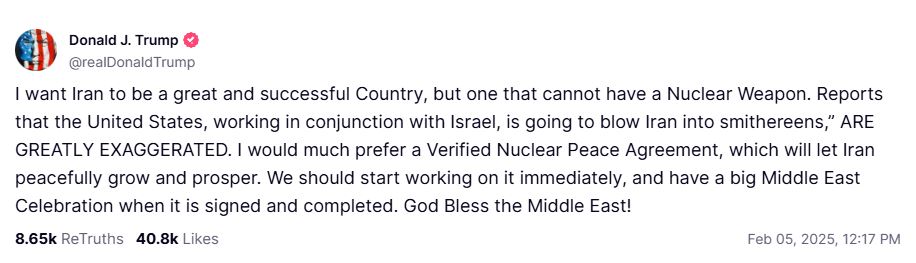
On November 5, U.S. President-elect Donald Trump stated at a campaign rally that he wants Iran to be “a very successful country” but “cannot allow it to have nuclear weapons.”

The next day, Rafael Grossi, the director general of the IAEA, said he might travel to Tehran in the coming days to discuss Iran’s nuclear program.

He also added that he hopes to work with U.S. President-elect Donald Trump to address Iran’s nuclear challenge.

U.S. Department of Justice: IRGC Ordered an Agent to Assassinate Trump Before Election

0

On November 8, the U.S. Department of Justice released a statement providing further details on the Iranian regime’s efforts to assassinate U.S. President-elect Donald Trump before the November 5 election.

According to the statement, a criminal complaint filed in Manhattan federal court indicates that an unnamed official in Iran’s Islamic Revolutionary Guard Corps (IRGC) instructed an operative, identified as Farhad Shakeri, in September to devise a plan to monitor and ultimately assassinate Trump.

The Department of Justice stated that the IRGC official informed Shakeri that if he could not carry out the assassination before the election, the plot would be postponed until after the election, as Trump was expected to lose, which would make it easier to assassinate him.

The statement mentions that Shakeri had previously informed the FBI that he did not intend to submit an assassination plan within the seven-day deadline imposed by the IRGC official.

The U.S. government had earlier confirmed that the Iranian regime sought revenge for the death of Qassem Soleimani, the former commander of the IRGC’s Quds Force, by targeting Donald Trump and several members of his first administration, including Mike Pompeo, Brian Hook, and John Bolton.

According to the U.S. Department of Justice, Farhad Shakeri, a 51-year-old Iranian, Carlisle Rivera (known as “Pop”), a 49-year-old from Brooklyn, New York, and Jonathon Loadholt, a 36-year-old from Staten Island, New York, were charged on Friday for involvement in a plot to assassinate an Iranian-American citizen in New York.

Rivera and Loadholt were arrested on Thursday, November 7, and appeared in the Southern District of New York court. They will remain in custody until trial, while Farhad Shakeri remains at large, likely residing in Iran.

U.S. Attorney General Merrick B. Garland said:“There are few actors in the world that pose as grave a threat to the national security of the United States as does Iran. The Justice Department has charged an asset of the Iranian regime who was tasked by the regime to direct a network of criminal associates to further Iran’s assassination plots against its targets, including President-elect Donald Trump. We have also charged and arrested two individuals who we allege were recruited as part of that network to silence and kill, on U.S. soil, an American journalist who has been a prominent critic of the regime. We will not stand for the Iranian regime’s attempts to endanger the American people and America’s national security.”

Christopher Wray, FBI Director, also commented: “The charges announced today expose Iran’s continued brazen attempts to target U.S. citizens, including President-elect Donald Trump, other government leaders and dissidents who criticize the regime in Tehran. The Islamic Revolutionary Guard Corps — a designated foreign terrorist organization — has been conspiring with criminals and hitmen to target and gun down Americans on U.S. soil, and that simply won’t be tolerated. Thanks to the hard work of the FBI, their deadly schemes were disrupted. We’re committed to using the full resources of the FBI to protect our citizens from Iran or any other adversary who targets Americans.”

Damian Williams, U.S. Attorney for the Southern District of New York, added:  “Actors directed by the Government of Iran continue to target our citizens, including President-elect Trump, on U.S. soil and abroad. This has to stop. Today’s charges are another message to those who continue in their efforts – we will remain unrelenting in our pursuit of bad actors, no matter where they reside, and will stop at nothing to bring to justice those who harm our safety and security. I want to thank the career prosecutors of this office and our law enforcement partners for their ongoing work in this and related investigations. They are truly the best of the best and work tirelessly to keep our country safe.”

According to the U.S. Department of Justice, Shakeri, an IRGC agent residing in Tehran, migrated to the United States as a child and was deported around 2008 after serving a 14-year sentence for theft.

The DOJ statement adds that in recent months, Shakeri leveraged a network of criminals he met in U.S. prisons to recruit individuals for the IRGC’s espionage and assassination operations.

Shakeri informed law enforcement officers that on October 7, 2024, he was ordered to devise a plan to assassinate U.S. President-elect Donald J. Trump. He told officers he did not intend to carry out the plan within the IRGC’s specified timeframe. Shakeri also reported that he had been tasked with spying on two Jewish-American citizens in New York, with an IRGC official offering $500,000 for the assassination of each individual. He was additionally instructed to target Israeli tourists in Sri Lanka.

Iranian Regime Reactions to Trump’s Second Presidency

0

The political landscape in Iran, particularly in light of international developments, reveals that the ruling regime has long pursued a policy of confronting internal discontent through repression. The regime closely monitors local and international events to assess their impact on the growing public discontent. This has gained particular significance with the increasing international isolation and economic crises threatening the regime’s survival. Political developments in the United States, especially election outcomes, bear critical implications for the future of the Iranian regime. While Supreme Leader Ali Khamenei and other leaders publicly deny such influence, initial reactions reveal the truth.

Ahmad Zaid Abadi, a theorist from the so-called reformist faction within the regime, commented on the possible return of Donald Trump to presidency in the U.S.: “To have a narcissistic, deceitful, and unpredictable figure in the White House for another four years is torment for people like me thousands of kilometers away.”

Zeid Abadi added, “The primary problem is that we do not know how Trump would handle global crises, especially the Middle East crisis. Personally, I would need three days of meditation in the mountains around the village of Shurcheshmeh to reorganize my thoughts and understand the new circumstances.”

He further emphasized Iran’s limited capabilities: “If Trump acts aggressively in our region, how can we confront him? Our capabilities are limited, while his executive apparatus possesses immense power!”

Zeid Abadi also expressed concern about the potential return of David Friedman as part of the U.S. administration, stating: “I cannot bear the thought of David Friedman’s return to a position of power in the U.S. Middle East policy! Are the three mentioned problems not enough to highlight more?”

In a previous interview with the “Ham-Mihan” newspaper, Zeid Abadi noted: “If we assume Donald Trump regains the presidency and figures such as Jared Kushner and Mike Pompeo return to power, they will push us into submission under humiliating conditions. Otherwise, they will escalate and initiate attacks… Sometimes governments are forced to choose between bad and worse. Under current conditions, we need to find the best option for our country. Continued conflict means more blows to Iran, potentially extending beyond military strikes to affect its political standing and even creating an existential crisis.”

Similarly, Sadeq Hosseini, another prominent regime theorist, expressed his concerns about Trump’s return and its negative impact on the Iranian regime on his Telegram channel: “Four years ago, when Biden was elected, I said that Trump and Trumpism would return strongly and win the next presidential election. I repeatedly warned that time is running out, and we need to undertake internal reforms and solidify our position in the region and the world before Trump’s return. However, nothing was done.”

Hosseini also foresees that a second Trump term would be more perilous, expecting early pressure on Iran’s regime, particularly through reduced oil revenues. He also anticipates the U.S. to confront Iran’s regime openly, thereby increasing economic risks and complicating regional decision-making.

Use Of Mazut in Iranian Power Plants Due to Gas Shortage

Keramat Veis Karami, the CEO of the National Iranian Oil Products Distribution Company, announced an 80% increase in the supply of fuel oil (mazut) to the country’s power plants last month due to a shortage of natural gas.

On Monday, November 4, Veis Karami stated that the supply of mazut to Iranian power plants in September and October this year had increased by 75% and 80%, respectively, compared to the same months last year.

He did not specify the current status of mazut use in power plants but mentioned that diesel delivery to power plants in November had also risen by 80% compared to last year due to a 3.8-degree drop in temperature.

Saeed Tavakoli, CEO of the National Iranian Gas Company, stated last week that Iran faces a daily gas deficit of 250 to 300 million cubic meters this year, which must be offset by supplying equivalent fuels (mazut and diesel) to power plants and industries.

Mazut is the most polluting fossil fuel, and Iranian-produced mazut is especially harmful due to its 3.5% sulfur content, which is seven times the limit set by the International Maritime Organization for tanker fuel.

The diesel fuel used in Iran’s electric power plants also does not meet Euro standards and, with its high sulfur content and low quality, produces significant pollution.

The regime’s Majlis (parliament) Research Center and the National Development Fund of Iran report that Iran faces a gas deficit throughout the year, which intensifies sharply in the autumn and especially in winter.

Veis Karami’s comments indicate that Iran has even increased mazut and diesel supplies to power plants during the warmer months, leading to an overall 38% increase in the delivery of these polluting fuels to power plants this year.

Despite the severe gas shortage and widespread use of mazut, the CEO of the National Iranian Gas Company stated that “halting gas exports is not advisable.”

On October 31, he remarked that stopping gas exports to Turkey, for instance, “could not only damage Iran’s credibility in global markets but also lead to the replacement of Iranian gas with gas from rival countries like Russia and Turkmenistan.”

He added that suspending gas exports would also reduce the country’s foreign exchange earnings.

Under this year’s budget law, the government has planned to export 11 billion cubic meters of gas to Turkey and Iraq, while in next year’s budget bill, Massoud Pezeshkian’s administration aims to raise this figure to 16 billion cubic meters, projecting a revenue of 5.2 billion dollars.

Despite possessing the world’s second-largest natural gas reserves, Iran struggles to meet its domestic consumption needs.