Home Blog Page 169

Iran: Nationwide Protests of Nurses Reach Tehran

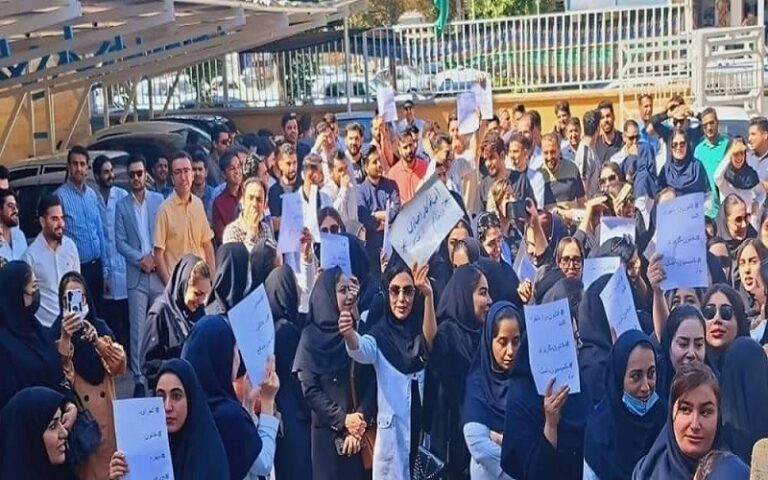
The nationwide protests of nurses over harsh working conditions and unaddressed demands have reached the capital of Iran after more than two weeks.

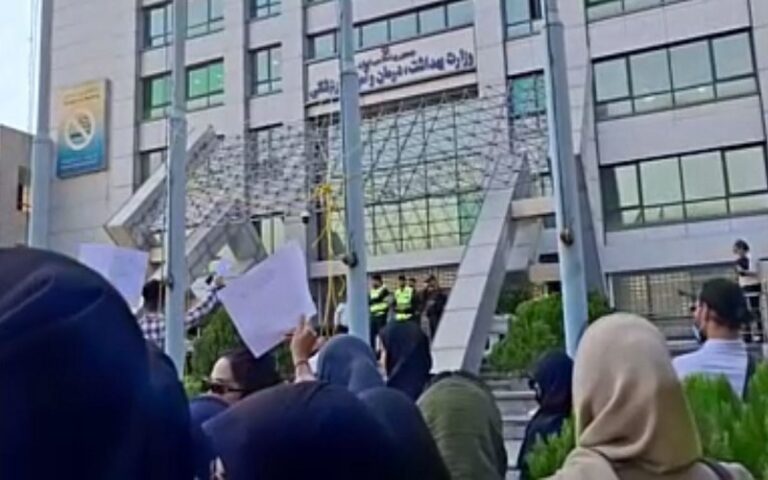
According to images shared on social media, nurses in Tehran gathered in front of the Ministry of Health, Treatment, and Medical Education on Wednesday, August 21.

At this gathering, nurses chanted slogans such as “Overtime pay of 200,000 rials (approximately $0.33), shame, shame,” “Promises are just slogans, poor nurses,” and “Without nurses, the system will collapse.”

Simultaneously, other protest gatherings were held in cities like Isfahan, Tabriz, Rasht, Ahvaz, Marivan, Dehdasht, and Kermanshah.

The nurses’ protests have been ongoing for months, but the latest wave began on August 3 with protests and strikes at hospitals in Shiraz, which then spread to other cities.

Nurses at Shiraz hospitals have been on strike since Saturday, August 3, in protest against “mandatory overtime, non-implementation of laws, low wages, heavy and demanding work, insults, and threats,” and have demanded direct attention from Massoud Pezeshkian, the President of Iran’s regime.

In some cities, including Shiraz, nurses have stopped working, and in other cities, like Isfahan, nurses have threatened to strike if the authorities continue to ignore their demands.

The state-run Ham-Mihan newspaper reported on Sunday, August 11, that 90% of nurses at Shiraz hospitals have stopped working, and instead of hospital managers contacting these nurses, “security agencies and head nurses have contacted them, threatening them with dismissal, legal action, and summons.”

Previously, professional associations had also reported threats against nurses in this city by security agencies.

Mohammad Sharifi Moghadam, Secretary of the Nurses’ Home, said on Thursday, August 15, that due to the nurses’ strike in recent days, operating rooms in five or six hospitals in Shiraz have been completely shut down.

Sharifi Moghadam, pointing out the extreme difficulties of the nursing profession, stated that the suicide rate among nurses is “significantly higher than other groups, but it is not publicized.”

Security Forces Raid, Shut Down Goethe Institute in Tehran

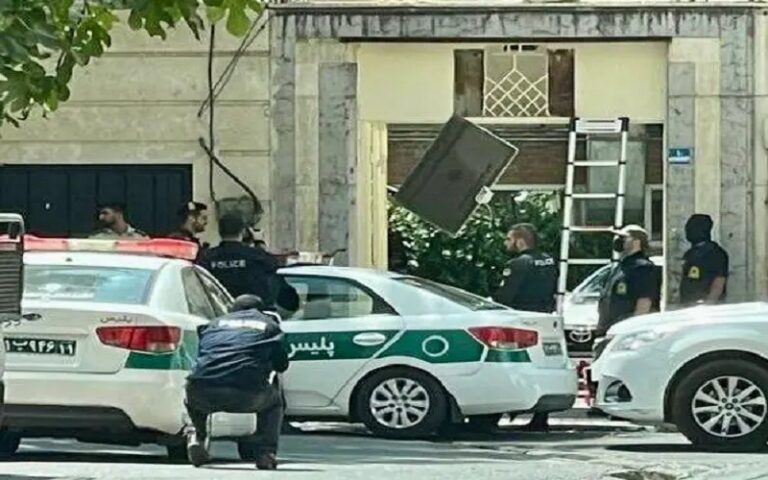
Less than a month after the German government banned the Islamic Center Hamburg and 50 related centers, Iranian police raided two branches of the Goethe Institute in Tehran, forcibly removing its staff, employees, and visitors. The sign of the institute, which operated under the supervision of the German Embassy, was also removed.

Hours after the incident, Germany summoned the Iranian regime’s ambassador in Berlin.

On Tuesday, the German Foreign Ministry announced that it had summoned Iran’s ambassador and demanded that the Iranian government immediately allow the Goethe Institute in Tehran to resume its teaching activities.

A spokesperson for the German Foreign Ministry stated, “We condemn the actions of the Iranian security forces against the German language institute in Tehran. There is no justification for this action. Language exchange is fundamental to mutual understanding.”

Government forces removed the signs from the institute’s branches in Dibaji and Qolhak in northern Tehran and sealed the institute, which operates under the German Embassy’s supervision.

Mizan News Agency, the media outlet of the Iranian judiciary, issued a statement on Tuesday labeling the Goethe Institute as an “illegal center affiliated with the German government” and accusing it of “violating national laws.”

The regime-affiliated media outlet also claimed that the two branches of the Goethe Institute had engaged in “multiple illegal activities and widespread financial violations,” stating that their closure was carried out “under judicial orders.”

The Goethe Institute, with years of experience, offers various German language courses for adults at different levels and conducts official and international language proficiency exams.

According to Mizan, investigations are “underway” regarding “other German-affiliated centers” operating in Iran, based on “reports of violations.”

Meanwhile, the Sabereen News Telegram channel, affiliated with the Islamic Revolutionary Guard Corps (IRGC), stated that this was “a retaliatory action for the closure of cultural and Islamic centers in Germany.”

The attack on the Goethe Institute comes as the head of a Health Ministry committee reported in an interview with a newspaper that there has been a large-scale migration of nurses to Germany, stating that in recent years, 30,000 hospital faculty members have emigrated.

Germany’s Office for the Protection of the Constitution had previously stated that there is evidence indicating that the Islamic Center Hamburg is a significant propaganda hub for Iran in Europe and a branch of the Iranian regime.

According to a ruling by the Hamburg Administrative Court, the Islamic Center of Hamburg, also known as the “Blue Mosque,” has been classified as an “extremist Islamist organization.”

In June 2022, Hamburg officials issued an expulsion order to Soleiman Mousavi-Far, the deputy head of the Islamic Center Hamburg, and three months later, he was deported from Germany.

Iran’s Regime Stealing U.S. Election Data, Attempting to Affect Outcome

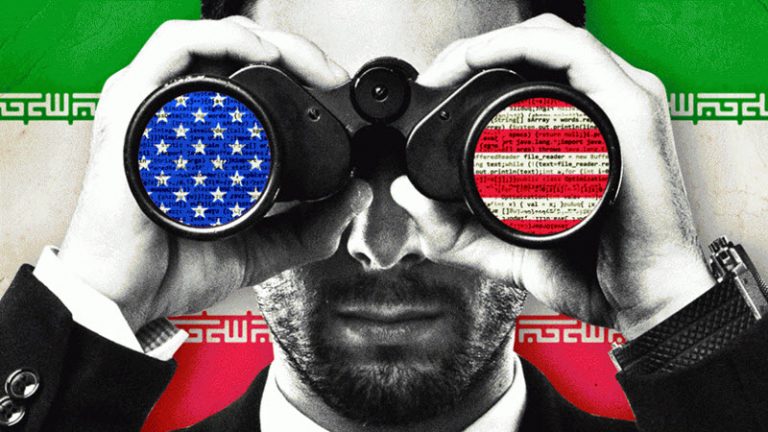
The FBI, the Office of the Director of National Intelligence, and the Cybersecurity and Infrastructure Security Agency of the United States issued a joint statement on Monday warning about the Iranian regime’s attempts to interfere in the 2024 U.S. presidential elections.  

They advised campaign teams to implement necessary security measures, including using official emails only for official business, not opening suspicious emails, updating software, using strong passwords, and enabling multi-factor authentication.  

The three organizations stated that the Iranian regime seeks to sow discord and undermine public trust in U.S. democratic institutions. Additionally, Iran has a long-standing interest in exploiting social tensions through various means, including cyber operations to access sensitive information related to U.S. elections.  

The statement also notes that the Iranian regime is aiming to complicate any U.S. administration’s ability to pursue foreign policies that conflict with Tehran’s interests.  

The statement recalls that the U.S. intelligence community had previously reported that the Iranian regime views this fall’s U.S. elections as particularly significant and is increasingly attempting to influence the outcome.  

“We have observed increasingly aggressive Iranian activity during this election cycle, specifically involving influence operations targeting the American public and cyber operations targeting Presidential campaigns,” said the statement released by the FBI, DNI, and CISA.

In their joint statement, the three U.S. security agencies mentioned that the Iranian regime’s activities include those recently reported regarding the compromise of former U.S. President Donald Trump’s campaign, which the U.S. intelligence community attributed to the Iranian government.  

The Iranian Regime’s Response to the Report  

In response to the report, Mizan News Agency, affiliated with Iran’s judiciary, quoted Iran’s representative at the United Nations as saying, “Such claims are baseless and without any merit.” He reiterated that “Iran has no intention or motive to interfere in U.S. elections.”  

The Iranian representative at the UN, asserting that Iran has “no intention or motive to interfere in U.S. elections,” asked the U.S. government to “provide us with their evidence so we can respond.”  

Last Monday, the FBI announced that it was investigating suspicious attempts attributed to the Iranian government to hack the Democratic Party’s campaign and one of Donald Trump’s aides.  

Earlier, U.S. media reported that Iranian regime hackers had likely managed to hack the personal email account of Roger Stone, a veteran Republican operative and close associate of Trump.  

The joint statement by U.S. security agencies indicates that the U.S. intelligence community is confident that Iranian regime operatives, through “social engineering” and other efforts, have sought access to individuals directly involved in the presidential campaigns of both major U.S. political parties, and “such activities, including thefts and leaks, are intended to influence the U.S. election process.”  

According to the statement, such actions have previously been carried out by the Iranian and Russian regimes during past U.S. elections and in other countries. The FBI has tracked these activities, been in contact with the targets, and continues to investigate and gather information to pursue and disrupt those threatening the integrity of U.S. elections.  

The FBI, DNI, and CISA stated that they will not tolerate foreign efforts to influence or interfere in the November 5, 2024, U.S. presidential elections, including targeting the candidates’ campaign teams.

Protests by Nurses in Several Iranian Cities

Protests by groups of nurses and healthcare workers continue in objection to poor working conditions and unmet demands.

These protests were held on Sunday, August 18, in several cities, including Mashhad, Yasuj, Jahrom, and Qazvin.

The protest by nurses at Imam Reza Hospital in Mashhad continued for a second day, and nurses from other medical centers in the city, including Hasheminejad Hospital, Akbar Children’s Hospital, Taleghani Hospital, and Velayat Hospital, joined the protests on Sunday.

In Yasuj, the nurses’ protest also continued for a second day.

Images of the nurses’ protests in the cities of Jahrom and one of the hospitals in Qazvin have also been circulated on social media.

The main demands of the protesting nurses include tariff reform, implementation of the law on hard and hazardous jobs, and the cancellation of mandatory overtime.

Nurses’ protests have been ongoing for months, but the latest round began on August 3 at hospitals in Shiraz and has since spread to other cities.

During previous protests, reports emerged of threats and pressure against the protesters. Last month, Mohammad Sharifi Moghadam, the Secretary-General of the House of Nurses, stated that around 60 nurses in Kerman had been summoned to participate in the protests.

Following the widespread nurses’ strike across the country, teachers’ and students’ unions also expressed their support for the nurses’ strike.

Security forces at Sadoughi Hospital in Yazd have threatened striking nurses that they will be dismissed if the protests continue.

A senior nursing expert from Isfahan told Iran Focus:

“Our main problem is the lack of implementation of the tariff law, merit increases and compulsory overtime. We receive 20,000 tomans (approximately $0.33) for each hour of overtime. Doctors’ payment for overtime can be up to ten times or more. My net salary is 13.8 million tomans (approximately $230). Even service jobs receive 40,000 tomans (approximately $0.66) per hour for overtime.

The tariff law is not being implemented, and there is a mafia behind this corruption. Work experience does not significantly affect our salary.

Overtime is mandatory. We have no desire to work overtime for 20,000 tomans per hour, but due to staff shortages, we are forced to do so. My total salary is no more than 15 million tomans (approximately $250).

Patients’ companions do not treat us well. No one bothers the doctors; they directly confront us.

The number of work shifts is very high. This month, I have worked more than 29 shifts. Nurses are not provided with hospital food, which is of very low quality. We only get one meal during the night shift.

Low wages are not just for nurses. Even faculty members with a master’s degree earn around $250, and a nurse with a Ph.D. earns about 25 million tomans (approximately $417). As a nurse, I intend to emigrate.”

Qasem Abotalebi, a member of the Supreme Council of the Nursing System, announced in Mars 2024 that the country is facing a shortage of at least 100,000 nurses.

Frustrated with their working conditions, nurses are striking in an attempt to secure their rights.

The strikers are demanding an immediate wage increase, the elimination of mandatory overtime, proper and prompt implementation of nursing tariffs, payment of overdue wages, improvement of harsh working conditions, and an end to the security crackdowns on protesting nurses.

The strike is so widespread that the regime’s security apparatus is attempting to intensify repression through threats, summons, legal action, and the deployment of replacement forces to break the strike.

The statement emphasized that everyone must collectively support the strike in the face of “assaults, threats, and attacks by the regime against the nurses.”

Parvaneh Mandani, a nurse at Imam Hossein Hospital in Sepidan, died on August 2 after accompanying three patients for transfer from this hospital to another in Shiraz due to overwork, a condition referred to in medicine as “Karoshi Syndrome.”

After the death of this 32-year-old nurse, widespread nurses’ strikes began in various cities.

Ahmad Nejatiyan, the head of the Nursing Organization, said in a television interview: “Currently, our nurses are working with half the standard nursing workforce, which leads to mandatory overtime. We cannot stop serving patients, and therefore, nurses are forced to work up to 100 hours of mandatory overtime per month.”

It is reported that nurses receive around 200,000 rials (approximately 33 cents) for each hour of mandatory overtime.

Mohammadreza Sharifi Moghadam, Secretary-General of the House of Nurses, in an interview with the regime’s Shargh daily, mentioned that according to statistics, more than 30% of nurses have experienced physical violence in the workplace. He stated, “A nurse in Yasuj lost an eye due to an attack by a patient’s companion. We have received reports of knife wounds to the neck, chest, and fractures as a result of attacks by patients’ companions.”

On August 11, the Ham-Mihan newspaper reported that nurses from nine hospitals in Shiraz and one hospital in Karaj have stopped working since last week in protest over the neglect of their demands.

The Ham-Mihan report also pointed out the security measures taken against the protesting nurses.

The newspaper quoted a nurse as saying that security forces had contacted him, accused him of being a leader of these strikes, and subsequently threatened him with dismissal.

Sharifi Moghadam, in an interview with Sharg, stated that a formally employed nurse with 15 years of experience earns a salary of 14.9 million tomans (approximately 2.49 million rials or $250), from which 10%, or 1.49 million rials (approximately $25), is deducted for insurance.

The Secretary-General of the House of Nurses noted that nurses in the United States earn between $4,000 and $6,000, and in Europe between €3,000 and €4,000. He said, “Our nurses prefer to stay home rather than do such hard work for a monthly salary of 15 million tomans (approximately 2.5 million rials or $250).”

The problems in the nursing system and the healthcare sector in Iran are not limited to the recent strikes. Nurses also protested in July of this year.

Fereydoun Moradi, a member of the Supreme Council of the Nursing System, announced in June that 150 to 200 nurses migrate each month.


At Least 8 Prisoners Executed in Iran, over 100 Executions Since Presidential Election

Human rights sources report the ongoing trend of executions in Iranian prisons, and political prisoners held in the women’s ward of Evin Prison have stated that despite the pressures, they will continue to fight against the death penalty.

Human rights media outlets have reported that at least eight prisoners were executed early Monday morning, August 19.

Reports indicate that five people were executed in Yazd Prison, identified as three Baluch citizens and two Afghan nationals.

The Iran Human Rights Organization also reported the execution of three people in Adelabad Prison in Shiraz early Monday morning.

On Tuesday, August 8, security forces at Evin Prison attacked women who had gathered as part of the “No to Executions Tuesdays” campaign to protest the execution of Reza Rasaei. According to reports, they were assaulted.

The prisoners, noting the pressures following this raid, including the banning of visits and phone calls for those who participated in the gathering, emphasized that despite these pressures, their opposition to the death penalty would continue.

Golrokh Iraee, a political prisoner held in Evin Prison, also emphasized in a letter published on Monday that all citizens “from whatever position we are in, as political activists, critics, or opponents, and even those who consider themselves apolitical” must condemn the death penalty and openly oppose it.

The pace of executions has increased in recent months, and according to estimates by the Norway-based Iran Human Rights Organization, at least 87 people were executed in Iranian prisons in just one month following the election of Masoud Pezeshkian as president. Including those executed during the election campaign, this number reaches 100.

Recently, Volker Türk, the United Nations High Commissioner for Human Rights, also expressed concern over the trend of executions in Iran.

Iran: Power Outages Eliminate 40% of Production Capacity in Khorasan Province

The head of the Iranian regime’s Chamber of Commerce has reported that Iran’s production has reached its lowest level in the last 36 months. Meanwhile, Mohammad Sahamian-Moghaddam, a member of the board of the Industrial Managers Association of Razavi Khorasan Province, has announced that at least 40% of production capacity has been lost. Tavanir (the Iran Power Generation, Transmission, and Distribution Company) has ordered industries to reduce consumption by 90%.

Samad Hassanzadeh, the head of Iran’s Chamber of Commerce, also emphasized that in July this year, there has been a significant reduction in production in 12 industrial sectors across the country.

Sahamian-Moghaddam told the state-run Ham-Mihan newspaper that on Saturday, August 17, “around 1,000 factories were contacted,” and “there is a recording stating that electricity consumption must be reduced by more than 90% for two weeks; otherwise, due to grid issues, power will be cut off without notice.”

Sahamian-Moghaddam emphasized that this order was issued by Mostafa Rajabi Mashhadi, the CEO of Tavanir, from Tehran. According to him, “By law, they do not have the right to cut off electricity to industries.”

This private sector activist also spoke about the consequences of power outages on Iran’s economy, stating that many export-oriented companies have fallen significantly behind in their export schedules, and many of their export contracts are on the verge of cancellation.

Sahamian-Moghaddam also mentioned the impact of these blackouts on the domestic market, saying, “Some companies are losing their customers, suffering losses, and facing penalties.”

Another impact of the blackouts is on employment. Sahamian-Moghaddam told Ham-Mihan newspaper that some companies have lost employees and are in the process of layoffs, while others have faced equipment failures due to sudden power cuts.

Finally, this private sector activist stressed that in a year when production was supposed to leap forward, “we have already lost at least 40% of our production capacity.

Experts believe that mismanagement and lack of planning are the main factors behind the imbalance in Iran’s energy sector. The Bushehr nuclear power plant, which took more than two decades to complete, provides only 1.3% of the country’s electricity.

Hashem Oraei, an electrical engineering professor at Sharif University, criticized the mismanagement and “weak planning” in August last year, noting that the combined nuclear, renewable, self-supply, and diesel power plants in Iran “provide only 5% of the country’s electricity.”

In addition to damaging industries and household appliances, power outages are also driving up the prices of some products.

Reza Mohtashamipour, the regime’s Deputy Minister of Industry, Mining, and Trade, announced in a letter to the Minister of Industry, Mines, and Trade in late June this year that the electricity restrictions on industries this summer will intensify, leading to significant disruptions in industries such as steel and cement, ultimately resulting in reduced production and increased prices.

House Renting in Tehran Up By 50%

Davood Beigi-Nejad, the vice president of the Real Estate Union, says that the average rent in Tehran has increased by more than 50 percent, and due to the rise in housing prices, tenants are no longer considering buying homes.  

On Sunday, August 18, Beigi-Nejad added that currently, the rental market and the buying and selling of housing are in a state of stagflation.  

According to him, “There are generally no buyers in the housing market.”  

Previously, the Central Bank of Iran had reported that the rental rates in Tehran and urban areas of the province had increased by 47 percent and 51.6 percent, respectively, in June compared to June 2023.  

The Central Bank’s statistical archive shows that while nearly 15,000 homes were sold in Tehran in June 2018, before the US sanctions against Iran were implemented, this figure dropped to less than 4,000 units in June this year.  

Since the start of Ebrahim Raisi’s administration, the average price per square meter of housing in Tehran has soared from under 32 million tomans (approximately 534 dollars) to nearly 85 million tomans (approximately 1,417 dollars).  

At the beginning of his term, Ebrahim Raisi’s government promised to build one million housing units annually; however, on April 13, Mohammadreza Rezaei Kochi, the regime’s head of the Parliamentary Commission on Construction, announced that the progress of the “National Housing Movement” plan had stalled at 25 percent, and only a “very small portion” of the government housing projects had been completed.  

He added that what has been delivered is related to the “National Housing Action” project of the previous government.  

The vice president of the Real Estate Union also mentioned the approval of a 25 percent cap on rent increases this year, stating that currently, there is no suitable pricing model.  

Last year, the government also banned rent increases of more than 25 percent in Tehran, but in practice, rents rose by twice that amount.  

Beigi-Nejad says that, as in previous years, no steps have been taken in the housing market to help tenants become homeowners because the pricing is beyond the financial capability of tenants; in other words, the purchasing power of the average tenant has declined, and for this reason, the housing market is in recession, as there are no buyers.  

He added that tenants, due to their reduced financial power, are moving from the areas they live in to lower-income neighborhoods.

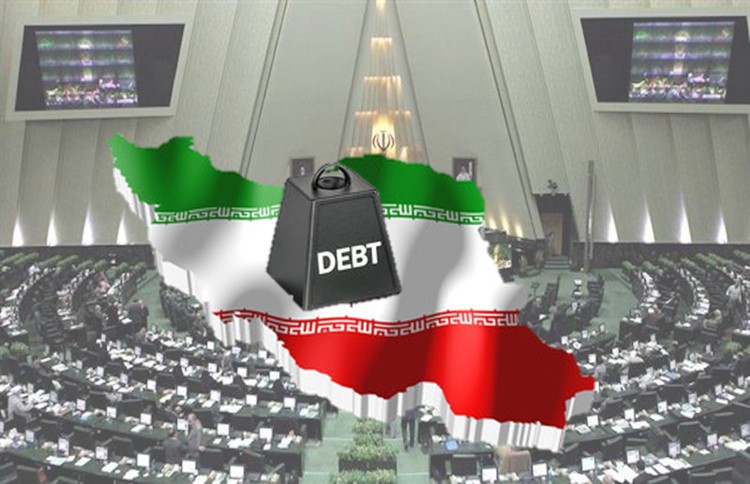
The Iranian Regime’s Debt to the Central Bank Increased by 72% in June

New statistics from the Central Bank indicate a 72% jump in the government’s debt to the Central Bank this June compared to the same month last year.

Furthermore, the total debt of the government and state-owned companies to the Central Bank and other banks in the country surpassed 1.5 quadrillion tomans (approximately $25 billion) this June, which is 37% more than last June.

Of this amount, more than 1.3 quadrillion tomans (approximately $21.6 billion) is related to the government’s debt, while the rest pertains to the debt of state-owned companies to the banking system.

The government’s debt to the banking system is equivalent to six months of the national budget, and it is unclear how the government intends to repay this massive debt.

Moreover, the government’s bank debt is only a small part of its total debt; the National Development Fund also claims more than $100 billion from the government, an amount equivalent to 2.5 years of the national budget.

The International Monetary Fund (IMF) in its spring report stated that the total debt of the Iranian government last year amounted to 28.5% of the country’s Gross Domestic Product (GDP).

This significant increase in the government’s debt to the banking system comes despite the fact that the 13th government, under the presidency of Ebrahim Raisi, had promised at the beginning of its term to stop borrowing from the banking sector to control liquidity and inflation. However, over the past three years, the government’s debt to domestic banks has doubled.

Central Bank statistics show that liquidity in the country surged by 27% in June this year compared to June 2023, reaching an astronomical 8.5 quadrillion tomans (approximately $141.6 billion).

Economic experts have identified uncontrolled liquidity as the main factor behind inflation in Iran.

In recent years, the Iranian government has forced the Central Bank to print unbacked currency to cover budget deficits, enabling it to borrow directly from the Central Bank and other banks. As a result, inflation in Iran has consistently remained above 40% over the past three years, and the value of the national currency has more than halved.

Iran is Entering a Cycle of “Mass Migration,” Government Agency Warns

The Strategic Research Center of the Iranian Presidency, in a report based on the results of a survey, has highlighted serious issues in utilizing human capital and warned that Iranian society is entering a phase of “mass migration.”

In a report titled “Managing Migration Abroad,” the center wrote: “We are currently at the peak of the ‘desire and decision’ to migrate, especially among skilled and capital-rich labor.”

The report from the Strategic Research Center is dated August 3, but it gained attention from domestic media on Thursday, August 15.

According to this report, Iranian society is in a unique migratory situation, with a heavy psychological atmosphere surrounding the desire to emigrate, significantly affecting people’s lives.

The report adds that the desire and decision to migrate have “intensified” among various groups, including workers, athletes, doctors, researchers, entrepreneurs, and investors.

In this study, two groups—”doctors and nurses” and “students and graduates”—have identified the economic effects of inflation as a major factor influencing their desire to migrate.

Seventy-three percent of doctors and nurses and 59% of students stated that the effects of inflation had a “very significant” impact on their desire to migrate. Additionally, 63% of doctors and nurses and 51% of students assessed the impact of sanctions on their migration desires as “very significant.”

Doctors and nurses cited dissatisfaction with job income, lack of future security, imbalance between income and expenses, and the commercialization of their field as the main reasons for their migration.

Previously, the head of the Iranian Medical Council had warned, “The exodus of doctors from the country is a serious issue.”

In June 2023, the head of the Health and Treatment Commission of the Iranian regime’s Majlis (Parliament) reported that about ten thousand specialists and sub-specialists had obtained the necessary certification for work migration over two years, stating that Arab countries have become the primary destination for Iranian doctors.

According to the report by the Strategic Research Center, on the other hand, entrepreneurs and startups have cited reasons related to economic uncertainty and insecurity, including economic sanctions, severe inflation, currency fluctuations, economic instability and unpredictability, the unprofitability of production, complex bureaucracy, and instability in domestic and foreign policies. They have mentioned the attractiveness of the investment environment and the stability of the destination country as reasons for their migration.

IRGC-Linked Hackers Targeted the Trump and Biden Campaigns

0

Iran-linked hackers targeted the campaign headquarters of both current President Joe Biden and former President Donald Trump, Google has confirmed.

On Wednesday, August 14, Google’s Threat Analysis Group reported that the APT42 hacker group targeted the personal email accounts of about a dozen individuals associated with Biden and Trump, the Republican Party’s nominee in this November’s election.

Google’s report also stated that APT42 “successfully accessed the personal Gmail account of a veteran political advisor,” but the name of the advisor was not disclosed.

On Tuesday, it was reported that the personal email account of Roger Stone, a supporter of Donald Trump, was possibly accessed by hackers linked to the Iranian government.

According to Google, the APT42 hacker group is linked to the Islamic Revolutionary Guard Corps (IRGC) and consistently targets high-profile users in Israel and the United States.

Based on a chart included in Google’s report, this hacking group has even targeted users inside Iran to gain access to their computer systems.

Current and former government officials, political campaigns, diplomats, think tank members, as well as NGOs and academic institutions involved in foreign policy discussions, have all been targeted by this IRGC-linked group.

According to Google, in the past six months, about 60% of APT42’s known geographic targets were focused on the U.S. and Israel, indicating this group’s aggressive and multifaceted efforts to rapidly shift its operational focus in support of the Iranian regime’s political and military priorities.

According to the report, the APT42 hacker group had also previously attempted to interfere in the 2020 U.S. presidential election.

According to Politico, early Wednesday, Trump, in his first public comment on the incident, accused the Iranian regime of hacking his campaign and praised the FBI’s investigation into the hack.

On the same day, The Washington Post reported that the FBI stated it is also investigating suspicious attempts attributed to the Iranian regime to hack the Biden-Harris campaign and a Trump aide.

The Washington Post, citing several informed sources, reported that FBI agents investigating the efforts of Tehran-linked hackers to target the Trump, Biden, and Harris campaigns have found evidence indicating that one of the targets of these hackers was Susie Wiles, a senior advisor to Trump.