Home Blog Page 182

Iran’s Regime Evading Oil Sanctions Through Malaysia

Brian Nelson, the U.S. Department of the Treasury’s Under Secretary for Terrorism and Financial Intelligence, sees Iran’s increased capacity to transport its oil as dependent on service providers based in Malaysia, with this oil being transferred from the vicinity of Singapore’s waters and other areas to China.

Previously, numerous reports had been published about the transfer of Iranian oil to Malaysian waters, rebranding it, and sending it to China under the name of Malaysian oil to evade international sanctions.

The American official told reporters that the United States is striving to prevent Malaysia from becoming a “jurisdiction” of the United States, which is involved in illegally sending money to Iran and proxy groups such as Hamas.

Chinese customs statistics show that last year, more than 1.1 million barrels of oil were imported from Malaysia daily. Such a massive volume of “Malaysian oil” imports comes at a time when Malaysia’s total oil production doesn’t even reach 650,000 barrels.

On the other hand, China’s oil imports from Malaysia have increased more than sixfold compared to the period before U.S. sanctions against Iran.

In December 2023, the U.S. Treasury sanctioned four companies based in Malaysia on charges of supporting Iran’s drone production program.

According to data from the information company Kepler, Iran’s regime had daily oil exports of 1.5 million cubic meters in the first three months of this calendar year, which is 200,000 barrels more than in 2023. In 2023, Iran’s oil exports were also 48% higher than the previous year.

Iran’s daily oil exports dropped from 2.5 million barrels in 2018 and before U.S. sanctions to 330,000 barrels in 2020. However, with the Biden administration coming into power and hopes for the revival of the JCPOA, this figure has increased every year.

According to Reuters, more than 90% of Iran’s oil exports go to China with a $13 discount, while the rest is shipped to Syria and unknown destinations.

Mr. Nelson also stated that sanctions and export controls against Russia show “progress”: the $60 price ceiling on Russian oil reduces the Kremlin’s capacity to profit from oil sales while maintaining stability in global energy markets.

Under the sanctions of the seven industrialized countries and the European Union, Russian oil customers are only allowed to receive insurance and transit services from companies based in the G7 and Europe if they purchase Russian oil for less than $60.

This prevents both global oil markets from facing shortages and reduces Russia’s oil revenue.

Currently, global oil prices are around $83.

Iran’s Cooperation Level Unacceptable, IAEA Director Says

The Director-General of the International Atomic Energy Agency (IAEA) described the regime’s cooperation with the agency as unacceptable upon returning from his trip to Iran and called for a change in Iran’s approach.

On Tuesday, May 7, Rafael Grossi stated in Vienna that the two sides have reached a mutual understanding, and Tehran has expressed readiness to work on specific actions.

He also stated that there are three categories of issues: inspections, remaining issues, and voluntary actions that Iran can take.

Mr. Grossi told reporters at Vienna Airport that we need to make progress. The current situation is completely unacceptable to me. We are almost at a deadlock, and it needs to change.

He added that there is a need to first agree on inspections, then take a step forward. Grossi underlined the need to take steps gradually.

According to Grossi, Tehran is also ready to follow through, including lifting sanctions, which Grossi is willing to pursue.

This comes as earlier in Iran, the head of the Atomic Energy Organization of Iran and Grossi announced reaching an agreement to implement the cooperation document of March 2022.


Grossi, who had traveled to Iran for a two-day trip, announced before leaving Tehran, in a joint press conference with Mohammad Eslami, the head of the Iranian regime’s Atomic Energy Organization, that the two sides agreed to cooperate based on the March 2022 agreement to resolve disputes.

He further stated that he had proposed practical steps to illuminate the future path, and the two sides’ teams are currently in discussions to outline the future path.

During a trip 13 months ago, Tehran and the agency had agreed that Grossi would cooperate with Iran on four locations in Iran where the agency has doubts about Iran’s nuclear activities.

Mr. Grossi also stated in the press conference on Wednesday that the agency is looking for specific actions that can operationalize this agreement.

Eslami also told reporters in this meeting that the important topic of discussion is the two remaining locations.

Grossi also urged Iran to take specific and tangible measures to help strengthen cooperation on the nuclear program, highlighting Iran’s slow cooperation with the agency.

The Director-General of the Agency had spoken about the worsening problems regarding Iran’s nuclear plans during a meeting two months ago at the Agency’s Board of Governors in Vienna and emphasized the need for serious attention to it.

Iran’s Gold Merchants on Strike in Several Cities

Reports and images circulated on social media indicate the expansion of protests and strikes by gold sellers in several cities of Iran.

On Sunday, May 5, videos and images were released showing gold sellers in several cities of Iran joining the strike of merchants in this profession and closing their shops.

Some gold sellers in the Tehran market, starting from April 28, protested against the regime’s parliamentary tax resolution and the reactivation of the “Comprehensive Trade System” and went on strike, closing their shops.

In the following days, gold sellers in the markets of Tabriz, Hamedan, and Isfahan also joined this strike.

The reactivation of the “Comprehensive Trade System” and the plan for “Capital Gain Tax” are the main reasons for the gold sellers’ strike, which now seems to have turned into a nationwide strike.

The Ebrahim Raisi government claims that the “Comprehensive Trade System” is designed to facilitate access for traders and merchants to domestic trade information and also to monitor and regulate various sectors of the buying, selling, and trading market.

However, now all producers and wholesale and retail sellers of gold and jewelry are asked to register their transactions in this system; a matter that has raised concerns among market participants in this profession.

On the other hand, representatives of the regime’s Majlis (parliament) amended two articles of the “Profit Tax and Note Trading Tax” bill, or the “Capital Gain Tax”, to secure the approval of the Guardian Council, which exacerbated the protests of the gold sellers.

These protests, which began with the closure of gold shops in some cities a week ago, continued on Sunday, May 5, in the cities of Shiraz, Yazd, Tehran, Isfahan, Mashhad, Tabriz, Hamedan, Urmia, Zanjan, Qom, and Ardabil.

On this day, merchants in Bandar Abbas also organized a gathering in protest against the increase in value-added tax rates.

According to the country’s 2024 budget law, the value-added tax rate has increased from 9% to 10% since the beginning of the Persian year (from March 21).

Some experts say that increasing the value-added tax, as it is supposed to be paid out of the consumer’s pocket, means inflation and price hikes.

According to a recent report published by the Central Bank of Iran on calculating debt settlement and dowry, the inflation rate in 2023 was over 52%.

Intense Rainfall and Floods Damage Dozens of Cities Across Iran

0

Heavy rainfall has again led to flooding in dozens of cities across Iran, damaging residential homes and agricultural lands. The Iranian Red Crescent (Hilal Ahmar) Organization stated that 21 provinces have been affected by the floods and inundation.

The Meteorological Organization announced on Saturday, May 4, that a new wave of rainfall will enter Iran starting from Monday.

In late April, another round of heavy rainfall caused flooding and inundation in the Sistan and Baluchestan Province in southeastern Iran, resulting in the destruction of dozens of villages and the disruption of electricity and water supply of at least 300 more villages.

During this flood, which according to citizens was accompanied by a lack of assistance from the Iranian regime, several people lost their lives.

With the arrival of a new rainfall system in Iran, the Meteorological Organization predicted on May 4 that the intensity of the rainfall is not enough to cause widespread flooding but reports of flooding and road inundation in some Iranian cities have been published in recent days.

Videos and eyewitness reports indicate that in Shabestar County, East Azerbaijan Province, the flooding was severe, causing extensive damage.

In Khuzestan, the CEO of the provincial Water and Power Organization announced that following recent rainfall, the capacity of the Dez Dam is 100% complete, thus its discharge is increased to control flooding.

Reports of severe rainfall damage to infrastructure and agriculture, house inundation, and submerged orchards have also been reported in Dezful, Khuzestan.

Hossein Zafari, Deputy Director of Crisis Management Organization in Iran, announced that besides Khuzestan, floods have caused serious damage to nomadic routes in Ilam and Chaharmahal and Bakhtiari provinces, resulting in the loss of livestock.

Gholamreza Gholami, the director of the Crisis Management Headquarters in Fars Province, announced on May 3, the occurrence of new rainfall and its heavy damage to the agricultural sector in the province.

On the other hand, the head of Persepolis World Heritage Site announced that due to recent rainfall, the ancient site of Naqsh-e Rostam has been flooded, leading to multiple subsidence incidents in the area.

The Tehran Traffic Police Information Center announced on Saturday, May 4, that due to the entrance of mud and debris onto the main highway, a traffic ban has been imposed on a section of Kharrazi Highway in the western part of the capital.

Babak Mahmoudi, the head of the Iranian Red Crescent Organization, said on Saturday that from May 1st to May 4th, 21 provinces experienced flooding and inundation.

Mahmoudi reported assistance from operational forces of the Red Crescent to over 2,600 people, but despite several weeks passing since the floods in some areas of Iran, communication routes to villages and cities remain impassable.

Iran is the Second Largest Prison for Writers in the World

The 2023 Freedom to Write Index, released by PEN America, shows that Iran continues to be the world’s second-largest jailer of writers, second only to China.

According to the report, “Iran remained in second place globally, jailing a total of 49 writers during the year, down from 57 in 2022. Of this total, 34 are men and 15 are women. This represents a decline from the sharp spike seen in 2022, when writers were caught up in a wide-ranging crackdown on protests and other forms of dissent, including by the creative community.”

Pen America added that while the regime released several writers who were jailed as part of the 2022 protests, about seventy percent of these releases were on bail, with writers facing a range of restrictive conditions, including potential re-arrest and limited employment options.

Pen America indicates that, “Given Iran’s history of severe and persistent crackdowns on all forms of dissent, which escalated in response to the Woman Life Freedom movement, it comes as little surprise that Iran was again the second largest jailer of writers in 2023. Incarceration is merely one tactic in a broader array of repressive measures that include short-term detentions, spurious legal charges, and conditions on release such as job losses and restrictions on social media use.”

“This has led to increased self-censorship and a significant number of Iranian writers seeking exile,” said Karin Deutsch Karlekar, director of PEN America’s Writers at Risk program.

“In 2023, Iran remained the leading jailer of female writers globally, targeting 15 women, many for their writing and advocacy against mandatory hijab and other laws that discriminate against women,” according to the report.

The “Writing Freedom Index” report estimates that in 2023, at least 339 people around the world were arrested for expressing their opinions and beliefs.

Iranian Proxies Still Planning Attacks on US Forces

On Thursday, May 2, Avril Haines, the director of the U.S. National Intelligence Agency, told a Senate Armed Services Committee hearing on “Global Threats” that Iranian government militias are still planning to attack U.S. forces in the Middle East.

Haines added that although the Iranian regime and its proxies have stopped attacking Americans for now, it is unclear how long the break will last.

She said the Iranian regime and its proxies fired hundreds of weapons at Israel in response to Israel’s killing of Iranian regime’s officials in Damascus.

Haines went on to say that the pace and intensity of cross-border attacks in northern Israel are controlled however could potentially intensify. Hezbollah does not want to go into an all-out war with Israel and the United States.

The director of the U.S. National Intelligence Agency said the Iranian linked group has resumed daily attacks on commercial vessels in the region since last week, spreading it to the Indian Ocean.

At the beginning of the hearing, Senator Jack Reed, the Democratic chairman of the Senate Armed Services Committee, said the United States is facing a dangerous moment in a unique way in which Iran seeks to exploit the turmoil caused by the war between Israel and Hamas to drive the United States out of the region.

According to Senator Reed, the Iranian regime targets U.S., Israel, and U.S. allies and partners in the region through its proxies.

The Democratic chairman of the Senate Armed Services Committee on the Houthis said hundreds of missiles and drone strikes on commercial vessels in the Red Sea had disrupted half of the world’s trade.

In another part of the meeting, Senator Reed cited reports from the U.S intelligence community, saying that Iran’s regime was seeking to use the conflict in Gaza to advance its interests. He went on to ask questions from the Director of National Intelligence and General Jeffry Kruse, the director of the U.S Defense Intelligence Agency, about the Iranian regime’s possible strategy, and He asked if it was an action strategy or a reaction.

Avril Haines responded by saying that the Iranian regime supported Hamas and provided financial and training support to the group. According to her, the Iranian regime is taking every opportunity to undermine Israel and increase its influence in the region.

General Jeffry Kruse said that the Iranian government supports its proxies within its overall strategy and seeks to exploit every opportunity during the ongoing war between Israel and Hamas and seeks to increase its regional influence.

Immediately after the October 7 attack, Iranian authorities praised the attack and encouraged their proxies, including Hezbollah, the Yemeni Houthis, and Iraqi Shiite militias, to launch direct attacks on Israeli territory.

After seven senior IRGC commanders and officials were killed during an alleged Israeli attack on the Iranian consulate in Damascus on April 1, the Iranian regime fired more than 300 missiles and drones from Iranian territory into Israel.

Growing Calls for the Terrorist Designation of the IRGC

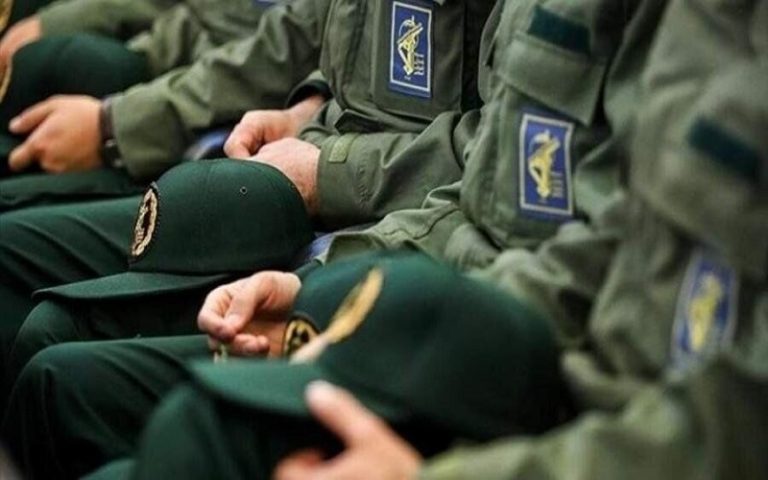
On Monday, April 29, the Iranian regime’s Foreign Ministry spokesman, Nasser Kanani, in a weekly press briefing, claimed that the Iranian regime was “anti-terrorist” by referring to the European Parliament discussing the terrorist designation of the Islamic Revolutionary Guards Corps (IRGC).

Kanani called the IRGC “the world’s largest counter-terrorism force” and claimed that “if it had not been for the IRGC’s counter-terrorism role, members of the European Parliament would have been exposed to the threat of takfiri and multinational terrorists behind the doors of parliament.”

The Iranian Foreign Ministry spokesman also called the IRGC “the official military force of Iran.” He advised MEPs to “think about the IRGC and think about every decision.”

On April 25, MEPs called for the IRGC to be listed as a terrorist organization.

In his remarks, Kanani also emphasized the regime’s cooperation with Russia in countering terrorism, saying: “Any action by Iran in fighting terrorism is on the side of friends, including Russia. “Terrorism is a common threat to all countries of the world.”

Despite the agreement to increase sanctions, there is still no agreement on putting the IRGC on the terrorist list.

During the Iranian attack on Israel and the sale of drones to Russia, the issue of declaring the IRGC terrorist has become more and more prominent in European political circles. The Iranian regime’s financial, material and equipment support for Hamas and proxies including the Houthis in Yemen has also created a topic for the proposal in recent months.

British Foreign Secretary David Cameron told a parliamentary committee on Tuesday, April 30, that Britain should not add the IRGC to the list of terrorist groups because it would end diplomatic relations with Iran.

The British Foreign Secretary has also argued that in times of crisis, particularly in relation to the war in Gaza, it is important that he be able to pick up the phone and speak to Iranian Foreign Minister Hossein Amir Abdollahian.

The Foreign Secretary noted that cutting diplomatic ties with Iran was not in Britain’s interest because it would not strengthen its approach and in many ways would even undermine it.

Referring to a relatively short list of countries like the United States, Canada and Bahrain that cut diplomatic ties with Iran, Cameron said that sometimes I see countries that don’t have diplomatic relations with Iran, send messages to Iranians. And sometimes Iranians ask me and say, what do you think and what do they mean? I want to have this direct conversation.

Iranian Merchants Facing 60% Decline in Sales Due to Presence of Morality Police

0

Discontent among merchants due to a 60% decrease in sales attributed to the presence of the morality police, exerting pressure on Iranian women and violating individual and social freedoms, has become a concern for half of Iran’s population, especially women who do not adhere to compulsory hijab, with the return of the “Morality Police” under the guise of the “Light Plan” (tarh-e noor). This concern, as reported by Etemad newspaper, has also gripped businesses.

On May 1, the state-run Etemad newspaper ran a field report from Tehran, narrating the dissatisfaction of merchants who claim that with the return of the “Morality Police,” especially women customers have significantly decreased.

One shopkeeper told Etemad: “People prefer to change their route rather than confront the morality police. When the morality police car stops near us, or even when it passes by, we are stressed the whole time, fearing they might seal the shop.”

Although the economic conditions of society contribute to market stagnation, according to merchants and shopkeepers as reported by Etemad, “the presence of the morality police in the streets and the fear of sellers and buyers from sealing and arrests” have significantly reduced their sales and worsened conditions.

Another shopkeeper told Etemad that he cannot force people who do not believe in hijab. He criticized the country’s economic situation, saying, “The economic situation, which is already bad, has worsened due to these events, reducing our sales by about 20 to 30 percent.”

An old wholesaler told Etemad that the head of the garment union asked him not to let unveiled women in, a behavior which, according to this 63-year-old merchant, “is not in his dignity and ethics.” He said, “They expect things that are not feasible.”

Many sellers told Etemad that “our customers have decreased by 60%. No one dares to come here anymore. When a customer wants to leave, they follow them with motorcycles and vans, grab them, throw them into the van, and take them away.”

Since April 13, the crackdown on hijab by the police in Iran has resumed, and reports indicate the enforcement officers’ violence in the new round of confrontation with the people to impose compulsory hijab. From the detention and arrest of women who do not believe in compulsory hijab to the sealing of medical, recreational, and restaurant centers.

This police action has faced widespread criticism on social networks. Some media have also written that the bill known as the “Chastity and Hijab” has not yet become law and has no legal basis.

The majority of Iranians have condemned the regime’s violent actions against women by the so-called morality police and considered the continuation of government policies in this regard as “contrary to the law and public freedoms.”

Thus, the Iranian regime attempts to suppress the people under the pretext of inappropriate hijab to prevent uprising and protest, protests that peaked in 2022 after the killing of Mahsa Amini. In these protests, at least 750 people were killed by state security forces, and more than 30,000 were arrested. The Iranian regime has no solution other than increasing repression to control the explosive social atmosphere.

Dire Living Conditions of Iranian workers on International Labor Day

0

On the occasion of International Workers’ Day, May 1, the dire economic conditions of Iranian workers have reached a critical point.

Issues such as wages below the poverty line, delayed paychecks, lack of job security, increasing inflation, and decreasing purchasing power have put immense pressure on millions of workers and their families in Iran.

Several labor activists and unions have emphasized the need for “unity, organization, and mobilization” among workers and wage earners to change the current situation in Iran, criticizing the government’s “anti-labor policies.”

The Syndicate of Workers of Tehran and Suburbs Bus Company, in its statement, highlighted that this year’s International Workers’ Day is being commemorated under circumstances where hundreds of workers, teachers, labor rights defenders, and toilers are facing unfair sentences and imprisonment. They added that suppression, harassment, and persecution of toilers, women, and youth in Iran have intensified.

The union addressed various issues faced by Iranian workers, including lack of job security, temporary work contracts, expansion of subcontracting companies, unpaid wages, non-implementation of job classifications, failure to harmonize the rights and benefits of retirees, and wages below the poverty line.

They also criticized the “astronomical housing costs, rampant inflation, and exorbitant prices” which have imposed unbearable conditions on a significant portion of the working class.

The Syndicate of Workers of Tehran and Suburbs Bus Company emphasized that “putting pressure on pioneering workers, threatening and intimidating them, dismissal, detention, imprisonment, and unjust verdicts have become the norm.” They stated that even for organizing independent events on International Workers’ Day, workers are not spared.

The Syndicate wrote: “Union members have been arrested and beaten many times in the past on International Labor Day” and “in recent years, they have been repeatedly summoned and threatened to stop union activities.”

Moreover, the Free Union of Iranian Workers, in its statement on International Workers’ Day, referred to nearly two years since the “revolutionary uprising of Iranian people and its brutal suppression” and highlighted the resilience of women and oppressed masses in reshaping the political landscape of the country.

According to the Free Union of Iranian Workers, in these circumstances, Iran regime seeks to maintain its precarious position through regional military adventurism and domestic intimidation by issuing and implementing inhumane execution sentences and aggressively targeting women and girls opposing compulsory hijab.

The statement emphasized that “only a popular social-political revolution and the formation of a secular and democratic government based on freedom and equality, rejecting exploitation, can put an end to the inhumane conditions existing in the country and the warmongering and atrocities in the Middle East.”

On April 29, the semiofficial ILNA news agency quoted Ali Ziaei, the head of the Crime Scene Investigation Group of the Forensic medicine Organization of the country, that in 2023, 2,115 people lost their lives in work-related accidents, indicating an 11.3% increase compared to the previous year.

According to a number of labor activists, this official statistic does not include workers not covered by the labor law or those working in the so-called “under-stairs (very small businesses)” workshops.

Additionally, the Coordinating Council of Nurses‘ Protesters stated, “As nurses whose lives are drained in hellish work environments in hospitals and who suffer from exhaustion with meager wages, on International Workers’ Day, we declare we will no longer submit to servitude.”

“Reforming tariffing and registering nursing services under the name of nurses, eliminating compulsory overtime, and correcting overtime compensation” are among the demands raised by this council.

Only One-Fifth of Iran’s Annual Housing Needs Are Met

0

Beytollah Setarian, a housing expert, said in an interview that Iran needs one million housing units annually, but only 200,000 houses are built. He added that only a “privileged and powerful class derived from a rent-seeking and corrupt economy” can afford to buy a house given the current conditions in the country.

Satarian, in an interview with the regimes Entekhab news website on April 29, referred to severe inflation in Iran and said that housing in the country has become a “luxury commodity” and “unattainable.”

The Central Bank announced an annual inflation rate of 52.3% for 2023, the highest annual inflation rate in 80 years.

Setarian attributed the problems in the housing sector to the inefficiency of macroeconomic policies in the country and said, “A closed and semi-Marxist government economy fosters an extremely capitalist rent-seeking economy within itself,” leading most of the society towards poverty.

On April 22, the state-run Etemad newspaper, by examining information on poverty rate data, wrote that a 10% growth in the poverty rate in two years means that about 8 million people have been added to the number of poor in the country.

Setarian criticized the government’s housing policies and added that the government’s slogan of housing construction discourages construction companies from entering this field and leads them to withdraw their capital from the market.

This expert emphasized that since the government announced the slogan of national housing, housing production has significantly decreased.

During his election campaign, Ebrahim Raisi promised to build one million housing units annually.

After intensifying criticisms of the government’s inability to fulfill this promise, Mohammad Mokhber, Raisi’s vice president, said in December 2022, “There is a difference between building housing and letting people build. The government should build a part; we can give land to the people so they can build themselves.”

Setarian further predicted in his interview with the Entekhab news website that housing prices would continue to rise this year.

He added, “2024 is like 50 years ago, a year of housing inflation… When housing prices increase, all associated parameters, including rent, will also increase. We might have much more than 40% inflation in prices and rent. The government just makes slogans.”

Official reports indicate a historic rise in house rent in 2023, with a 52% growth in the capital over one year.

A look at house rent amounts and messages from Iranian International’s audience shows that contrary to the claims of Iranian regime officials, rents have increased by an average of 130% in Tehran and other cities.

The examination of citizens’ messages on social media indicates that house rent has become one of the most important economic concerns for Iranians.