

 AP: Diplomats following nuclear talks between Iran and six world powers say two days of negotiations have failed to narrow differences standing in the way of agreement by a July 20 target date. The diplomats spoke Thursday ahead of a third day of planned meetings, with the possibility that they would wrap up the round early because of the lack of progress.
Deadlock continues at Iran-6-power nuclear talks
Saudis give apparent warning to Iran: don’t meddle in Iraq

Reuters: Saudi Arabia gave an apparent warning to arch enemy Iran on Wednesday by saying outside powers should not intervene in the conflict in neighbouring Iraq. Foreign Minister Prince Saud al-Faisal also said Iraq was facing a full-scale civil war with grave consequences for the wider region.
The United States should not cooperate with Iran on Iraq

Washington Post: It’s sometimes true that very different countries can cooperate against a common enemy, as the United States and Soviet Union did during World War II. But the suggestion of a united U.S.-Iran front is more reminiscent of the wishful thinking among conservatives who argued in the 1930s that Britain and the United States shared a common interest with Nazi Germany in countering communism.
Iran’s dubious interest in Iraq
Deutsche Welle: It’s certainly one of recent history’s biggest ironies – only a few years ago, Iran was part of the “axis of evil.” Now it has suddenly become an anchor of stability in a region riddled with existential crises. The real reasons for this unbelievable transformation is the United States’ catastrophic Middle East policy and the utterly unnecessary war in Iraq.
Iran dissidents to march on Paris

Guardian Liberty Voice: Iranian dissidents, representatives from the British and European Parliaments, democracy advocates, international dignitaries, activists and over 300 Iranian opposition groups are set to march on Paris on June 27th to protest the lack of democratic freedoms in Iran under the nation’s religious extremist regime.
Iran is not an ally in Iraq
Wall Street Journal: During the second Iraq war, Iran’s Islamic Revolutionary Guard Corps was one of the United States’ fiercest foes. The IRGC was responsible not only for organizing, training and equipping Shiite militants who fought U.S. troops, but also for manufacturing and importing into Iraq so-called “explosively formed penetrators,” or EFPs, one of the chief banes of American forces there.
US lawmakers want bigger say in Iran deal

The Hill: The top Republican and Democrat on the House Foreign Affairs Committee are upping the pressure on the White House to work with Congress before agreeing to any final deal with Iran. Chairman Ed Royce (R-Calif.) and Rep. Eliot Engel (D-N.Y.) are collecting signatures on a letter to Obama pointing out that any permanent agreement to lift sanctions on Iran must be approved by Congress.
Hillary Clinton notes distance from Obama on Syria rebels
Reuters: Potential Democratic presidential candidate Hillary Clinton pointed out her differences with President Barack Obama on Tuesday over his decision not to arm moderate Syrian rebels, as neighboring Iraq struggles to cope with extremist spillover from Syria. “We pushed very hard. But as I say in my book, I believe that Harry Truman was right, the buck stops with the president,” Clinton said in a CNN interview.
Iran, six powers push to salvage momentum for nuclear deal
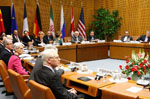
Reuters: Iran and six world powers re-launched talks on Tuesday to try to salvage a deal on Tehran’s nuclear activity by a July deadline, striving to prevent a long-time standoff from descending into a wider Middle East war. With time running short if a risky extension of the nuclear talks is to be avoided, negotiators face formidable challenges to bridge gaps in positions.
UK to re-open Iran embassy
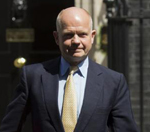
Reuters: Britain said on Tuesday it would re-open its embassy in Iran “within months,” after a hiatus of more than two and a half years, a diplomatic breakthrough that underscores the West’s desire to secure Tehran’s help in Iraq and elsewhere. The announcement, by British Foreign Secretary William Hague coincided with negotiations aimed at securing a nuclear agreement with Iran.
