


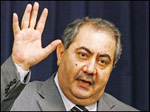
 AFP: Iraqi Foreign Minister Hoshyar Zebari warned on Monday that prolonged “bickering” over who should be the war-torn country’s prime minister is angering the public and risks stoking deadly street riots.
by Arthur MacMillan
BAGHDAD, June 21, 2010 (AFP) – Iraqi Foreign Minister Hoshyar Zebari warned on Monday that prolonged “bickering” over who should be the war-torn country’s prime minister is angering the public and risks stoking deadly street riots.
With no new government in sight almost four months after an inconclusive general election, Zebari told AFP that a frenzied protest over electricity rationing in which a man was shot dead could be a harbinger of more trouble.
The economy is also suffering, he said, because of a political vacuum that has seen the process bogged down since the March 7 national ballot, the second such poll since the US-led ouster of Saddam Hussein in 2003.
The failure to form a government after months of fruitless “horsetrading, manoeuvring and jockeying for position,” may also require the United Nations to help broker a deal to end the impasse, according to Zebari.
“What we saw in Basra on Saturday was a warning. It was the writing on the wall. The anger they (demonstrators) showed was extraordinary,” he said.
Thousands protested in Basra, 450 kilometres (280 miles) south of Baghdad, amid temperatures of 54 degrees Celsius (130 Fahrenheit) to demand the electricity minister’s resignation.
Some of the men carried a coffin draped in a black flag, while windows of a government building were smashed, reflecting their anger at inadequate power supplies which have seen much-needed air-conditioning units sit idle.
A similar protest on Monday over electricity shortages injured 17 policemen as hundreds of demonstrators hurled stones at provincial government offices in Nasiriyah, another southern city.
Zebari said there was a risk that the ambition of politicians, including Prime Minister Nuri al-Maliki and former premier Iyad Allawi, was overshadowing nationwide demands for nuts-and-bolts services.
“Bickering over the position of the prime minister and who will form the new government… has been one of the key impediments to progress,” said Zebari.
“There isn’t much attention (being given) to the ordinary public, how they feel, how they survive during this summer heat with a lack of electricity.
“People are tired of a lack of services, lack of action and all this debate on television about government formation and positions. The public sense is one of anger.”
Iraq’s second parliament since Saddam’s overthrow opened one week ago but it was immediately adjourned as no political bloc has put together the 163 seats needed to form a majority government in the 325-seat chamber.
Allawi, a Shiite who was prime minister between 2004-2005, came first in the election with 91 seats, two more than incumbent premier Maliki, also Shiite, but neither man seems willing to yield in their battle to lead the country.
Zebari, a Kurd, said that although Allawi, backed by much of Iraq’s Sunni Arab minority, won the most seats, he personally gained only 11 more than five years ago and the election had exposed the country’s sectarian divisions.
“Society has been polarised,” he said. “Even this election did not produce cross-sectarian ethnic movement. The Shia voted for the Shias, the Sunnis voted for the Sunnis and the Kurds voted for Kurds.”
Zebari said Maliki’s State of Law Alliance, the Iraqi National Alliance — a Shiite religious grouping — Allawi’s Iraqiya coalition, and his own Kurdish Alliance, which won 57 seats, should hold joint discussions.
“The situation is not hopeless, but it is also not easy,” said the foreign minister, who is a member of the Kurdish negotiating team.
“We have advocated that the four major blocs get together to first break the ice and secondly create a process of serious negotiation to lead to a final government in which nobody feels alienated.
“The UN could facilitate the process because it has a mandate, while not being an arbiter.”
The withdrawal of US combat troops from Iraq before September 1 was closely connected with the successful seating of a government in Baghdad, he said.
“They deny there is any linkage but I believe there is a linkage. If come August there is still no government, given the security challenges we have seen, it could be awkward or embarrassing” for Washington.
Iraq’s economy is also being damaged by the hiatus.
“It harms the confidence of investors and the drive for new companies to invest in Iraq,” Zebari said.


