


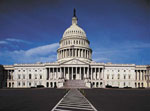
 AFP: The US Congress on Thursday sent President Barack Obama a sweeping package of tough new energy and financial sanctions on Iran, aiming to force Tehran to halt its suspected nuclear weapons program.
by Olivier Knox
WASHINGTON, June 25, 2010 (AFP) – The US Congress on Thursday sent President Barack Obama a sweeping package of tough new energy and financial sanctions on Iran, aiming to force Tehran to halt its suspected nuclear weapons program.
The US Senate and House of Representatives approved the legislation — which backers described as the toughest ever unilateral US sanctions against the Islamic republic — by crushing 99-0 and 408-8 margins, respectively.
The new measures, piled atop new UN Security Council and European sanctions, aimed to choke off Iran’s access to imports of refined petroleum products like gasoline and jet fuel and curb its access to the international banking system.
“Our goal is to target Iran where it will hurt the regime the most,” said Democratic Senate Majority Leader Harry Reid, who warned a nuclear-armed Tehran would “threaten the national security of the United States and of Israel.”
World powers led by Washington have accused the Islamic republic of seeking to build nuclear weapons and demanding it freeze its uranium enrichment activity, which can be a key step towards developing an atomic arsenal.
The bill would shut US markets to firms that provide Iran with refined petroleum products that the oil-rich nation must import to meet demand because of a weak domestic refining capability.
It also takes aim at firms that invest in Iran’s energy sector, including non-US companies that provide financing, insurance, or shipping services.
It could also see non-US banks doing business with certain blacklisted Iranian entities — including Iran’s elite Islamic Revolutionary Guard Corps and several banks — shut out of the US financial system.
“We will be posing a choice to companies around the world: Do you want to do business with Iran? Or do you want to business with the United States? We don’t think that is much of a choice, but we will force companies to make it. They can’t have it both ways,” said Republican Senator John McCain.
The bill would also enable US states and local governments to divest from foreign firms engaged in Iran’s energy sector, and would tighten the existing US trade embargo on Iranian goods by curbing the number of exempted products.
Lawmakers noted that Iran had rejected Obama’s efforts, since taking office in January 2009, to engage Tehran diplomatically on issues from its nuclear program to its support for Islamist groups branded terrorists in Washington.
“We are at a defining moment,” said Representative Ileana Ros-Lehtinen, the top Republican on the House Foreign Affairs Committee, who called the bill “one of our last best hopes to force Iran to end its nuclear weapons program.”
But they also cautioned that the bill’s impact would depend on whether Obama invoked its powers rather than use his considerable authority to waive some of the most punishing measures.
“We do provide the tools, but there’s little guarantee that they’ll be used,” complained Republican Representative Ed Royce, who warned the Obama administration “will have to be pressured into action.”
And US officials cautioned this week that Iran had anticipated efforts to squeeze its gasoline imports, changing its consumption patterns and stockpiling needed fuel to reduce its dependence.
The Islamic republic now relies on imports for about 25 percent of domestic consumption, down from 40 percent a few years ago.
The legislation also calls for the US government to identify Iranian officials who are human rights abusers and target them for sanctions like a travel ban and asset freeze.
And it would also for the first time require companies seeking US government contracts to certify that they and their subsidiaries do not do business with Iran, which denies charges it seeks nuclear weapons.
Opponents of the bill said Iran’s elite would escape unscathed while its people suffered, stoking anti-US resentment rather than turning the population against leaders in Tehran.
“Iranians still like Americans. Yet this legislation allows the regime to rally support by blaming the United States for hardships,” said Democratic Representative Earl Blumenauer.


