


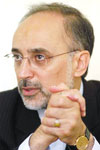
 AFP: Iran acknowledged for the first time on Wednesday that newly imposed sanctions “may slow down” its nuclear drive, including its sensitive uranium enrichment work, but said it will not halt it.
By Jay Deshmukh
TEHRAN (AFP) — Iran acknowledged for the first time on Wednesday that newly imposed sanctions “may slow down” its nuclear drive, including its sensitive uranium enrichment work, but said it will not halt it.
The comments by the head of Iran’s atomic energy, Ali Akbar Salehi, were the first admission by a senior official of the impact of new UN sanctions imposed on June 9.
“One can’t say sanctions are ineffective,” Iran’s ISNA news agency quoted Salehi as telling a press conference in the southern port city of Bushehr.
“If sanctions are aimed at preventing Iran’s nuclear activities… we say they may slow down the work, but will not stop the activities. This is a certainty.”
Previously senior officials, including President Mahmoud Ahmadinejad, had been defiant in their dismissal of the new sanctions.
Speaking soon after the UN Security Council adopted the new measures, Ahmadinejad said they were like a “used hanky which should be thrown in the dustbin.”
Salehi, who is one of several vice presidents in Ahmadinejad’s government, said the sanctions would not affect a nuclear power station nearing completion in Bushehr, which he visited on Wednesday.
But he said there could be some impact on Iran’s uranium enrichment programme as it would now be more difficult to procure some equipment.
“The Bushehr site is not (affected) by the sanctions and Russian officials have repeatedly maintained that the sanctions are not targeting Bushehr,” he said after inspecting the Russian-built plant, which he said would open in September.
“But on the issue of enrichment, we may face problems with some equipment such as measuring instruments,” he said.
He added: “If we face a problem over this equipment, we will manufacture it.”
Talks with the major powers on a plan drafted by the UN nuclear watchdog last October for the supply of fuel for a Tehran medical research reactor in return for Iran’s shipping most of its stockpiles of low-enriched uranium abroad failed to bear fruit.
A fresh proposal brokered by Brazil and Turkey before the adoption of the new UN sanctions has been cold-shouldered by the West.
Salehi said Iran was “ready to negotiate” with the major powers over the fuel supply plan but he insisted that the talks should be on the basis of the proposal agreed with Brazil and Turkey.
He said the Tehran reactor was currently being run so as to ensure that the existing fuel “will suffice until September next year.”
On Tuesday, Iran set this September as a possible date for the resumption of talks with the major powers, provided they are genuine.
Its top nuclear negotiator Saeed Jalili sent a letter to European Union foreign policy chief Catherine Ashton saying that the powers must first make clear whether the talks were aimed at “engagement and cooperation or continued confrontation and hostility towards Iranians.”
In Washington, State Department spokesman Mark Toner told reporters: “If Iran is serious about talking to the P5-plus-one (the major powers), then I think we’re willing to meet.
“Obviously we’d have to evaluate the Iranian offer,” Toner added.
President Barack Obama vowed the United States would keep up the pressure on Iran as he received Israeli Prime Minister Benjamin Netanyahu at the White House on Tuesday.
“We intend to put pressure on Iran to meet its international obligations and to cease the kinds of provocative behaviour that have made it a threat to its neighbours and the international community,” Obama said.
The Israeli premier was due to hold talks with UN Secretary General Ban Ki-moon later on Wednesday at which he was expected to press for internatioal support for Washington’s tough line.
Since the UN measures were adopted, both the United States and the European Union have slapped additional sanctions on Iran unilaterally.
Western governments suspect that Iran’s nuclear programme is cover for a weapons drive, something Tehran has repeatedly denied, insisting it is aimed solely at power generation and medical research.


