


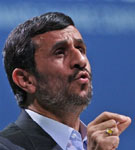
 Reuters: Coordination within the European Union isn’t always easy, but the bloc stayed on message this year when all 27 EU delegations left the U.N. General Assembly to protest the Iranian president’s speech.
By Louis Charbonneau
UNITED NATIONS (Reuters) – Coordination within the European Union isn’t always easy, but the bloc stayed on message this year when all 27 EU delegations left the U.N. General Assembly to protest the Iranian president’s speech.
The moment came on Thursday, when Iranian President Mahmoud Ahmadinejad used his speech to the 193-nation U.N. General Assembly during its annual session in New York City to once again question the Holocaust and suggest that the U.S. government might have been behind the Sept. 11, 2001 attacks.
After listening to a few minutes of Ahmadinejad’s speech, the European, U.S., Canadian and other Western delegations marched out of the General Assembly hall to register what one delegate described as their “disgust at his views.”
The Western walk-out has become an annual ritual in response to Ahmadinejad’s speeches, which one Western diplomat said have become “stale and predictably offensive.”
EU walk-outs haven’t always gone so smoothly. Two years ago, delegations from Sweden and Cyprus stayed in their seats and listened as Ahmadinejad finished his speech, which railed against the United States and “inhuman policies” of Israel.
“Some of us were rather annoyed with the Swedes and Cypriots for staying,” a European diplomat told Reuters on condition of anonymity. “We want to present a unified face by walking out at the same time. It didn’t happen that way.”
Sweden, which was holding the six-month rotating EU presidency at the time, brushed off the criticism, suggesting that it took courage to face down the Iranian president in the General Assembly hall, European diplomats said.
In past years, some Western delegations called journalists to announce that they were the first ones to walk out of the cavernous assembly hall during Ahmadinejad’s speech, but that practice stopped after the disunity of 2009.
“It’s not a race, it’s a protest,” said a European envoy.
RED LINES
Traditionally the EU has had difficulty maintaining unity on issues related to the Middle East. In 2009, it split three ways on a U.N. vote to endorse the Goldstone Report, which said both Israel and Palestinian Hamas militants committed war crimes during Israel’s brief 2008-09 war in the Gaza Strip.
After the apparent disunity during Ahmadinejad’s 2009 speech, European delegations made sure in planning meetings ahead of the annual U.N. General Assembly session to clarify “red lines” that would trigger a mass walk-out during Ahmadinejad’s annual diatribe against Israel and the West.
“They’re what you would expect,” a diplomat said. “Implications that 9/11 was a U.S. conspiracy, Holocaust denial, denial of Israel’s right to exist, and so on.”
There’s no formal coordination with the Americans, Canadians, Australians and others, though “there is a touch-base” ahead of time, a Western diplomat said.
Israel has less of a problem, since it boycotts Ahmadinejad’s U.N. speeches as a rule.
Not all Europeans, however, walk out during Ahmadinejad’s speeches. Norway, which is not a member of the EU, remains in its seat during the Iranian president’s addresses.
In a March 2011 article, Norwegian Foreign Minister Jonas Gahr Store defended Norway’s opposition to walk-outs. He gave as an example the so-called Durban II U.N. anti-racism conference in 2009, which many Western nations boycotted.
“Despite the fact that we found Ahmadinejad’s claims abhorrent, our delegation decided to remain for his address,” Store wrote. “We believed that it was important to listen to his words and then to use our position as the next speaker to directly engage and challenge his hateful claims.”
(Editing by Cynthia Osterman)


