


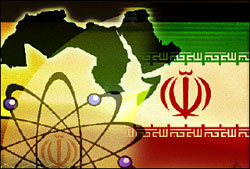
 AFP: Just days before crucial talks with world powers on its disputed nuclear programme, Iran was presenting a defiant face on Wednesday, announcing the halt of oil exports to EU nations and warning the West to drop its “language of force.”
By Marc Burleigh
TEHRAN (AFP)— Just days before crucial talks with world powers on its disputed nuclear programme, Iran was presenting a defiant face on Wednesday, announcing the halt of oil exports to EU nations and warning the West to drop its “language of force.”
At the same time, chief nuclear negotiator Saeed Jalili was promising to lay out “new initiatives” at the talks due to take place in Istanbul on Saturday — as long as the nations on the other side of the table employed a “constructive approach.”
The declarations underlined the high stakes involved in the negotiations, which are widely seen as a last chance to defuse the increasingly tense international showdown over Iran.
Two Iranian broadcasters, Al-Alam and Press TV, reported that Iranian oil exports to Germany had been halted and exports to Italy could soon likewise be stopped, without identifying their sources.
On Tuesday, the two networks said crude exports to Spain had also ended, expanding on a February decision to stop oil sales to France and Britain.
Oil Minister Rostam Qasemi also said on Tuesday that Iran was no longer supplying oil to Greece.
The announcements were portrayed in Iran as pre-emptive punishment against the European Union for imposing an oil embargo on the Islamic republic that is to come into full effect on July 1.
But Spain said it had already stopped buying all Iranian crude more than a month ago to comply with the embargo. And France and Britain bought only negligible amounts of Iranian oil before it was cut off.
The Iranian gestures, nonetheless, showed that Tehran was ready to flex its muscle as OPEC’s second-biggest producer after Saudi Arabia in response to the sanctions by the European Union and others by the United States.
Fear of that has kept global oil prices high, which in turn is increasing the revenue Iran earns on the 2.5 million barrels per day it exports. Last year, Iran generated $100 billion (76 billion euros) from oil sales abroad.
Iranian President Mahmoud Ahmadinejad on Tuesday said his country’s economy could keep ticking over even if no oil was sold “for two or even three years”.
On Wednesday, he told the Western nations engaging Iran to drop “the language of force and insults,” the official news agency IRNA reported.
“I say to them in the name of the Iranian people that the method you have adopted will have no result. They need to change their language and speak with respect,” he said.
Jalili, who is to lead Iran’s negotiating team in Istanbul, used almost identical words.
“The language of threat and pressure has never yielded results and only reinforces the determination of the Iranian people,” he told Al-Alam.
Jalili said Iran could introduce new points into the talks with the so-called P5+1, which comprises the five permanent UN Security Council members (the United States, France, Britain, China and Russia) plus Germany.
“The Iranian delegation will have new initiatives and we hope that the other party will have a constructive approach,” he said, without elaborating.
The United States and its European allies suspect Iran’s activities mask a drive to get to the “breakout” threshold of having the capability to make atomic weapons.
Iran denies any military dimension to its nuclear activities and has responded defiantly by accelerating them.
In February, Khamenei said Iran considered nuclear weapons a “sin.”
US Secretary of State Hillary Clinton referred to that position by Khamenei during a trip to Turkey on April 1, saying the talks will be aimed at how to “translate what is a stated belief into a plan of action.”
The United States, and its Middle East ally Israel, have threatened to use military force in a last resort against Iran to prevent it reaching the threshold of being able to make nuclear weapons.


