


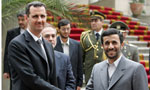
 Reuters: Iran, dismayed at the plight of Syrian President Bashar al-Assad, is seeking to shore him up and counter a perceived drive by Western and U.S.-aligned Sunni Muslim nations to roll back its own power in the Middle East. By Marcus George
 LONDON (Reuters) – Iran, dismayed at the plight of Syrian President Bashar al-Assad, is seeking to shore him up and counter a perceived drive by Western and U.S.-aligned Sunni Muslim nations to roll back its own power in the Middle East.
A hastily-convened conference in Tehran on Thursday looked like an attempt by the Islamic Republic to forge a coalition of friendly countries opposed to Western and Arab support for rebels determined to end four decades of Assad family rule.
Iran, handed geostrategic windfalls in the past decade by Washington’s elimination of two of its main enemies, Saddam Hussein in Iraq and the Taliban in Afghanistan, now fears the pendulum of regional influence could swing the other way.
Success for the Sunni-led uprising in Syria could have grave implications for the Shi’ite rulers in Tehran and their vaunted “axis of resistance” against Israel and the United States.
The axis has already lost one cog, Hamas, a Palestinian Sunni Islamist group which turned against Assad months ago for his bloody repression of foes including the Muslim Brotherhood.
Assad’s fall would weaken a pivotal component, Lebanon’s Hezbollah, for which Syria has provided arms, support and a route for weapons from Iran, the Shi’ite group’s main patron.
It would also complicate life for Syria’s eastern neighbor Iraq, whose Iran-friendly Shi’ite-led government fears that a mainly Sunni leadership could take power in Damascus in place of one dominated by Assad’s Shi’ite-rooted Alawite minority.
Western officials have accused Iran of providing funds, weapons and intelligence support to Assad in his struggle to crush opposition. Syrian rebels also says Tehran has sent Revolutionary Guards and Hezbollah fighters against them.
How far Iran will go in backing Assad, widely perceived across the Arab world as a tyrant killing his own people, is an open question – and one sometimes debated openly in Tehran.
“RELIGIOUS POLARISATION”
“There are rational views versus radical ones, but this is Iran. It’s very difficult to be more flexible, to argue for change,” said one Tehran-based diplomat.
The political and military hardliners in control say Syria stood by Iran in its hour of need, the only Arab nation on its side in the 1980-88 war with Iraq, and deserves loyalty now.
They also view the conflict in Syria as an extension of a sectarian power struggle with Iran’s regional rival Saudi Arabia, as well as a U.S.-led campaign to shackle its nuclear ambitions by sanctions or if necessary by military force.
“Iran doesn’t accept this is about opening Syria up to democracy. It’s not at all democratic,” said Mohammad Marandi of Tehran University. “Saudi advocates Wahhabi Islam and Iran believes it’s pushing for religious polarization.”
Iran said it had won support at Thursday’s conference for its call for a halt to violence in Syria and dialogue between Assad and his foes on the Syrian leader’s “reform” program.
Iranian Foreign Minister Ali Akbar Salehi said outside interference was worsening the crisis. “It will be a mistake to think that with the continuation of pressure and unwise moves, the Syrian leadership would finally collapse,” he added.
Iranian officials have in recent weeks offered to host talks between Syria’s government and opposition, although Assad’s foes have shown no interest in such a dialogue with the man they want to topple, let alone one organized by Tehran.
Iran may be seeking a diplomatic role after the failure of Kofi Annan’s U.N.-backed peace plan, but its chances of success appear doomed from the start, as perhaps its authors know, since Tehran’s policy is predicated on keeping Assad in power.
“Iran is trying to take control of and redirect a failed diplomatic process, even though these endeavors will likely fail,” said Anthony Skinner of the Maplecroft risks consultancy.
“Tehran is attempting to offset pressure from allies of the armed and unarmed opposition in Syria. It might also show that Iran is running out of ideas on what to do.”
HONEST BROKER
Salehi, in an opinion piece in the Washington Post on the eve of the Tehran meeting, presented Iran as “part of the solution, not the problem” – as the United States contends.
“As the world has witnessed during the past decade, we have acted as a stabilizing force in Iraq and Afghanistan, two other Muslim countries thrown into turmoil,” he wrote, alluding to U.S.-led military interventions in both states.
Salehi also said Syrians should decide their own destiny through a forthcoming presidential election, decreed by Assad.
Tehran has resisted any negotiated transition requiring Assad’s exit and the loss of a partner who has helped Iran flex its muscles in Lebanon and in the Israeli-Palestinian conflict.
Earlier this week, senior Iranian envoy Saeed Jalili was in Damascus for talks with Assad, declaring that his country wouldn’t allow “the axis of resistance, of which it considers Syria to be an essential part, to be broken in any way”.
Next week President Mahmoud Ahmadinejad will attend an extraordinary meeting of the Organisation of Islamic Countries set to focus on the Syrian crisis. Iran will want to prevent any attempt to suspend Syria’s membership of the Jeddah-based OIC.
While Iran has repeatedly denounced Turkey and Qatar, alongside Saudi Arabia, for supporting Syrian rebels, it has been forced to seek their help in securing the release of 48 Iranians kidnapped by the insurgents last week.
Syrian rebels accuse them of being elite Revolutionary Guards sent to assist Assad’s forces in crushing the opposition.
Salehi has acknowledged that some are retired Guards or soldiers, but said they were religious pilgrims, not fighters.
Maplecroft’s Skinner said concern over the captives might in part have motivated Iran’s flurry of diplomacy.
“If they are serving members of the Guards, then Iran’s diplomatic initiatives may be linked to the hostage-taking because of the sensitive information they may have,” he said.
For Iran, “losing” Syria would be a damaging blow, but prolonged post-Assad instability might offer opportunities to a country adept at pursuing its interests in a conflict-ridden region, as it has shown in Iraq, Afghanistan and elsewhere.
“Assad is far from gone and even when he is, things are going to be chaotic for a while,” said Dina Esfandiary of the International Institute for Strategic Studies in London. “
“And Iran thrives in that kind of context.”
(Additional reporting by Peter Apps; Editing by Alistair Lyon)


