


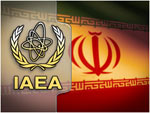
 AFP: Russia and China on Wednesday joined Western powers in rounding on Iran at the UN atomic watchdog in a move aimed not only at pressuring Tehran but also persuading Israel that diplomacy must continue.
By Simon Sturdee
VIENNA (AFP) — Russia and China on Wednesday joined Western powers in rounding on Iran at the UN atomic watchdog in a move aimed not only at pressuring Tehran but also persuading Israel that diplomacy must continue.
After days of haggling, the United States, Russia, China, Britain, France and Germany managed to hammer out a resolution criticising Tehran, at a meeting of the International Atomic Energy Agency’s board of governors in Vienna.
It singles out Iran’s defiance of UN Security Council resolutions to suspend uranium enrichment, its refusal to allow IAEA inspectors into the Parchin military base and the suspected removal of evidence of nuclear weapons research.
According to a draft seen by AFP, it stresses “once again its serious concern that Iran continues to defy the requirements and obligations contained in the relevant IAEA Board of Governors and UN Security Council Resolutions.”
On Tuesday the broad outlines of a text were agreed on, but it had been unclear whether it would become merely a statement to be read out at the 35-nation board meeting or a more significant resolution to go to a vote.
It stops short of a referral of Iran to the Security Council, and the IAEA resolution, likely to be voted on Thursday, is the 12th in nine years.
But it is significant that Western nations were able to get Moscow and Beijing on board as they are traditionally more lenient on Tehran, with China a major buyer of Iranian oil and Russia having close commercial ties with Iran.
The draft resolution comes as the European Union is considering imposing more sanctions on the Islamic republic.
The timing is also important since it follows weeks of growing speculation that Israel may bomb the Gulf country’s atomic facilities, said Mark Hibbs, analyst at the Carnegie Endowment for International Peace.
The resolution “reflects the desire of member states to underscore that diplomacy is paramount and it warns Israel in two separate paragraphs that the diplomatic process should be supported,” Hibbs told AFP.
Israeli frustration has grown at what it sees as a failure by the international community to take seriously the threat posed by Iran or to stop it inching ever closer to “break-out capacity.”
In particular, Israeli Prime Minister Benjamin Netanyahu has been pressing US President Barack Obama to identify “red lines” for when it would take action.
“The world tells Israel: Wait, there’s still time. And I say: wait for what? Wait until when?” Netanyahu said on Tuesday in comments clearly aimed at the White House.
Obama, running for re-election in November and keen to avoid being depicted as soft on Iran by Republican challenger Mitt Romney, spoke to Netanyahu for an hour by phone in the early hours of Wednesday.
The IAEA’s latest report on August 30 said Iran had doubled since May the capacity at the underground Fordo site by installing around 1,000 new centrifuges, although the number of machines operational was unchanged.
Enriched uranium can be used for nuclear power generation or medical purposes but also, when highly purified, in the fissile core of an atomic bomb. Iran says its nuclear programme is peaceful.
IAEA head Yukiya Amano told the board on Monday that Iran had to allow access to Parchin “without further delay” and that a failure in a string of meetings with Iran was “frustrating”.
Commercially available satellite imagery shown to IAEA member states at a briefing last week by chief inspector Herman Nackaerts showed what the agency’s report called “extensive activities and resultant changes” at the site.
The Security Council has also imposed four rounds of sanctions on Iran, while additional US and EU restrictions have also hit Tehran, leading to a halving of Iranian oil exports this year, the International Energy Agency says.
The diplomatic track of talks between the six world powers (the so-called P5+1) and Iran appears deadlocked until at least after the US election, following meetings in Istanbul in April, Baghad in May and Moscow in June.
The IAEA board includes several members of the Non-Aligned Movement (NAM), of which Iran recently assumed the rotating presidency, including Cuba, Ecuador, Egypt, India, Jordan and Saudi Arabia.
The last IAEA board resolution in November, following the publication of a major report on Iran’s suspected weapons research, was approved by 32 countries with Indonesia abstaining and only Cuba and Ecuador voting against.


