


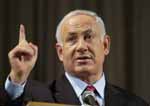
 AP: Israeli Prime Minister Benjamin Netanyahu will make his case against Iran before the United Nations General Assembly on Thursday, arguing that time is quickly running out to stop the Islamic Republic from becoming a nuclear power and the threat of force must be seriously considered. The Associated Press
By ARON HELLER
 Israeli Prime Minister Benjamin Netanyahu will make his case against Iran before the United Nations General Assembly on Thursday, arguing that time is quickly running out to stop the Islamic Republic from becoming a nuclear power and the threat of force must be seriously considered.
His demand that President Barack Obama declare “red lines” that would trigger an American attack on Iran’s nuclear facilities has been rejected in Washington and sparked a public rift between the two leaders.
Netanyahu claims international diplomatic efforts and economic sanctions have failed. His time at the U.N. podium gives him an opportunity in front of the international community to press his case once again, perhaps in a final plea before Israel takes matters into its own hands. Israeli leaders have issued a series of warnings in recent weeks suggesting that if Iran’s uranium enrichment program continues it may soon stage a unilateral military strike, flouting even American wishes.
The Obama administration has urgently sought to hold off Israeli military action, which would likely result in the U.S. being pulled into a conflict and cause regionwide mayhem on the eve of American elections.
Such an attack would almost certainly lead to retaliatory Iranian missile strikes on Israeli population centers. On Sunday, Iranian leaders suggested they may strike Israeli preemptively if they feel threatened.
Israel considers a nuclear-armed Iran to be an existential threat, citing Iranian calls for Israel’s destruction, Iran’s development of missiles capable of striking the Jewish state and its support for hostile Arab militant groups.
Also Thursday, on the sidelines of the General Assembly, key figures will gather for a Friends of Yemen meeting that will be co-chaired by British Foreign Secretary William Hague, Yemen’s President Abed Rabbo Mansour Hadi and Saudi Arabia’s Deputy Foreign Ministe Abdulaziz bin Abdullah Abdullah. The meeting will produce a communique aimed at generating support for Hadi, who took office in February after more than a year of political turmoil and is now trying to steer his country’s democratic transition.
Later, political directors from the United States, Russia, China, Britain, France and Germany will be meeting on the Iranian nuclear issue.
A few hours before Netanyahu flew to the U.S., Iranian leader Mahmoud Ahmadinejad, known for past fiery denunciations of the United States and Israel, spoke at length about his vision for a “new world order” during his speech at the U.N. His speech on Wednesday happened to fall on Yom Kippur, the most sacred day on the Jewish calendar, devoted to fasting, prayer and introspection.
Netanyahu issued a statement condemning the speech soon after the fast ended. “On the day when we pray to be inscribed in the book of life a platform was given to a dictatorial regime that strives, at every opportunity, to sentence us to death,” Netanyahu said. ‘In my remarks to the UN General Assembly, they will hear my response. History has proven that those who have wanted to wipe us off the map have failed, as the Jewish People have overcome all obstacles,” Netanyahu said.
Netanyahu has said he is going to the U.N. to draw attention to what Israel perceives as the Iranian threat. Speaking to his Cabinet on Sunday, he said at the U.N. he would “reiterate that the most dangerous country in the world must not be allowed to arm itself with the most dangerous weapon in the world.” He did not elaborate.
On Tuesday, the Maariv daily reported that Netanyahu would present his own “red lines” to the world body. It said Netanyahu would spell out what limits the international community should set for Iran to prevent it from becoming a nuclear power and how long that will take. Netanyahu has never laid out these limits precisely.
Iran insists its nuclear program is for peaceful purposes but Israel, the U.S. and other Western allies reject the claim. Four rounds of U.N. sanctions have already been placed on Iran.
A U.N. report last month only reinforced Israeli fears, finding that Iran has moved more of its uranium enrichment activities into fortified bunkers deep underground where they are impervious to air attack. Enrichment is a key activity in building a bomb, though it has other uses as well, such as producing medical isotopes.
While Israel is convinced that Iran is pursuing a nuclear weapon, American officials believe Iran has not yet made a final decision to take the plunge, even as it develops much of the infrastructure needed to do so.
Obama has repeatedly said he will not allow Iran to gain nuclear weapons and has said the U.S. would be prepared to use force as a last resort. But in an interview Sunday with “60 Minutes” he also vowed to “block out any noise that’s out there” on the issue, in an apparent swipe at Netanyahu.
Israel’s timeline for military action is shorter than that of the United States, which has far more powerful bunker-busting bombs at its disposal, and there is great suspicion in Israel over whether in the moment of truth Obama will follow through on his pledge.
Netanyahu has a history of fiery speeches at the U.N. General Assembly.
In 2009, he waved the blueprints for the Nazi death camp Aushwitz and invoked the memory of his own family members murdered by the Nazis while making his case against Iran’s Holocaust denial and threats to destroy Israel.
To those who remained at the General Assembly while Iranian President Mahmoud Ahmadinejad spoke, he chastised: “Have you no shame? Have you no decency?”
And last year, he warned the world about the threat of militant Islam and Iran.
During his three-day visit, Netanyahu is scheduled to meet with U.N. Secretary-General Ban Ki-Moon, EU foreign policy chief Catherine Ashton, Canadian Prime Minister Stephen Harper — who recently expelled the Iranian ambassador from his country — and U.S. Secretary of State Hillary Clinton. He is not scheduled to meet Obama.
Palestinian President Mahmoud Abbas is also set to speak in New York. The Palestinian leader is expected to ask the United Nation’s General Assembly to vote on recognizing Palestine as an observer state in November.
Abbas has said he wants to put off a vote until after U.S. elections to avoid entangling the Palestinian statehood bid in presidential politics.
“I’m not in the U.N. to delegitimize Israel but to present the two state solution,” Abbas told U.S. Jewish community leaders last week at a meeting by the S. Daniel Abraham Center for Middle East Peace. “I want to have Palestine as a nonmember state.” said.
Abbas’ relatively low-key approach is in contrast to last year when he was at center stage with his attempt to win full membership in the world body. That application failed to win enough support in the Security Council.


